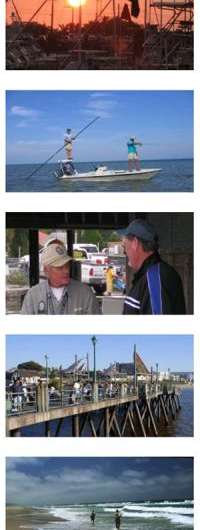
NOAA unveils improved way to estimate saltwater recreational fishing

January 26, 2012

NOAA today announced it has begun to use an improved method to estimate the amount of fish caught by saltwater anglers, which will allow rules that fishermen follow to be based on more accurate information.

The is part of an overall effort to improve the accuracy of recreational catch data collected by the Marine Recreational Information Program, and was developed by a team of NOAA scientists and outside experts.

“The new estimation method is a fundamental change that better reflects what is happening on the water and within the recreational fishing community,” said Eric Schwaab, NOAA’s acting assistant secretary of commerce for conservation and management. “Better, more accurate can only be a plus for the saltwater recreational fishing industry, which provides jobs for many Americans and contributes to the economic vitality of our coastal communities.”

The agency today released recalculated estimates going back to 2004 using the new method. There were no overall trends in terms of size or direction of the new estimates; catch estimates for some species go up, some go down, and some remain about the same. To view comparisons of recreational catch estimates using the previous method and the revised method, go to: http://www.CountMy … ish.noaa.gov .

NOAA unveils improved way to estimate saltwater recreational fishing
Enlarge


“The community has a shared interest in scientifically sound, accurate data and a shared responsibility in making it available,” said Bruce Freeman, a New Jersey recreational fisherman, scientist and member of the Jersey Coast Anglers Association. “With this new estimation method, NOAA is taking an important first step toward the high-quality catch data that many of us have been calling for.”

Using these new estimates, NOAA will now work with the regional councils, the states, and other stakeholders to integrate these results into fisheries science and management.

Beginning this year, NOAA will use the new method to calculate estimates for the Atlantic coast and Gulf of Mexico for use in fishery management and stock assessment by NOAA, regional fishery management councils and states. Other areas of the country, such as the West Coast, Hawaii, and Alaska, use different survey and estimation methods for saltwater recreational catch. NOAA is working with these regional partners to conduct similar evaluations and, as necessary, implement improvements to their estimation methods.

Another important part of the Marine Recreational Information Program is the National Saltwater Angler Registry, which will help NOAA improve the accuracy of fishing effort estimates by increasing the proportion of fishing households that are surveyed. Additional improvements that will increase the accuracy of the estimates are being developed, including revised dockside survey methods, testing of approaches to improving data timeliness, and use of electronic logbooks in the for-hire vessel sector. To learn more about MRIP, go to: http://www.CountMy … ish.noaa.gov .

Provided by NOAA


Rank 5 /5 (1 vote)
Relevant PhysicsForums posts

More news stories

Manufacturing genes to attack flu virus

An international research team has manufactured a new protein that can combat deadly flu epidemics.

Biology / Biotechnology

created 6 hours ago | popularity not rated yet | comments 0 | with audio podcast

Scientist: Evolution debate will soon be history

(AP) -- Richard Leakey predicts skepticism over evolution will soon be history. Not that the avowed atheist has any doubts himself.

Biology / Evolution

created May 26, 2012 | popularity 3.5 / 5 (20) | comments 89

More plant species responding to global warming than previously thought

(Phys.org) -- Far more wild plant species may be responding to global warming than previous large-scale estimates have suggested.

Biology / Ecology

created May 22, 2012 | popularity 4.6 / 5 (14) | comments 18 | with audio podcast

For monogamous sparrows, it doesn't pay to stray (but they do it anyway)

It's quite common for a female song sparrow to stray from her breeding partner and mate with the male next door, but a new study shows that sleeping around can be costly.

Biology / Plants & Animals

created May 22, 2012 | popularity 5 / 5 (2) | comments 8 | with audio podcast

Thousands of shellfish found dead in Peru

Thousands of crustaceans were found dead off the coast of Lima following the mystery mass death of dolphins and pelicans, the Peruvian Navy said Friday.

Biology / Ecology

created May 26, 2012 | popularity 4.7 / 5 (7) | comments 7


Stunning image of smallest possible five-ringed structure

Scientists have created and imaged the smallest possible five-ringed structure – about 100,000 times thinner than a human hair – and you'll probably recognise its shape.

'Unzipped' carbon nanotubes could help energize fuel cells, batteries

Multi-walled carbon nanotubes riddled with defects and impurities on the outside could replace some of the expensive platinum catalysts used in fuel cells and metal-air batteries, according to scientists at ...

Change in developmental timing was crucial in the evolutionary shift from dinosaurs to birds: study

At first glance, it's hard to see how a common house sparrow and a Tyrannosaurus Rex might have anything in common. After all, one is a bird that weighs less than an ounce, and the other is a dinosaur that ...

Computer model used to pinpoint prime materials for efficient carbon capture

When power plants begin capturing their carbon emissions to reduce greenhouse gases – and to most in the electric power industry, it's a question of when, not if – it will be an expensive undertaking.

T cells 'hunt' parasites like animal predators seek prey, study shows

By pairing an intimate knowledge of immune-system function with a deep understanding of statistical physics, a cross-disciplinary team at the University of Pennsylvania has arrived at a surprising finding: T cells use a movement ...

Land and sea species differ in climate change response: study

(Phys.org) -- Marine and terrestrial species will likely differ in their responses to climate warming, new research by Simon Fraser University and Australia’s University of Tasmania has found.