January 31, 2012 report
MtDNA tests trace all modern horses back to single ancestor 140,000 years ago
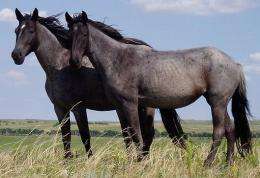
(PhysOrg.com) -- For many years archeologists and other scientists have debated the origins of the domesticated horse. Nailing down a time frame is important because many historians view the relationship between man and horse as one of the most important in the development of our species. Horses allowed early people to hunt for faster prey, to wander farther than before and to create much bigger farms due to pulling plows. Now, new evidence has come to light suggesting that all modern horses, which are believed to have been domesticated approximately 10,000 years ago, descended from one mare around 140,000 years ago. The new evidence comes from a team made up of international researchers who, as they describe in their paper published in the Proceedings of the National Academy of Sciences, say that DNA evidence shows that the horse subsequently diverged into 18 different genetic lines, suggesting that domestication occurred independently in many places throughout the world.
Most other domestic animals such as cows, sheep and goats by contrast appear to have evolved from a relatively small pool, likely shortly before horses followed suit.
Interestingly, horses appear in cave art as early as 30,000 years ago, which suggests that early humans certainly knew about them and likely killed them for food for twenty thousand years before the idea of taming them came about which ultimately led to domestication.
To trace back the horse’s lineage, the research team tested mitochondrial DNA (which is passed down only on the mother’s side) samples from modern horses living in the Americas, Europe, Asia and the Middle East. This allowed them to follow the genetic line from the single mare to the eighteen gene clusters that show that people in several different places learned to domesticate horses and to use them for their own specific purposes. Previous researchers looking into horse lineage had used only a portion of DNA known as the control region, which wasn’t enough to provide a complete profile.
Prior to this new research many scholars had attributed the first domestication of the horse to the Eurasian Steppes, due to fossilized evidence showing horse domestication dating to around 3500 BC. This new research will undoubtedly cause new discussions in the community as a whole which will likely lead to new theories being developed to describe how so many different groups of people came to domestic horses in so many places.
More information: Mitochondrial genomes from modern horses reveal the major haplogroups that underwent domestication, PNAS, Published online before print January 30, 2012, doi: 10.1073/pnas.1111637109
Abstract
Archaeological and genetic evidence concerning the time and mode of wild horse (Equus ferus) domestication is still debated. High levels of genetic diversity in horse mtDNA have been detected when analyzing the control region; recurrent mutations, however, tend to blur the structure of the phylogenetic tree. Here, we brought the horse mtDNA phylogeny to the highest level of molecular resolution by analyzing 83 mitochondrial genomes from modern horses across Asia, Europe, the Middle East, and the Americas. Our data reveal 18 major haplogroups (A–R) with radiation times that are mostly confined to the Neolithic and later periods and place the root of the phylogeny corresponding to the Ancestral Mare Mitogenome at ∼130–160 thousand years ago. All haplogroups were detected in modern horses from Asia, but F was only found in E. przewalskii—the only remaining wild horse. Therefore, a wide range of matrilineal lineages from the extinct E. ferus underwent domestication in the Eurasian steppes during the Eneolithic period and were transmitted to modern E. caballus breeds. Importantly, now that the major horse haplogroups have been defined, each with diagnostic mutational motifs (in both the coding and control regions), these haplotypes could be easily used to (i) classify well-preserved ancient remains, (ii) (re)assess the haplogroup variation of modern breeds, including Thoroughbreds, and (iii) evaluate the possible role of mtDNA backgrounds in racehorse performance.
Journal information: Proceedings of the National Academy of Sciences
© 2011 PhysOrg.com


