New method pinpoints important gene-regulation proteins
Jan 18, 2012
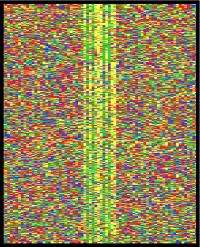
A novel technique, developed and demonstrated in the B. Frank Pugh lab at Penn State University, precisely pinpoints the location of proteins that read and regulate chromosomes. The order of these proteins determines whether a brain cell, a liver cell, or a cancer cell is formed. Until now, it has been exceedingly difficult to determine exactly where such proteins bind to the chromosome, and therefore how they work. The new technique has the potential to take high-resolution snapshots of proteins as they regulate or miss-regulate an entire genome. This image shows the type of map that scientists use to show the DNA-sequence-specific binding patterns of proteins. Credit: Credit: B. Franklin Pugh, Penn State University

A novel technique has been developed and demonstrated at Penn State University to map the proteins that read and regulate chromosomes -- the string-like structures inside cells that carry genes. The specific order in which these proteins attach DNA-containing nucleosomes along the chromosome determines whether a brain cell, a liver cell, or a cancer cell is formed. Until now, it has been exceedingly difficult to determine exactly where such proteins bind to the chromosome, and therefore how they work. The new technique precisely pinpoints their location, and has the potential to take high-resolution snapshots of proteins as they regulate or miss-regulate an entire genome.

The research will be published on 18 January 2012 as an Advance Online Publication in the journal Nature. Related research by the Penn State scientists recently was published in the journal Cell.

The research process, lead by Willaman Professor of Molecular Biology B. Franklin Pugh with Graduate Student Ho Sung Rhee, began by their using a molecular tool called an exonuclease to remove DNA that is not bound by one of the gene-regulating proteins. They then determined the for each of the remaining protein-bound DNA bundles -- the sequence of the four major component bases of DNA, labeled A, T, C, and G. "The advantage over other techniques of this technique, called ChIP-exo, is its ability to narrow down any binding location across millions and billions of nucleotide genomes to a certainty of about one nucleotide," Pugh said. "This improvement is roughly analogous to going from a low-resolution 240p television to a high-definition 1080p home-theater system. It provides an unprecedented view into how genes are regulated."

The ChIP-exo technique also removes a substantial amount of noise in the detection system that plagues other methods. The lower-noise technique reveals 2-to-5 times more binding locations, providing a much-more-complete picture of which genes are regulated by a particular protein, as well as a broader understanding of their structural organization across genomes. Having a more-complete picture allows scientists to understand in more detail how gene pathways work in normal human development, or fail to work in disease.

Explore further: Intestinal bacteria protect against E. coli O157:H7

Related Stories

Packaging process for genes discovered

May 19, 2011

Scientists at Penn State University have achieved a major milestone in the attempt to assemble, in a test tube, entire chromosomes from their component parts. The achievement reveals the process a cell uses ...

Scientists Shed Light on Evolution of Gene Regulation

Nov 25, 2008

Scientists at Penn State have shed light on some of the processes that regulate genes -- such as the processes that ensure that proteins are produced at the correct time, place, and amount in an organism -- ...

Researchers Shed Light on Evolution of Gene Regulation

Nov 18, 2008

(PhysOrg.com) -- Scientists at Penn State have shed light on some of the processes that regulate genes -- such as the processes that ensure that proteins are produced at the correct time, place, and amount ...

'Moonlighting' molecules discovered

Oct 29, 2009

Since the completion of the human genome sequence, a question has baffled researchers studying gene control: How is it that humans, being far more complex than the lowly yeast, do not proportionally contain in our genome ...

Recommended for you

Single-cell sequencing

1 hour ago

When studying any kind of population—people or cells—averaging is a useful, if flawed, form of measurement. According to the US Census Bureau, the average American household size in 2010 was 2.59. Of ...

User comments : 0

More news stories

Coral reefs 'ruled by earthquakes and volcanoes'

(Phys.org) —Titanic forces in the Earth's crust explain why the abundance and richness of corals varies dramatically across the vast expanse of the Indian and Pacific Oceans, a world-first study from the ...

100K Pathogen Genome Project maps first genomes

(Phys.org) —Striking a blow at foodborne diseases, the 100K Pathogen Genome Project at the University of California, Davis, today announced that it has sequenced the genomes of its first 10 infectious microorganisms, including ...

Strawberry fields forever and fungus-free

(Phys.org) —Strawberries are one of the most economically important berry crops in the world, and a high value export crop for the Australian horticultural industry.For the first time, researchers at The ...

Theorists weigh in on where to hunt dark matter

(Phys.org) —Now that it looks like the hunt for the Higgs boson is over, particles of dark matter are at the top of the physics "Most Wanted" list. Dozens of experiments have been searching for them, but ...