Mathematicians use computer to solve minimum Sudoku solution problem
Jan 06, 2012 by Bob Yirka weblog
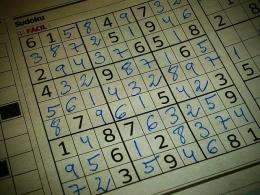
A standard 9x9 Sudoku matrix. Image credit: Héctor Rodríguez.

(PhysOrg.com) -- Over the past several years, Sudoku, as most people know, has become wildly popular. Where once mainstream newspapers carried only crossword puzzles, they now also carry a Sudoku puzzle as well. But along with that popularity, has come increased scrutiny and competition between people to see if certain properties of the puzzle can be found. For example, in any given Sudoku puzzle, how many clues must be given in order to have just one unique solution to the problem? Most Sudoku enthusiasts will answer 17, because nobody has ever been able to find one with 16 or less; which is fine, except that people as a general rule like some sort of proof of such things. Thus, it should not come as much of a surprise to anyone that a team of mathematicians have not only set out to prove what everyone thinks they know, but have succeeded in their endeavor.

Sudoku, for the uninitiated, is a whereby a square is created with 9x9 rows and columns of boxes to be filled in with numbers (1 through 9). The puzzle is further divided into nine 3x3 sections. The trick to solving the puzzle is that each row and column cannot have repeating numbers and neither can any of the 3x3 sections. Also, when a puzzle is created, a certain number of the boxes are prefilled, creating in essence, a unique puzzle each time. Thus, to solve the puzzle, all a person has to do is figure out how to fill in the rest of the boxes.

The thing about Sudoku puzzles though, is that those that make them can pre-fill as many boxes as they choose, the more clues they give, generally, the easier the puzzle will be to solve. Thus, creators who want to make their puzzles as hard as possible want to fill in the fewest possible clues that will still allow for a unique single solution.

To prove that 17 is the magic number, Gary McGuire and colleagues at University College, Dublin, took the brute force approach. After all with every there is a solution, to find it, all a computer would have to do is try every possible scenario for every possible configuration. Unfortunately, that approach would take too long, so the team had to figure out a way to trim down the number of possibilities they’d have to check for.

Throwing out grids that are equivalent helps, that reduces the number of tests dramatically. But that’s still not enough, so the team wrote a software routine that tests to see if certain subsets of the puzzle are equivalent to others, which would mean not having to test for the others if the first are found. This reduced the amount of testing as well. But even so, it took almost all of a full year of computing to test all of the possible scenarios.

But when the program stopped, the researchers had their answer. To create a Sudoku puzzle that is unique, you have to give at least 17 clues.

Explore further: Researchers develop fast, economical method for high-definition video compositing

More information: There is no 16-Clue Sudoku: Solving the Sudoku Minimum Number of Clues Problem, arXiv:1201.0749v1 [cs.DS] arxiv.org/abs/1201.0749

Abstract
We apply our new hitting set enumeration algorithm to solve the sudoku minimum number of clues problem, which is the following question: What is the smallest number of clues (givens) that a sudoku puzzle may have? It was conjectured that the answer is 17. We have performed an exhaustive search for a 16-clue sudoku puzzle, and we did not find one, thereby proving that the answer is indeed 17. This article describes our method and the actual search.
The hitting set problem is computationally hard; it is one of Karp's twenty-one classic NP-complete problems. We have designed a new algorithm that allows us to efficiently enumerate hitting sets of a suitable size. Hitting set problems have applications in many areas of science, such as bioinformatics and software testing.

via ArxivBlog

Related Stories

Discovery could lead to more difficult Sudoku puzzles

Feb 13, 2010

(PhysOrg.com) -- A new analysis of number randomness in Sudoku matrices could lead to the development of more difficult and multi-dimensional Sudoku puzzles. In a recent study, mathematicians have found that ...

Toy Robot to Solve Sudoku (w/ Video)

Sep 03, 2009

(PhysOrg.com) -- A Swedish programmer, Hans Andersson, has used a Lego Mindstorms NXT kit to develop a robot to solve Sudoku puzzles.

DARPA Shredder Challenge sizzling but no winner yet

Nov 22, 2011

(PhysOrg.com) -- With only days left until the December 4 Shredder Challenge deadline, DARPA is still asking the sharpest-minded computer scientists and simply the curious if anyone among them has the skills ...

Recommended for you

Amazon plans greenhouse-style headquarters

5 hours ago

US online giant Amazon has unveiled plans for a futuristic greenhouse style headquarters "where employees can work and socialize in a more natural, park-like setting."

With high-tech guns, users could disable remotely

6 hours ago

A high-tech startup is wading into the gun control debate with a cellphone controller that would allow gun owners to know when their weapon is being moved—and disable it remotely.

Best Buy reports 1Q loss on restructuring costs

9 hours ago

(AP)—Best Buy Co. on Tuesday reported a loss for its fiscal first quarter as it sold its stake in Best Buy Europe and works on a turnaround plan that includes cutting costs and closing some stores.

Apple's Cook faces Senate questions on taxes (Update)

9 hours ago

The Senate dragged Apple Inc., the world's most valuable company, into the debate over the U.S. tax code Tuesday, grilling CEO Tim Cook over allegations that its Irish subsidiaries help the company avoid ...

User comments : 4

Adjust slider to filter visible comments by rank

Display comments: newest first

mhenriday
not rated yet Jan 08, 2012
Despite proofs of this type, related ultimately to the ancient Greek proof that the square root of 2 is not a rational number, someone of your acquaintance within the next day or so is sure to mouth that demonstrably false cliché to the effect that «you can't prove a negative»....

Henri
mhenriday
not rated yet Jan 08, 2012
Despite this proof and others like it - ultimately related to the ancient Greek proof that the square root of 2 is not a rational number, within the next couple of days someone of your acquaintance is likely to mouth that demonstrably false cliché to the effect that «you can't prove a negative»....

Henri
mhenriday
not rated yet Jan 08, 2012
Despite this proof and others like it - ultimately related to the ancient Greek proof that the square root of 2 is not a rational number, within the next couple of days someone of your acquaintance is likely to mouth that demonstrably false cliché to the effect that «you can't prove a negative»....

Henri
antialias_physorg
not rated yet Jan 08, 2012
ultimately related to the ancient Greek proof that the square root of 2

this has nothing to do with it.

The adage that you can't prove a negative is only relevant if the entirety of your searchspace cannot be tested. With the brute force approach used here they did test it.

That said I would have guessed that information theory might have sufficed to show that the amount contained in 16 clues is not enough to contain all the information inherent in a completed sudoku puzzle.

More news stories

Game system castAR debuts at Maker Faire

(Phys.org) —Two tech talents, formerly employees at video game publisher Valve, have been working on their own vision in the form of game-ready glasses. Their company, Technical Illusions, will seek to ...

Green conversion of heat to electricity

Soon, it will be possible to produce electricity from heat over 30 degrees emitted from a waste incinerator, refinery, or data processor. The start-up Osmoblue has just confirmed the feasibility of this new ...

Encouraging signs for bee biodiversity

Declines in the biodiversity of pollinating insects and wild plants have slowed in recent years, according to a new study. Researchers led by the University of Leeds and the Naturalis Biodiversity Centre in the Netherlands ...

If you can remember it, you can remember it wrong

(Medical Xpress)—Native peoples in regions where cameras are uncommon sometimes react with caution when their picture is taken. The fear that something must have been stolen from them to create the photo ...

B vitamins could delay dementia

(Medical Xpress)—Despite spending billions of dollars on research and development, drug companies have been unable to come up with effective treatments for dementia and Alzheimer's Disease (AD). Now, A. ...

New method for producing clean hydrogen

Duke University engineers have developed a novel method for producing clean hydrogen, which could prove essential to weaning society off of fossil fuels and their environmental implications.