Malaysia saves endangered pygmy elephant on Borneo
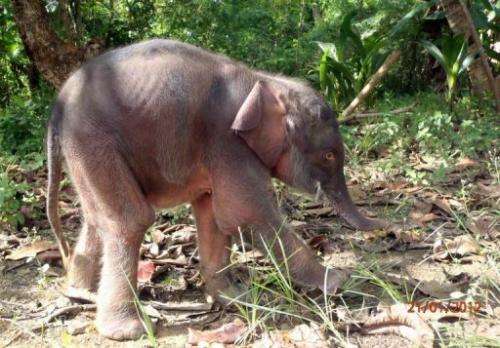
A pygmy elephant calf on Borneo island, in Malaysia's Sabah state. Malaysian wildlife authorities said they had rescued a pygmy elephant calf on Borneo island and expressed hope a planned sanctuary would provide protection for the endangered animals.
Malaysian wildlife authorities said they had rescued a pygmy elephant calf on Borneo island and expressed hope a planned sanctuary would provide protection for the endangered animals.
The male calf, which is less than a month old, was pulled out of a deep moat surrounding a palm oil plantation in remote Sabah state on Friday, said Sen Nathan, a senior official with the Sabah Wildlife Department.
It is the fifth calf rescued by wildlife officials since 2009. Three of those previously saved have died but a female has recovered and is now at a wildlife park.
There are fewer than 2,000 Borneo pygmy elephants left in the wild, according to authorities. A sub-species of the Asian elephant, the creatures have a rounded appearance and are smaller than mainland elephants.
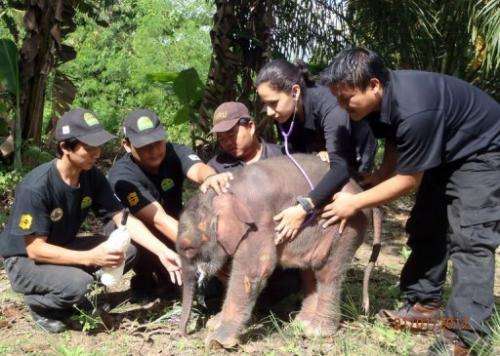
Wildlife officials take care of a pygmy elephant calf on Borneo island, in Malaysia's Sabah state. The male calf, which is less than a month old, was pulled out of a deep moat surrounding a palm oil plantation in remote Sabah state.
The latest rescued calf, which weighed about 50 kilograms (110 pounds), was in a serious condition, Nathan told AFP."He suffered severe dehydration and cuts and abrasions, probably while trying to get out of the moat," he said.
The elephant's mother was probably forced to leave it behind after the pair fell into the moat, and the calf likely spent more than a day there before being spotted by plantation workers, he said.
Nathan said a planned elephant sanctuary on 1,200 hectares (3,000 acres) of land within the 26,000-hectare Kinabatangan wildlife sanctuary in Sabah would help protect the animals.
The sanctuary would be able to house up to 60 injured elephants, as well as those found when they were too young to be reintroduced into the wild.
Authorities announced plans for the sanctuary earlier this month and want it open by the end of the year. "We really need this sanctuary," Nathan said.
The sanctuary will be funded with 5.3 million ringgit ($1.7 million) from industry body the Malaysian Palm Oil Council and 1.5 million ringgit from NGO the Borneo Conservation Trust.
Wildlife activists warn that pygmy elephants are fast losing their natural habitat to deforestation and human encroachment on Borneo, a vast island shared by Malaysia, Indonesia and Brunei.
(c) 2012 AFP
-
From lemons to lemonade: Reaction uses carbon dioxide to make carbon-based semiconductor,
32 comments
-
Thioridazine kills cancer stem cells in human while avoiding toxic side-effects of conventional cancer treatments,
3 comments
-
SpaceX private rocket blasts off for space station (Update),
42 comments
-
Climate scientists say they have solved riddle of rising sea,
31 comments
-
SpaceX capsule has 'new car' smell, astronauts say (Update),
4 comments
-
What would stain as translucent on light-coloured fabric?
May 26, 2012
-
How do I identify different bacteria on culture plates?
May 26, 2012
-
Why Do Dogs do Strange things...
May 25, 2012
-
What does exophillic and endophillic mean in terms of mosquito and their control?
May 24, 2012
-
Semen stains glows under black lights (uv light)?
May 23, 2012
-
Question on Human Chromosome 2
May 23, 2012
- More from Physics Forums - Biology
More news stories
Manufacturing genes to attack flu virus
An international research team has manufactured a new protein that can combat deadly flu epidemics.
6 hours ago |
not rated yet |
0
|
Scientist: Evolution debate will soon be history
(AP) -- Richard Leakey predicts skepticism over evolution will soon be history. Not that the avowed atheist has any doubts himself.
May 26, 2012 |
3.5 / 5 (20) |
89
More plant species responding to global warming than previously thought
(Phys.org) -- Far more wild plant species may be responding to global warming than previous large-scale estimates have suggested.
May 22, 2012 |
4.6 / 5 (14) |
18
|
For monogamous sparrows, it doesn't pay to stray (but they do it anyway)
It's quite common for a female song sparrow to stray from her breeding partner and mate with the male next door, but a new study shows that sleeping around can be costly.
May 22, 2012 |
5 / 5 (2) |
8
|
Thousands of shellfish found dead in Peru
Thousands of crustaceans were found dead off the coast of Lima following the mystery mass death of dolphins and pelicans, the Peruvian Navy said Friday.
May 26, 2012 |
4.7 / 5 (7) |
7
Stunning image of smallest possible five-ringed structure
Scientists have created and imaged the smallest possible five-ringed structure about 100,000 times thinner than a human hair and you'll probably recognise its shape.
'Unzipped' carbon nanotubes could help energize fuel cells, batteries
Multi-walled carbon nanotubes riddled with defects and impurities on the outside could replace some of the expensive platinum catalysts used in fuel cells and metal-air batteries, according to scientists at ...
Change in developmental timing was crucial in the evolutionary shift from dinosaurs to birds: study
At first glance, it's hard to see how a common house sparrow and a Tyrannosaurus Rex might have anything in common. After all, one is a bird that weighs less than an ounce, and the other is a dinosaur that ...
Computer model used to pinpoint prime materials for efficient carbon capture
When power plants begin capturing their carbon emissions to reduce greenhouse gases and to most in the electric power industry, it's a question of when, not if it will be an expensive undertaking.
T cells 'hunt' parasites like animal predators seek prey, study shows
By pairing an intimate knowledge of immune-system function with a deep understanding of statistical physics, a cross-disciplinary team at the University of Pennsylvania has arrived at a surprising finding: T cells use a movement ...
Land and sea species differ in climate change response: study
(Phys.org) -- Marine and terrestrial species will likely differ in their responses to climate warming, new research by Simon Fraser University and Australia’s University of Tasmania has found.
