The perfect liquid -- now even more perfect
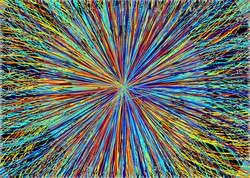
Simulation of Quark-Gluon-Plasma (Copyright: CERN)
Ultra hot quark-gluon-plasma, generated by heavy-ion collisions in particle accelerators, is supposed to be the "most perfect fluid" in the world. Previous theories imposed a limit on how "liquid" fluids can be. Recent results at the Vienna University of Technology suggest that this limit can be broken -- making the world's "most perfect fluid" even more perfect.
How liquid can a fluid be? This is a question particle physicists at the Vienna University of Technology have been working on. The "most perfect liquid" is nothing like water, but the extremely hot quark-gluon-plasma which is produced in heavy-ion collisions at the Large Hadron Collider at CERN. New theoretical results at Vienna UT show that this quark-gluon plasma could be even less viscous than was deemed possible by previous theories. The results were published in Physical Review Letters and highlighted as an "editors' selection".
Highly viscous liquids (such as honey) are thick and have strong internal friction, quantum liquids, such as super fluid helium can exhibit extremely low viscosity. In 2004, theorists claimed that quantum theory provided a lower bound for viscosity of fluids. Applying methods from string theory, the lowest possible ratio of viscosity to the entropy density was predicted to be ħ/4π (with the Planck-constant ħ). Even super fluid helium is far above this threshold. In 2005, measurements showed that quark-gluon-plasma exhibits a viscosity just barely above this limit. However, this record for low viscosity can still be broken, claims Dominik Steineder from the Institute for Theoretical Physics at Vienna UT. He obtained this remarkable result working as a PhD-student with Professor Anton Rebhan.
The viscosity of a quark-gluon plasma cannot be calculated directly. Its behavior is so complicated that very sophisticated methods have to be applied, says Anton Rebhan: "Using string theory, the quantum field theory of quark-gluon plasma can be related to the physics of black holes in higher dimensions. So we are solving equations from string theory and then transfer the results to the physics of the quark-gluon plasma." The previously established lower bound for viscosity was calculated in a very similar way. However, in these calculations the plasma was modeled to be symmetric and isotropic. "In fact, a plasma produced by a collision in a particle accelerator is not isotropic at the beginning", says Anton Rebhan. The particles are accelerated and collided along one specific direction so the resulting plasma shows different properties, depending on the direction from which one looks at it.
The physicists at Vienna UT found a way to include this anisotropy in their equations and surprisingly the limit for the viscosity can be broken in this new model. "The viscosity depends on several other physical parameters, but it can be lower than the number previously considered to be the absolute lower bound", Dominik Steineder explains. The on-going quark-gluon-experiments at CERN will provide opportunities for testing the new theoretical predictions.
More information: http://prl.aps.org … 8/i2/e021601
Provided by Vienna University of Technology
-
From lemons to lemonade: Reaction uses carbon dioxide to make carbon-based semiconductor,
32 comments
-
Thioridazine kills cancer stem cells in human while avoiding toxic side-effects of conventional cancer treatments,
3 comments
-
SpaceX private rocket blasts off for space station (Update),
42 comments
-
Climate scientists say they have solved riddle of rising sea,
31 comments
-
SpaceX capsule has 'new car' smell, astronauts say (Update),
4 comments
-
Why does a boiled egg rotates while a raw egg doesn't?
1 hour ago
-
Lightning strike in mindair
1 hour ago
-
Why does light move?
3 hours ago
-
How to calculate the repulsion force between a permanent and an electromagnet?
4 hours ago
-
Why does light allow us to see things?
4 hours ago
-
Room temperature superconductivity
4 hours ago
- More from Physics Forums - General Physics
More news stories
Is a classical electrodynamics law incompatible with special relativity?
(Phys.org) -- The laws of classical electromagnetism that were developed in the 19th century are the same laws that scientists use today. They include Maxwell’s four equations along with the Lorentz la ...
Landmark calculation clears the way to answering how matter is formed
(Phys.org) -- An international collaboration of scientists, including Thomas Blum, associate professor of physics, is reporting in landmark detail the decay process of a subatomic particle called a kaon ...
May 25, 2012 |
4.3 / 5 (22) |
52
|
Lying in wait for WIMPs: Researchers seek to dramatically increase sensitivity of Large Underground Xenon detector
Although it's invisible, dark matter accounts for at least 80 percent of the matter in the universe. No one knows what it is, but most scientists would bet on weakly interacting massive particles, or WIMPs.
May 23, 2012 |
4 / 5 (7) |
17
|
Hawaii lab turns laser-powered bubbles into microrobots
(Phys.org) -- A team of scientists from the University of Hawaii are working on microrobots created from bubbles of air in a saline solution. The bubbles take on their title of robots as a laser ...
Sound increases the efficiency of boiling
Scientists at the Georgia Institute of Technology achieved a 17-percent increase in boiling efficiency by using an acoustic field to enhance heat transfer. The acoustic field does this by efficiently removing vapor bubbles ...
May 24, 2012 |
5 / 5 (2) |
2
Stunning image of smallest possible five-ringed structure
Scientists have created and imaged the smallest possible five-ringed structure about 100,000 times thinner than a human hair and you'll probably recognise its shape.
'Unzipped' carbon nanotubes could help energize fuel cells, batteries
Multi-walled carbon nanotubes riddled with defects and impurities on the outside could replace some of the expensive platinum catalysts used in fuel cells and metal-air batteries, according to scientists at ...
Change in developmental timing was crucial in the evolutionary shift from dinosaurs to birds: study
At first glance, it's hard to see how a common house sparrow and a Tyrannosaurus Rex might have anything in common. After all, one is a bird that weighs less than an ounce, and the other is a dinosaur that ...
Computer model used to pinpoint prime materials for efficient carbon capture
When power plants begin capturing their carbon emissions to reduce greenhouse gases and to most in the electric power industry, it's a question of when, not if it will be an expensive undertaking.
T cells 'hunt' parasites like animal predators seek prey, study shows
By pairing an intimate knowledge of immune-system function with a deep understanding of statistical physics, a cross-disciplinary team at the University of Pennsylvania has arrived at a surprising finding: T cells use a movement ...
Land and sea species differ in climate change response: study
(Phys.org) -- Marine and terrestrial species will likely differ in their responses to climate warming, new research by Simon Fraser University and Australia’s University of Tasmania has found.
Jan 17, 2012
Rank: 2 / 5 (3)
Jan 17, 2012
Rank: 2 / 5 (3)
Ditto.
Jan 17, 2012
Rank: 3.3 / 5 (4)
about the most perfect liquid, beer.
Jan 17, 2012
Rank: 1 / 5 (6)
http://www.math.c.../?p=3338
http://www.popsci...s-report
To make it clear, I am quoting Daniel Friedan, a former string theorist at Rutgers from hep-th/0204131
"String theory has no credibility as a candidate theory of physics. Recognizing failure is a userful part of the scientific strategy. Only when failure is recognized can dead ends be abandoned and useable pieces of failed programs be recycled. Aside from possible utility, there is a responsibility to recognize failure. Recognizing failure
is an essential part of the scientific ethos. Complete scientific failure must be recognized eventually."
Apparently, the running train full of theorists cannot be stopped so easily - they need salaries, they must write articles..
Jan 17, 2012
Rank: 1 / 5 (4)
Simplified. Of course to produce this in any industrial quantities at this point is next to impossible.
Jan 17, 2012
Rank: 2 / 5 (4)
Jan 17, 2012
Rank: 1 / 5 (2)
Jan 18, 2012
Rank: 4.2 / 5 (5)
It tells us that we now have a test for string theory. If we can create a quark gluon plasma and the viscosity measured checks out with the predicted value then this is a pretty neat result.
The central part of the article is this:
Up to now string theory only got results that conformed to the standard model (or had so many free variables as to be tweakable until it conformed to those results). This seems to indicate that now there is an area where both theoretical frameworks make different predictions.
Jan 18, 2012
Rank: 4.7 / 5 (3)
Even if string theory turns out to be incorrect, it's not like all these physicists have wasted their time.
Lots of very useful mathematical techniques and results have been developed along the way.
String theorist Edward Witten, for example, won the Fields Medal for his work on topology.