US joins effort to draw up space 'code of conduct'
January 17, 2012

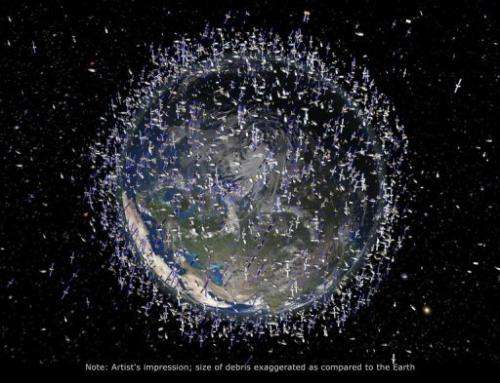
This artist's impression released in 2011 by the European Space Agency (ESA) shows the debris field

Enlarge

This artist's impression released in 2011 by the European Space Agency (ESA) shows the debris field in low-Earth orbit (LEO). The United States pledged on Tuesday to join an EU-led effort to develop a space "code of conduct" that would set out rules for orbiting spacecraft and for mitigating the growing problem of debris.

The United States pledged Tuesday to join an EU-led effort to develop a space "code of conduct" that would set rules for orbiting spacecraft and for mitigating the growing problem of orbiting debris.

"The long-term sustainability of our space environment is at serious risk from space debris and irresponsible actors," said a statement from Secretary of State Hillary Clinton.

"In response to these challenges, the United States has decided to join with the European Union and other nations to develop an International Code of Conduct for Outer Space Activities."

Such a code should "help maintain the long-term sustainability, safety, stability and security of space by establishing guidelines for the responsible use of space," Clinton added, noting that work on the code was just beginning.

The proposal was first submitted to the Conference on Disarmament by the European Union in 2009, just days after a disused Russian military satellite and a US communications satellite collided.

A draft code on civilian and military use, which includes pledges on the safety of orbiting space objects, had been previously approved by EU ministers in late 2008.

Countries signing up to the code would pledge to maintain freedom of access and use of outer space "for peaceful purposes without interference, fully respecting the security, safety and integrity of space objects in orbit," according to the text released in Geneva in 2009.
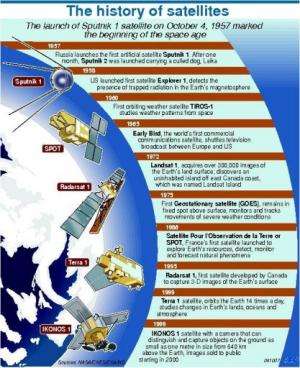
Graphic chronology with illustration of the history of satellites, dating from 1957 to 1999
Enlarge

Graphic chronology with illustration of the history of satellites, dating from 1957 to 1999

They also would pledge to cooperate to "prevent harmful interference in outer space activities" and seek to prevent outer space from being an area of conflict even if they were engaged in military activities in space.

Clinton said Washington "has made clear to our partners that we will not enter into a code of conduct that in any way constrains our national security-related activities in space or our ability to protect the United States and our allies."

However, she said the United States is "committed to working together to reverse the troubling trends that are damaging our space environment and to preserve the limitless benefits and promise of space for future generations."

The Pentagon said it also supported the concept of a space code of conduct and that the EU draft offered a "promising basis" from which to start.
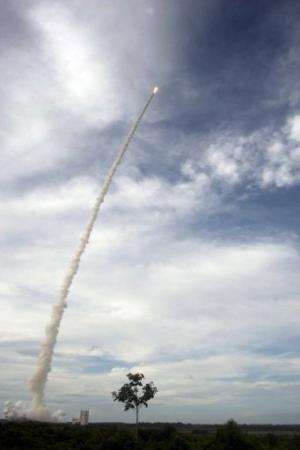
Ariane 5 rocket, seen here seconds after take-off from its launch site in Kourou, French Guiana
Enlarge

This file photo shows the Ariane 5 rocket, carrying telecommunication satellites, seconds after take-off from its launch site in Kourou, in the French overseas department of Guiana, in 2011. The United States has pledged to join an EU-led effort to develop a space "code of conduct" that would set rules for orbiting spacecraft and for mitigating the growing problem of orbiting debris.

"An international code of conduct can enhance US national security by encouraging responsible space behavior by reducing the risk of mishaps, misperceptions and mistrust," said Pentagon spokesman George Little.

The US announcement came days after parts of a defunct Russian Mars probe weighing 13.5 tons crashed into the Pacific Ocean after orbiting the Earth for more than two months.

A six-ton NASA satellite launched in 1991 met a similar fate in September last year, plunging into the Pacific Ocean off California.

The US government rejected a previous proposal from Russia and China in 2008 that would have banned the use of weapons in space.

US officials said the proposed treaty was deficient because it did not include a ban on terrestrial weapons that could shoot down satellites.

NASA and the Pentagon claim to be tracking by radar about 19,000 orbiting objects, many of them small pieces of space debris.

The International Space Station must regularly maneuver to avoid colliding with some of the orbiting debris, which could create catastrophic damage.

(c) 2012 AFP

4.8 /5 (8 votes)  

Filter


Move the slider to adjust rank threshold, so that you can hide some of the comments.


Display comments: newest first

Telekinetic
Jan 17, 2012

Rank: 3.3 / 5 (4)
Space exploring countries are like picnickers who spread their blankets out, gorge themselves and then take off, leaving behind a disgusting mess. Only the mess left behind in space is deadly.
antialias_physorg
Jan 18, 2012

Rank: 2.5 / 5 (10)
1) Space is big
2) No one has yet died through (or even been harmed by) space debris
3) There are a lot of objects out there that are not man made which are equaly dangerous. Several tons of that stuff impact the Earth every day

While space debris is a danger we really shouldn't blow this completely out of proportion. Chances that you will win the lottery are much greater than getting hit by some random piece of space debris.
Isaacsname
Jan 18, 2012

Rank: 4.3 / 5 (3)
"for peaceful purposes without interference, fully respecting the security, safety and integrity of space objects in orbit,"

...thanks for the laugh.
Telekinetic
Jan 18, 2012

Rank: 3 / 5 (2)
"More than 500,000 pieces of debris, or "space junk," are tracked as they orbit the Earth. They all travel at speeds up to 17,500 mph, fast enough for a relatively small piece of orbital debris to damage a satellite or a spacecraft.
The rising population of space debris increases the potential danger to all space vehicles, but especially to the International Space Station, space shuttles and other spacecraft with humans on board."- NASA
I'm impressed that you know more about the subject than NASA.
antialias_physorg
Jan 18, 2012

Rank: 3.7 / 5 (6)
From the site where you copied your info:

"If the probability of collision is greater than 1 in 100,000, a maneuver will be conducted if it will not result in significant impact to mission objectives. If it is greater than 1 in 10,000, a maneuver will be conducted unless it will result in additional risk to the crew. "

Given that we have heard it on the news every time the ISS was actually moved (which has been about a handful of times since its construction) the probability of a hit is - despite the many objects out there - very low.

As I said: Space is big. Creation of debris should be avoided but there are other things which are much more pressing. And you can't do anything against meteorite material. That will just continue to be inbound forever.
xNico
Jan 18, 2012

Rank: 4.8 / 5 (4)
1) Space is big
2) No one has yet died through (or even been harmed by) space debris
3) There are a lot of objects out there that are not man made which are equaly dangerous. Several tons of that stuff impact the Earth every day

While space debris is a danger we really shouldn't blow this completely out of proportion. Chances that you will win the lottery are much greater than getting hit by some random piece of space debris.


Your chances of being hit by Space Debris are 1 in 5,000,000,000
Telekinetic
Jan 18, 2012

Rank: 5 / 5 (2)
"Given that we have heard it on the news every time the ISS was actually moved (which has been about a handful of times since its construction) the probability of a hit is - despite the many objects out there - very low."- antialias

"The International Space Station must regularly maneuver to avoid colliding with some of the orbiting debris, which could create catastrophic damage."- from the article above
GDM
Jan 18, 2012

Rank: 5 / 5 (1)
In fact, both the ISS and the space shuttle have been impacted by debris, ranging in size from a grain of sand to about bullet sized. A fleck of paint nearly caused a breach in one of the space shuttles windows, and an ISS airlock door was replaced after taking a hit. Space IS big, but the amount of debris is becomming overwhelming. I vote that the international community agree to apply law-of-the-sea salvage rules and encourage private enterprise to help clean it up. You don't need an artist's conception to actually "see" how much is up there, Google Earth has the ability (via a special download file) to track a very large portion (but not all) of the debris. Pretty cool application.
Telekinetic
Jan 18, 2012

Rank: 4 / 5 (1)
"... and encourage private enterprise to help clean it up."-GDM

Now picture Tony Soprano in a spacesuit.
antialias_physorg
Jan 18, 2012

Rank: 3.4 / 5 (8)
I vote that the international community agree to apply law-of-the-sea salvage rules and encourage private enterprise to help clean it up.

Oh boy. Do you even have an idea how large space is? Do you have any idea how to collect this stuff that is floating around at terrific speeds? Most notably: How to collect it without creating additional shrapnel on impact?
Or how much gigatonnes of fuel it would take to maneuver to just a few locations to grab the occasional fleck of paint?

Sometimes I just despair at how limited the human mind is when it comes to things bigger than a house or how little people understand the effort to put something into space - let alone maneuver there.
The sheer volume and the orders of magnitude involved are so much beyond people on this site it makes me want to cry...
GDM
Jan 18, 2012

Rank: 5 / 5 (4)
Don't cry just yet. There are flight-tested methods of collecting and disposing space debris. See Star Tec's proposal at http://www.star-t...121.html
Also, the speeds we are talking about are relative to other objects. If you are in the same orbit and altitude, your relative closing speed can be brought down to a managable level. It is when you have crossing orbits at nearly 90 degrees to each other - boom!, just like to collision between the US and USSR satellites. I'm afraid we don't yet have the technology to catch flects of paint, or nuts and bolts, but we can capture and/or de-orbit the booster stages, defunct satellites, and the larger stuff before they collide with each other, preventing the creation of many smaller pieces. And, perhaps we can convince others (e.g. China, US) not to shoot down any more satellites to demonstrate their "manhood". The human mind is only as limited as you allow it to be.
TheGhostofOtto1923
Jan 18, 2012

Rank: 5 / 5 (1)
Heres an older one using lasers:
http://www.au.af....at20.pdf
GDM
Jan 18, 2012

Rank: 1 / 5 (1)
...and the laser method could remove the really small stuff. I wonder what we are waiting for?
vidyunmaya
Jan 19, 2012

Rank: 1 / 5 (1)
Sub: SPACE FOR PEACe- Create TRUST
ANTARIKSHASYA SHANTIH- PRIDHVEEM SHANTIH
Peace must prevail on Earth Region and Space holds the Key
Create :Necessity-Demand-Curiosity-Sustain the spirit of Co-existence
Human being Environment and Space must define
Objectivity-Business-Administration-Management- Association-
Vidyardhi nanduri [Cosmology World Peace]
Idiomatic
Jan 22, 2012

Rank: not rated yet
"The rising population of space debris increases the potential danger to all space vehicles, but especially to the International Space Station, space shuttles and other spacecraft with humans on board."- NASA
I'm impressed that you know more about the subject than NASA.


What, are humans magnetic? The ISS isn't at GREATER risk of damage because people are there. So yeah, NASA isn't the most rational.
antialias_physorg
Jan 23, 2012

Rank: not rated yet
I think they mean that while the chance of hitting a piece of debris (per effective square meter) is the same the chanc of that piece of debris causing some catastrophic failure is greater for the ISS. It's just a lot more fragile than most other sattelites out there.

Maybe they also mean that the ISS is in low orbit whereas many sattelites are not. There's more debris in lower orbit than in higher orbits.
Rank 4.8 /5 (8 votes)
Relevant PhysicsForums posts
  • Distance of planets from stars and revolution
    created7 hours ago
  • revamping general concept and cosmological principle
    createdMay 25, 2012
  • Transiting Exoplanet Light Curve
    createdMay 25, 2012
  • Math behind Theoretical Physics
    createdMay 24, 2012
  • Do we know whats at the center of galaxies yet?
    createdMay 23, 2012
  • Structure of the Milky Way?
    createdMay 20, 2012
  • More from Physics Forums - General Astronomy

More news stories

Land and sea species differ in climate change response: study

(Phys.org) -- Marine and terrestrial species will likely differ in their responses to climate warming, new research by Simon Fraser University and Australia’s University of Tasmania has found.

Space & Earth / Environment

created 5 hours ago | popularity 3.7 / 5 (3) | comments 5 | with audio podcast

Yale study concludes public apathy over climate change unrelated to science literacy

Are members of the public divided about climate change because they don't understand the science behind it? If Americans knew more basic science and were more proficient in technical reasoning, would public consensus match ...

Space & Earth / Environment

created 7 hours ago | popularity 4.8 / 5 (5) | comments 15 | with audio podcast

10 million years needed to recover from mass extinction

It took some 10 million years for Earth to recover from the greatest mass extinction of all time, latest research has revealed.

Space & Earth / Earth Sciences

created 7 hours ago | popularity 4 / 5 (4) | comments 1 | with audio podcast

Sophisticated simulations predict future warming

The chances of our planet being hit by a global warming of 3 degrees Celsius by 2050 is as likely as it being hit by an increase of 1.4 degrees, new research shows. Presented in the journal Nature Geoscience, the British study ...

Space & Earth / Earth Sciences

created May 22, 2012 | popularity 4.4 / 5 (9) | comments 51

Aliens don't want to eat us, says former SETI director

Alien life probably isn’t interested in having us for dinner, enslaving us or laying eggs in our bellies, according to a recent statement by former SETI director Jill Tarter.

Space & Earth / Space Exploration

created May 25, 2012 | popularity 4.4 / 5 (15) | comments 41


Stunning image of smallest possible five-ringed structure

Scientists have created and imaged the smallest possible five-ringed structure – about 100,000 times thinner than a human hair – and you'll probably recognise its shape.

'Unzipped' carbon nanotubes could help energize fuel cells, batteries

Multi-walled carbon nanotubes riddled with defects and impurities on the outside could replace some of the expensive platinum catalysts used in fuel cells and metal-air batteries, according to scientists at ...

Change in developmental timing was crucial in the evolutionary shift from dinosaurs to birds: study

At first glance, it's hard to see how a common house sparrow and a Tyrannosaurus Rex might have anything in common. After all, one is a bird that weighs less than an ounce, and the other is a dinosaur that ...

Computer model used to pinpoint prime materials for efficient carbon capture

When power plants begin capturing their carbon emissions to reduce greenhouse gases – and to most in the electric power industry, it's a question of when, not if – it will be an expensive undertaking.

T cells 'hunt' parasites like animal predators seek prey, study shows

By pairing an intimate knowledge of immune-system function with a deep understanding of statistical physics, a cross-disciplinary team at the University of Pennsylvania has arrived at a surprising finding: T cells use a movement ...

Scientists develop ultra-sensitive test that detects diseases in their earliest stages

Scientists have developed an ultra-sensitive test that should enable them to detect signs of a disease in its earliest stages, in research published today in the journal Nature Materials.