Chandra finds largest galaxy cluster in early universe
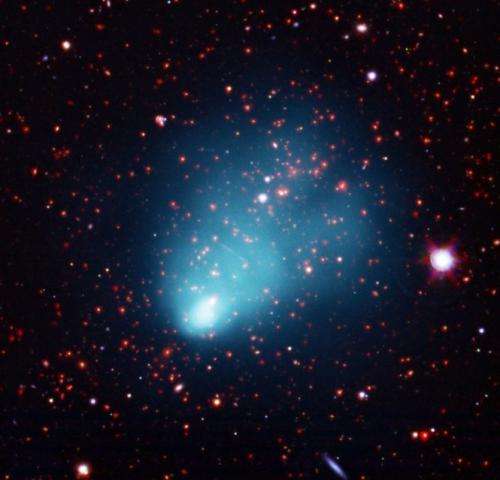
Composite image of the El Gordo galaxy cluster. (X-ray: NASA/CXC/Rutgers/J. Hughes et al; Optical: ESO/VLT & SOAR/Rutgers/F. Menanteau; IR: NASA/JPL/Rutgers/F. Menanteau )
(PhysOrg.com) -- An exceptional galaxy cluster, the largest seen in the distant universe, has been found using NASA's Chandra X-ray Observatory and the National Science Foundation-funded Atacama Cosmology Telescope (ACT) in Chile.
Officially known as ACT-CL J0102-4915, the galaxy cluster has been nicknamed "El Gordo" ("the big one" or "the fat one" in Spanish) by the researchers who discovered it. The name, in a nod to the Chilean connection, describes just one of the remarkable qualities of the cluster, which is located more than seven billion light years from Earth. This large distance means that it is being observed at a young age.
"This cluster is the most massive, the hottest, and gives off the most X-rays of any known cluster at this distance or beyond," said Felipe Menanteau of Rutgers University in New Brunswick, N.J., who led the study.
Galaxy clusters, the largest objects in the universe that are held together by gravity, form through the merger of smaller groups or sub-clusters of galaxies. Because the formation process depends on the amount of dark matter and dark energy in the universe, clusters can be used to study these mysterious phenomena.
Dark matter is material that can be inferred to exist through its gravitational effects, but does not emit and absorb detectable amounts of light. Dark energy is a hypothetical form of energy that permeates all space and exerts a negative pressure that causes the universe to expand at an ever-increasing rate.
"Gigantic galaxy clusters like this are just what we were aiming to find," said team member Jack Hughes, also of Rutgers. "We want to see if we understand how these extreme objects form using the best models of cosmology that are currently available."
Although a cluster of El Gordo's size and distance is extremely rare, it is likely that its formation can be understood in terms of the standard Big Bang model of cosmology. In this model, the universe is composed predominantly of dark matter and dark energy, and began with a Big Bang about 13.7 billion years ago.
The team of scientists found El Gordo using ACT thanks to the Sunyaev-Zeldovich effect. In this phenomenon, photons in the cosmic microwave background interact with electrons in the hot gas that pervades these enormous galaxy clusters. The photons acquire energy from this interaction, which distorts the signal from the microwave background in the direction of the clusters. The magnitude of this distortion depends on the density and temperature of the hot electrons and the physical size of the cluster.
X-ray data from Chandra and the European Southern Observatory's Very Large Telescope, an 8-meter optical observatory in Chile, show that El Gordo is, in fact, the site of two galaxy clusters running into one another at several million miles per hour. This and other characteristics make El Gordo akin to the well-known object called the Bullet Cluster, which is located almost 4 billion light years closer to Earth.
As with the Bullet Cluster, there is evidence that normal matter, mainly composed of hot, X-ray bright gas, has been wrenched apart from the dark matter in El Gordo. The hot gas in each cluster was slowed down by the collision, but the dark matter was not.
"This is the first time we've found a system like the Bullet Cluster at such a large distance," said Cristobal Sifon of Pontificia Universidad de Catolica de Chile (PUC) in Santiago. "It's like the expression says: if you want to understand where you're going, you have to know where you've been."
These results on El Gordo are being announced at the 219th meeting of the American Astronomical Society in Austin, Texas. A paper describing these results has been accepted for publication in The Astrophysical Journal.
More information: These results on El Gordo are being announced on 10 January 2012 at the 219th meeting of the American Astronomical Society in Austin, Texas. A paper, "The Atacama Cosmology Telescope: ACT-CL J0102−4915 'El Gordo', A Massive Merging Cluster at Redshift 0.87" by Felipe Menanteau et al, describing these results has been accepted for publication in The Astrophysical Journal.
Provided by
JPL/NASA
-
From lemons to lemonade: Reaction uses carbon dioxide to make carbon-based semiconductor,
32 comments
-
Thioridazine kills cancer stem cells in human while avoiding toxic side-effects of conventional cancer treatments,
3 comments
-
SpaceX private rocket blasts off for space station (Update),
42 comments
-
Climate scientists say they have solved riddle of rising sea,
31 comments
-
SpaceX capsule has 'new car' smell, astronauts say (Update),
4 comments
-
Distance of planets from stars and revolution
8 hours ago
-
revamping general concept and cosmological principle
May 25, 2012
-
Transiting Exoplanet Light Curve
May 25, 2012
-
Math behind Theoretical Physics
May 24, 2012
-
Do we know whats at the center of galaxies yet?
May 23, 2012
-
Structure of the Milky Way?
May 20, 2012
- More from Physics Forums - General Astronomy
More news stories
Land and sea species differ in climate change response: study
(Phys.org) -- Marine and terrestrial species will likely differ in their responses to climate warming, new research by Simon Fraser University and Australia’s University of Tasmania has found.
6 hours ago |
3.8 / 5 (4) |
5
|
Yale study concludes public apathy over climate change unrelated to science literacy
Are members of the public divided about climate change because they don't understand the science behind it? If Americans knew more basic science and were more proficient in technical reasoning, would public consensus match ...
8 hours ago |
4.8 / 5 (5) |
20
|
10 million years needed to recover from mass extinction
It took some 10 million years for Earth to recover from the greatest mass extinction of all time, latest research has revealed.
Space & Earth / Earth Sciences
8 hours ago |
4 / 5 (4) |
1
|
Sophisticated simulations predict future warming
The chances of our planet being hit by a global warming of 3 degrees Celsius by 2050 is as likely as it being hit by an increase of 1.4 degrees, new research shows. Presented in the journal Nature Geoscience, the British study ...
Space & Earth / Earth Sciences
May 22, 2012 |
4.1 / 5 (10) |
51
Aliens don't want to eat us, says former SETI director
Alien life probably isnt interested in having us for dinner, enslaving us or laying eggs in our bellies, according to a recent statement by former SETI director Jill Tarter.
Space & Earth / Space Exploration
May 25, 2012 |
4.4 / 5 (15) |
41
Stunning image of smallest possible five-ringed structure
Scientists have created and imaged the smallest possible five-ringed structure about 100,000 times thinner than a human hair and you'll probably recognise its shape.
'Unzipped' carbon nanotubes could help energize fuel cells, batteries
Multi-walled carbon nanotubes riddled with defects and impurities on the outside could replace some of the expensive platinum catalysts used in fuel cells and metal-air batteries, according to scientists at ...
Change in developmental timing was crucial in the evolutionary shift from dinosaurs to birds: study
At first glance, it's hard to see how a common house sparrow and a Tyrannosaurus Rex might have anything in common. After all, one is a bird that weighs less than an ounce, and the other is a dinosaur that ...
Computer model used to pinpoint prime materials for efficient carbon capture
When power plants begin capturing their carbon emissions to reduce greenhouse gases and to most in the electric power industry, it's a question of when, not if it will be an expensive undertaking.
T cells 'hunt' parasites like animal predators seek prey, study shows
By pairing an intimate knowledge of immune-system function with a deep understanding of statistical physics, a cross-disciplinary team at the University of Pennsylvania has arrived at a surprising finding: T cells use a movement ...
Scientists develop ultra-sensitive test that detects diseases in their earliest stages
Scientists have developed an ultra-sensitive test that should enable them to detect signs of a disease in its earliest stages, in research published today in the journal Nature Materials.
Jan 10, 2012
Rank: 1.2 / 5 (18)
So you'd better make very sure you know where you've been, then? Which of course makes it so much more important to know that the universe and everything in it was created by a vastly superior intelligence, who also created US. Hence if one knows where one really comes from, one will know where one is headed. Pick your origins very, very carefully.
How does this relate to the article? Well, the terrible reliance on dark matter and energy points to flaws in the original assumptions on which the big bang model is based. Examine the inference of dark matter and energy closely and one comes away with a feeling that philosophical directives are at the bottom of it all. Change the philosophy and the requirement for dark matter and energy disappear.
Jan 10, 2012
Rank: 2.3 / 5 (7)
Jan 10, 2012
Rank: 4.9 / 5 (13)
Interesting theory. I would like to see the evidence you have amassed in favor of it as well as a demonstration of it's predictive power. I would also be interested in a proposed method of falsifying it. Also, I assume you have an explanation for the origin of this "vastly superior intelligence", since it would be foolish to answer the question of origin with an entity having no explanation of it's own origin.
Jan 10, 2012
Rank: 1 / 5 (8)
Jan 10, 2012
Rank: 5 / 5 (5)
The realization that distant clusters are comparably easy to locate using SZE observations has led to several wide-field SZE surveys conducted specifically to discover these distant galaxy clusters, with a much higher success rate than conventional *blind* surveys.
"The Atacama Cosmology Telescope: ACT-CL J01024915 'El Gordo', A Massive Merging Cluster at Redshift 0.87":
http://arxiv.org/...53v3.pdf
Jan 10, 2012
Rank: 4.7 / 5 (6)
So you'd better make very sure you know where you've been, then? Which of course makes it so much more important to know that the universe and everything in it was created by a vastly inferior intelligence, who also created YOU perpetually ignorant. Hence if one falsely thinks he knows where one really comes from, one will not know where one is headed. Pick your origins fairytale very, very carefully.
How does this relate to the article? Well, the terrible reliance on a god points to flaws in the original assumptions on which the bible model is based. Examine the inference of dark spirits and the devil closely and one comes away with a feeling that philosophical directives are at the bottom of it all. Change the philosophy and the requirement for dark spirits and god disappear.
Jan 11, 2012
Rank: not rated yet
Jan 11, 2012
Rank: 1 / 5 (5)
Jan 11, 2012
Rank: not rated yet
Heard this from you more then twice for fdifferent things.
It seems _everthing_ appear to you like CMBR noise.
Jan 11, 2012
Rank: 1 / 5 (4)
Jan 12, 2012
Rank: not rated yet
Nothing more then some big words tossed together with no connection. I tend to think you are a bot. At least i could get the same theory out of some bots...
Edit: i want to second the question from 'Aliensarethere'
_How big is the extend of this blob?
Jan 12, 2012
Rank: not rated yet
A 2010 paper on several ACT clusters gave an X-ray derived diameter of 2.5 Mpc (or about 8 million light years) for this cluster. El Gordo indeed!
http://peumo.rutg...pted.pdf