Advance toward an imaging agent for diagnosing Alzheimer's disease
Jan 11, 2012
Advance toward an imaging agent for diagnosing Alzheimer's disease

Scientists are reporting development and initial laboratory tests of an imaging agent that shows promise for detecting the tell-tale signs of Alzheimer's disease (AD) in the brain — signs that now can't confirm a diagnosis until after patients have died. Their report appears in the journal ACS Medicinal Chemistry Letters.

Masahiro Ono and colleagues explain that no proven laboratory test or medical scan now exists for AD, which is claiming an increasingly heavy toll with the graying of the world's population. Patients now get a diagnosis of AD based on their medical history and symptoms, and symptoms like memory loss often are identical to those of normal aging. Currently, the only definitive way to diagnose AD involves an autopsy with examination of brain samples for the presence of the clumps and tangles of abnormal protein that occur in the disease.

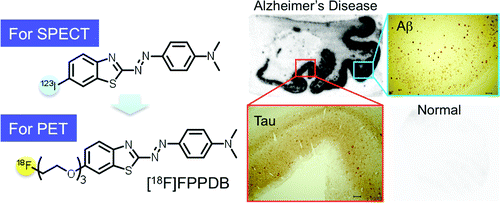
The scientists describe the synthesis and lab testing of a new (called FPPDB), which bound tightly to ß-amyloid plaques and neurofibrillary tangles — signs of AD — in human samples. In normal laboratory mice, which served as stand-ins for humans, FPPDB stayed in the body long enough for a PET scan (a sophisticated medical imaging technique). With further development, the imaging agent may allow early AD diagnosis in humans, the scientists indicate.

Explore further: Protein study suggests drug side effects are inevitable

More information: 18F-Labeled Phenyldiazenyl Benzothiazole for in Vivo Imaging of Neurofibrillary Tangles in Alzheimer's Disease Brains, ACS Med. Chem. Lett., Article ASAP. DOI: 10.1021/ml200230e

Abstract
We synthesized and evaluated (E)-4-((6-(2-(2-(2-fluoroethoxy)ethoxy)ethoxy)benzo[d]thiazol-2-yl)diazenyl)-N,N-dimethylaniline (FPPDB) as a probe for the imaging of neurofibrillary tangles (NFTs) in patients with Alzheimer's disease (AD). In assays using thioflavin S (ThS) as a competitive ligand, FPPDB competed with ThS well and showed high affinity for both tau and Aβ1–42 aggregates (Ki = 13.0 and 20.0 nM, respectively). The results of saturation binding assays also verified that FPPDB bound to both tau and Aβ1–42 aggregates with high affinity (Kd = 44.8 nM and Bmax = 45.8 pmol/nmol protein for tau aggregates and Kd = 45.4 nM and Bmax = 38.9 pmol/nmol protein for Aβ1–42 aggregates). Furthermore, [18F]FPPDB substantially labeled NFTs and senile plaques in AD brain sections but not control brain sections. In biodistribution experiments using normal mice, [18F]FPPDB displayed higher uptake (4.28% ID/g at 2 min postinjection) into and washout (2.53% ID/g at 60 min postinjection) from the brain with time. On the basis of the chemical structure of FPPDB, further increases in selective binding to tau aggregates may lead to the development of more useful probes for the imaging of NFTs in AD brains.

add to favorites email to friend print save as pdf

Related Stories

New fluorescent label sheds light on brain diseases

Nov 05, 2007

In an advance that may speed progress toward new diagnostic tests for Alzheimer’s disease (AD) and Parkinson’s disease (AD), scientists in New York are reporting development of the first direct method for measuring a ...

Recommended for you

Protein study suggests drug side effects are inevitable

May 20, 2013

A new study of both computer-created and natural proteins suggests that the number of unique pockets – sites where small molecule pharmaceutical compounds can bind to proteins – is surprisingly small, meaning drug side ...

Attacking MRSA with metals from antibacterial clays

May 17, 2013

In the race to protect society from infectious microbes, the bugs are outrunning us. The need for new therapeutic agents is acute, given the emergence of novel pathogens as well as old foes bearing heightened antibiotic resistance.

Keeping fruit, vegetables and cut flowers fresh longer

May 15, 2013

New technology offers the promise of reducing billions of dollars of losses that occur each year from the silent, invisible killer of fruits, vegetables and cut flowers—a gas whose effects are familiar to everyone who has ...

Why don't beetles freeze in the winter?

May 14, 2013

For 37 years, Queen's University Biochemistry professor Peter Davies has been unraveling the mystery of why some organisms including insects and fish don't freeze in the winter. His research into insect antifreeze protein ...

User comments : 0

More news stories

New method for producing clean hydrogen

Duke University engineers have developed a novel method for producing clean hydrogen, which could prove essential to weaning society off of fossil fuels and their environmental implications.

Protein study suggests drug side effects are inevitable

A new study of both computer-created and natural proteins suggests that the number of unique pockets – sites where small molecule pharmaceutical compounds can bind to proteins – is surprisingly small, meaning drug side ...

Beautiful 'flowers' self-assemble in a beaker

By simply manipulating chemical gradients in a beaker of fluid, materials scientists at Harvard have found that they can control the growth behavior of crystals to create precisely tailored structures—such ...

Attacking MRSA with metals from antibacterial clays

In the race to protect society from infectious microbes, the bugs are outrunning us. The need for new therapeutic agents is acute, given the emergence of novel pathogens as well as old foes bearing heightened antibiotic resistance.

NASA's BARREL mission launches 20 balloons

(Phys.org) —In Antarctica in January, 2013 – the summer at the South Pole – scientists released 20 balloons, each eight stories tall, into the air to help answer an enduring space weather question: ...

Amazon plans greenhouse-style headquarters

US online giant Amazon has unveiled plans for a futuristic greenhouse style headquarters "where employees can work and socialize in a more natural, park-like setting."