X-ray techniques help art historians verify Rembrandt sketch

December 4, 2011 by Nancy Owano
(PhysOrg.com) -- Advanced imaging technology from the Brookhaven Labs and the European Synchrotron Radiation Facility (ESRF) in Grenoble has revealed an authentic Rembrandt self-portrait in an art authenticity effort involving leading art historians and scientists at the two labs. The hunt for authenticity all began when a private collector showed art historians in Amsterdam a small panel Old Man with a Beard from about 1630. The collector wanted to know if it was a Rembrandt.
The experts turned to the modern science of x-ray imaging for answers. The scientific work showed an unfinished self-portrait by Rembrandt under the paint surface.
The ESRF and Brookhaven sites performed the scientific explorations. Ernst van de Wetering, emeritus professor of art history at the University of Amsterdam and head of the Rembrandt Research Project, said the evidence was clear that this is a Rembrandt.
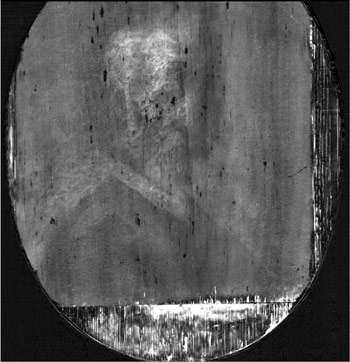
KES imaging of the painting Old Man with a Beard at beamline ID17 allowed a quick visualisation of the distribution of heavy elements in the paintings. Based on these results, the presence of a complete second figure could be excluded. Image credit: Koen Janssens.
The scanning technology that was used at ESRF was a dual energy X-ray imaging technique. The Brookhaven National Lab used used Macro-scanning X-Ray Fluorescence spectrometry (MA-XRF). Central to Brookhavens contribution was its new fluorescence microprobe system that can scan surfaces with high definition. The XRF technique was used with this new Maia detector system.The detector can produce high definition maps of the spatial distribution of different chemical elements in a painting. The painting is placed on a motorized scanning stage that allows for element-specific mapping. A pencil beam of synchrotron radiation (SR) is swept over the painting.
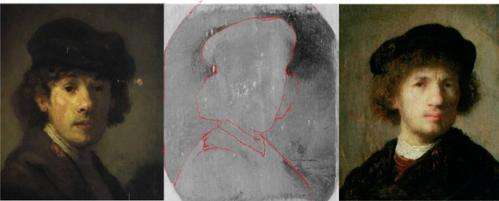
Copper distribution map from XRF analysis with the contours superimposed on the hidden portrait (centre) (reconstruction by E. Van de Wetering). Comparison of the outline to other self portraits by Rembrandt van Rijn: Rembrandt as a young man (left), (© Metropolitan Museum of Art, NY, USA); Self portrait of Rembrandt (right), dated 1630, (© National museum, Stockholm).
The Maia detector, according to the publication Lab Manager, which details the technology used in the Rembrandt probe, is based on a massively parallel detector array composed of 384 individual detectors, an on-the-fly scanning system, and advanced analysis software. The publication reported that the detector was able to image the entire painting in about eight hours, in a task that would normally take about 30 days.In general, X-ray Fluorescence (XRF) is considered a key technology for those in the art world, as it highlights pigments concealed beneath the surface, and has previously been used to authenticate works by Van Gogh and Goya, among other famous artists. The tool is especially helpful as it can determine chemical composition in a nondestructive way; the work of art is left intact.
Prof Ernst van de Wetering, an art historian at the Rembrandt House in Amsterdam, and head of the Rembrandt Research Project, had worked meanwhile with his team to examine the sketch for authenticity. The imaging results gave scientific support to authentication, which Prof. van de Wetering announced at the Rembrandt House Museum in Amsterdam on Friday.
From 1 May to 1 July 2012 the Rembrandt House Museum is staging a special exhibition of research into ten paintings by Rembrandt and his contemporaries using XRF technology.
More information: http://www.labmana … Purported-Re
http://www.bnl.gov … mplate=Today
http://webh01.ua.a … pxrf_100.jpg
http://webh01.ua.a … _301111.html
© 2011 PhysOrg.com
-
From lemons to lemonade: Reaction uses carbon dioxide to make carbon-based semiconductor,
32 comments
-
Thioridazine kills cancer stem cells in human while avoiding toxic side-effects of conventional cancer treatments,
3 comments
-
SpaceX private rocket blasts off for space station (Update),
42 comments
-
Climate scientists say they have solved riddle of rising sea,
31 comments
-
SpaceX capsule has 'new car' smell, astronauts say (Update),
4 comments
-
Why does a boiled egg rotates while a raw egg doesn't?
3 hours ago
-
Lightning strike in mindair
4 hours ago
-
Why does light move?
5 hours ago
-
How to calculate the repulsion force between a permanent and an electromagnet?
7 hours ago
-
Why does light allow us to see things?
7 hours ago
-
Room temperature superconductivity
7 hours ago
- More from Physics Forums - General Physics
More news stories
Is a classical electrodynamics law incompatible with special relativity?
(Phys.org) -- The laws of classical electromagnetism that were developed in the 19th century are the same laws that scientists use today. They include Maxwell’s four equations along with the Lorentz la ...
Landmark calculation clears the way to answering how matter is formed
(Phys.org) -- An international collaboration of scientists, including Thomas Blum, associate professor of physics, is reporting in landmark detail the decay process of a subatomic particle called a kaon ...
May 25, 2012 |
4.3 / 5 (22) |
53
|
Lying in wait for WIMPs: Researchers seek to dramatically increase sensitivity of Large Underground Xenon detector
Although it's invisible, dark matter accounts for at least 80 percent of the matter in the universe. No one knows what it is, but most scientists would bet on weakly interacting massive particles, or WIMPs.
May 23, 2012 |
4 / 5 (7) |
18
|
Hawaii lab turns laser-powered bubbles into microrobots
(Phys.org) -- A team of scientists from the University of Hawaii are working on microrobots created from bubbles of air in a saline solution. The bubbles take on their title of robots as a laser ...
Sound increases the efficiency of boiling
Scientists at the Georgia Institute of Technology achieved a 17-percent increase in boiling efficiency by using an acoustic field to enhance heat transfer. The acoustic field does this by efficiently removing vapor bubbles ...
May 24, 2012 |
5 / 5 (2) |
2
Stunning image of smallest possible five-ringed structure
Scientists have created and imaged the smallest possible five-ringed structure about 100,000 times thinner than a human hair and you'll probably recognise its shape.
'Unzipped' carbon nanotubes could help energize fuel cells, batteries
Multi-walled carbon nanotubes riddled with defects and impurities on the outside could replace some of the expensive platinum catalysts used in fuel cells and metal-air batteries, according to scientists at ...
Change in developmental timing was crucial in the evolutionary shift from dinosaurs to birds: study
At first glance, it's hard to see how a common house sparrow and a Tyrannosaurus Rex might have anything in common. After all, one is a bird that weighs less than an ounce, and the other is a dinosaur that ...
Computer model used to pinpoint prime materials for efficient carbon capture
When power plants begin capturing their carbon emissions to reduce greenhouse gases and to most in the electric power industry, it's a question of when, not if it will be an expensive undertaking.
T cells 'hunt' parasites like animal predators seek prey, study shows
By pairing an intimate knowledge of immune-system function with a deep understanding of statistical physics, a cross-disciplinary team at the University of Pennsylvania has arrived at a surprising finding: T cells use a movement ...
Land and sea species differ in climate change response: study
(Phys.org) -- Marine and terrestrial species will likely differ in their responses to climate warming, new research by Simon Fraser University and Australia’s University of Tasmania has found.
