Volcanic destruction? Not always
For many, the story of Pompeii defines what happens when a volcano erupts: It destroys everything in its path and kills everyone who cannot escape.
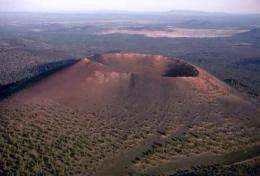
But nearly a millennium ago, a very different scenario played out just north of the modern-day city of Flagstaff in the Arizona desert. Here, the local Sinagua peoples survived the eruption of the powerful Sunset Crater volcano and adapted to a changed landscape to forge a more complex society and higher standard of living.
"They were much better evolved to deal with the volcano than we are," said archaeologist Mark Elson of Desert Archaeology, a Tucson firm that helps preserve ancient sites. By studying how the Sinagua adapted, Elson thinks we could learn better ways to cope with such massive catastrophes as Hurricane Katrina and the Great Plains floods.
Sinagua
Sinagua means "no water" in Spanish. Yet the Sinagua people, who lived in small, family-oriented settlements, had mastered desert survival. While the plateau around Flagstaff was too dry to support agriculture, they farmed the surrounding San Francisco Mountains. These mountains were tall enough to force some clouds to give up their moisture before they passed.
Yet rain did not water every part of the mountains equally. To compensate, the Sinagua planted many small plots of corn, beans, squash, and cotton. While summer withered some crops, a hillside dip or rock outcropping might shelter just enough moisture for other plants to survive.
Then, nearly 1,000 years ago, a 7-mile-long crack unzipped along the plateau. A curtain of lava surged 100-200 feet into the air in the center and 500-600 feet at the ends. The fissure closed within days and lava began to pour out of the northwestern end of the crack.
This became the 1,100-foot-high Sunset Crater volcano. By measuring how far cinders from the volcano fell, Northern Arizona University volcanologist Michael Ort estimated that its plume rose 5-10 miles into the sky. The volcano's fire would have been visible over all of northern Arizona for hours at a time.
Ort's investigations showed that the lava flowed for up to three months, shorter than previously believed. At first, it moved away from the volcano and cooled into a hard crust. As more lava flowed, it lifted the crust upwards. Sometimes, it broke through, creating hornitos, small mounds a few feet high.
Some Sinagua walked over the hardened lava to the hornitos and left corn, perhaps to appease the angry gods. After lava splattered the corn and cooled, they broke the rocks. The corn left casts so detailed, researchers can tell that it was three weeks short of ripe.
Changes
Archaeologists long believed the volcano changed Sinagua culture. Yet because the date of the eruption remained elusive, they could not tell how fast those changes occurred.
Ort, however, had a geological clock that let him make a better estimate. The Earth's magnetic north pole constantly drifts. Researchers have records of drift going back thousands of years made by measuring how certain minerals are magnetized to align with the magnetic poles as they settle in lake sediments.
What Ort needed was a way to link these paleomagnetic measurements to the age of artifacts found in villages abandoned after the eruption. Ort chose minerals in hearths because they become demagnetized when they heat up and realign when they cool. They would provide the date of their last use. By matching their alignment with known magnetic fields, Ort narrowed the time of the eruption to 1050-1100 A.D.
Researchers further narrowed the date by studying tree rings for strontium, an element trees absorb from the fallen debris of an eruption. The trees near Sunset Crater showed a strontium spike in year 1085.
Pinning the date of the eruption showed that changes happened quickly after the volcano erupted. The most visible change occurred in agricultural practices. The volcano deposited a layer of ash and small cinders over a large area. They acted as a mulch to keep rainfall from evaporating.
"The Sinagua might have seen that lots of plants -- big plants -- were growing in areas with mulch, and moved there," Elson said. They soon learned to manage the cinders to farm flat lands that were previously too dry to grow crops.
Increased production led to larger populations. The Sinagua originally lived in small clusters of pit houses, holes enclosed by walls only a few feet high. After the volcano, they began building pueblos from stone and mud. One such structure, the Wupatki pueblo, eventually expanded to nearly 100 rooms and had sections that rose three stories high. It possibly housed 100 or more people.
Elson believes Wupatki acted like a fort to mark a clan's territory. It looks out over a broad, flat expanse of land, so occupants could see an approaching enemy.
The land had become more violent. Archaeologists have found the number of dismembered bodies increased after the explosion. The 1943 eruption of Paricutin, a similar volcano in Mexico, erased established boundaries, and 300 people died as local subsistence farmers fought over land. This may have happened around Sunset Crater as well.
Wupatki lasted about 150 years, the time it took for desert winds to blow away the volcanic cinders. Yet it may still teach us something about how to respond to disaster.
After Paricutin erupted, the Mexican government resettled nearby farmers. “Those towns are now deserted or weak,” Ort said. The Sinagua show that "decisions made at a family level are more efficient and effective," he said.
Elson agreed. The modern instinct to await organized evacuation instructions can be counterproductive in certain disasters. The people at Sunset Crater "could see the lava coming. They packed up and moved," Elson said.
Source: Inside Science News Service


