Total eclipse of the moon
Dec 05, 2011 By Dr. Tony Phillips
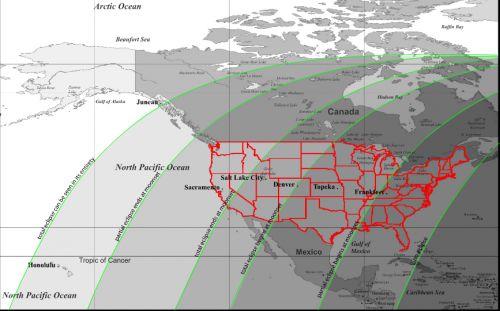
Clicking on this image takes you to an interactive visibility map courtesy of Larry Koehn, ShadowandSubstance.com.

Waking up before sunrise can be tough to do, especially on a weekend.  On Saturday, Dec. 10th, you might be glad you did.  A total eclipse of the Moon will be visible in the early morning skies of western Northern America.

The action begins around 4:45 am Pacific Standard Time when the red shadow of Earth first falls across the lunar disk.  By 6:05 am Pacific Time, the will be fully engulfed in red light. This event—the last total lunar eclipse until 2014—is visible from the Pacific side of North America, across the entire Pacific Ocean to Asia and Eastern Europe.

For people in the western United States the eclipse is deepest just before local dawn. Face west to see the red Moon sinking into the horizon as the sun rises behind your back.  It’s a rare way to begin the day.

Not only will the Moon be beautifully red, it will also be inflated by the Moon illusion.  For reasons not fully understood by astronomers or psychologists, low-hanging Moons look unnaturally large when they beam through trees, buildings and other foreground objects. In fact, a low Moon is no wider than any other Moon (cameras prove it) but the human brain insists otherwise. To observers in the western USA, therefore, the eclipse will appear super-sized.

This video is not supported by your browser at this time.

It might seem puzzling that the Moon turns red when it enters the shadow of the Earth—aren’t shadows supposed to be dark?  In this case, the delicate layer of dusty air surrounding our planet reddens and redirects the light of the sun, filling the dark behind Earth with a sunset-red glow. The exact hue (anything from bright orange to blood red is possible) depends on the unpredictable state of the atmosphere at the time of the eclipse. As Jack Horkheimer (1938-2010) of the Miami Space Transit Planetarium loved to say, "Only the shadow knows."

Atmospheric scientist Richard Keen of the University of Colorado might know, too.  For years he has studied lunar eclipses as a means of monitoring conditions in Earth's upper atmosphere, and he has become skilled at forecasting these events.

"I expect this eclipse to be bright orange, or even copper-colored, with a possible hint of turquoise at the edge," he predicts.

Earth's stratosphere is the key: "During a lunar eclipse, most of the light illuminating the moon passes through the stratosphere where it is reddened by scattering," he explains.  "If the stratosphere is loaded with dust from volcanic eruptions, the eclipse will be dark; a clear stratosphere, on the other hand, produces a brighter eclipse.  At the moment, the stratosphere is mostly clear with little input from recent volcanoes."

That explains the brightness of the eclipse, but what about the "hint of turquoise"?

 "Light passing through the upper stratosphere penetrates the ozone layer, which absorbs red light and actually makes the passing light ray bluer. This can be seen as a soft blue fringe around the red core of Earth's shadow."

Look for the turquoise near the beginning of the eclipse when the edge of Earth's shadow is sweeping across the lunar terrain, he advises.

A bright red, soft turquoise, super-sized lunar : It’s coming on Saturday, Dec. 10th. Wake up and enjoy the show.

Explore further: NASA head views progress on asteroid lasso mission

Related Stories

Total Lunar Eclipse

Feb 14, 2008

On Wednesday evening, February 20th, the full Moon over the Americas will turn a delightful shade of red and possibly turquoise, too. It's a total lunar eclipse—the last one until Dec. 2010.

New lunar eclipse video released

Jun 09, 2011

(PhysOrg.com) -- In anticipation of the upcoming lunar eclipse later this month, NASA has released a new video that shows how lunar eclipses work.

Get Ready For Total Lunar Eclipse Wednesday Night

Feb 19, 2008

In the late night hours of Feb. 20, 2008, a total lunar eclipse will dazzle the night sky. And this lunar eclipse may be worth staying up for, because it will be the last one until December 2010.

Partial lunar eclipse visible in western skies

Jun 27, 2010

(AP) -- Skygazers got a treat Saturday when a portion of the moon crossed into the Earth's shadow during a partial lunar eclipse visible in the western United States and Canada, the Pacific and eastern Asia.

Big Lunar Eclipse

Jun 25, 2010

(PhysOrg.com) -- This Saturday morning, June 26th, there's going to be a lunar eclipse—and for many residents of the USA, it's going to be a big one.

Recommended for you

Research team explains 'Lazarus' comets

1 hour ago

Astronomers from the University of Antioquia have discovered a graveyard of comets. These once-dormant comets, dubbed by astronomers as "The Lazarus comets," are now rejuvenated.

NASA ships sensors for seafaring satellite to France

2 hours ago

(Phys.org) —Three NASA-built instruments that are integral components of the next in a series of U.S./European ocean altimetry satellites have arrived in France for integration with their spacecraft in ...

Trip into space with DiCaprio costs $1.55m

2 hours ago

Leonardo DiCaprio is going to get closer to stars of a different kind as he heads into space aboard the Virgin Galactic, and a well-heeled bidder at the Cannes Film Festival has paid 1.2 million euros (1.5 million) to be ...

User comments : 4

Adjust slider to filter visible comments by rank

Display comments: newest first

moj85
5 / 5 (2) Dec 05, 2011
I think it is widely accepted that the moon appears larger when it is closer to the horizon because we have objects (trees, buildings, etc) that we can compare it to, giving it the appearance of being larger..
Sean_W
3.7 / 5 (3) Dec 05, 2011
I think it is widely accepted that the moon appears larger when it is closer to the horizon because we have objects (trees, buildings, etc) that we can compare it to, giving it the appearance of being larger..


Yes, I thought it was surprising that this was described as not being understood.
Ober
not rated yet Dec 05, 2011
Clicking the image simply gives you an enlarged version!!
Come on Physorg, you said it would be interactive!!!!!!!
Ober
not rated yet Dec 05, 2011
Try this site. Java caluclator for your part of the world.

http://eclipse.gs...dex.html

More news stories

Source of life running out: water scientists

The majority of people on Earth people will face severe water shortages within a generation or two if pollution and waste continues unabated, scientists warned at a conference in Bonn Friday.