Spandex manufacturer makes elastic electrical cable (w/ video)
December 2, 2011 by Lisa Zyga weblog

elastic cable

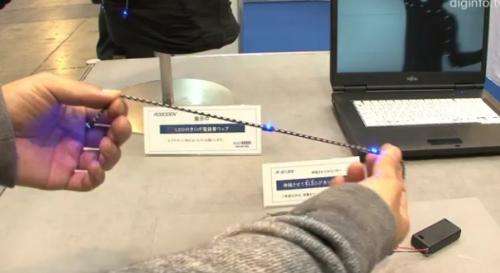
The Roboden elastic cable was originally designed for wiring robots' skin. Image credit: DigInfo News

(PhysOrg.com) -- Japanese company Asahi Kasei Fibers, which manufactures spandex and other textiles, has applied its knowledge of stretchable materials to make stretchable elastic power and USB cables.

Researchers at Asahi Kasei originally designed the elastic cable material, called Roboden, for wiring the soft, flexible skin of . As the researchers explain, can stretch by a factor of 1.5, the same as the new cable. As a result, the wiring can stretch with the robots’ movements, such as twisting and turning, without losing its ability to transfer power and data.

This video is not supported by your browser at this time.

Shunji Tatsumi of Asahi Kasei Fibers talks about Roboden at the International Robot Exhibition 2011. Video credit: DigInfo News

In the form of power and USB cords, the elastic cables could prove useful for minimizing cord clutter in homes and offices. The cable material is made of an outer elastic shell with spiraled internal wiring that unspirals when pulled.

Another application of the elastic cables could be wearable electronics - possibly for health-monitoring materials, wearable solar panels, and futuristic electronic clothing fashions.

More information: via: DigInfo News

© 2011 PhysOrg.com

Filter


Move the slider to adjust rank threshold, so that you can hide some of the comments.


Display comments: newest first

Blakut
Dec 02, 2011

Rank: 3.3 / 5 (3)
How long does this keep its elasticity? After how many stretch cycles does it become useless? And what happens if you "over" stretch it? Does it keep its conductive properties, or does it just snap?
Bowler_4007
Dec 02, 2011

Rank: 1.5 / 5 (2)
did you read the article or skip straight to commenting? the conductive material is wound into a helix therefore it is only the insulation that it is strechable
Valentiinro
Dec 02, 2011

Rank: 3.3 / 5 (3)
did you read the article or skip straight to commenting? the conductive material is wound into a helix therefore it is only the insulation that it is strechable


The coil of wire inside the insulation is essentially a spring. Springs can get stretched out, and can wear out and snap with age. Blakut had some valid concerns. I hypothesize that if you over stretch a material as described in the article it would stay "stretched".
Norezar
Dec 02, 2011

Rank: 5 / 5 (1)
Truly clean computer cabling possible?

Do want.
Nerdyguy
Dec 02, 2011

Rank: 1 / 5 (8)
Very cool stuff. I wonder if the useable life of these cables is comparable to traditional cabling? It would seem there'd have to be a tradeoff between the durability and the elasticity. But, until someone figures out how to Tesla-ize everything, this would very versatile stuff.
Bowler_4007
Dec 02, 2011

Rank: 1 / 5 (1)
did you read the article or skip straight to commenting? the conductive material is wound into a helix therefore it is only the insulation that it is strechable


The coil of wire inside the insulation is essentially a spring. Springs can get stretched out, and can wear out and snap with age. Blakut had some valid concerns. I hypothesize that if you over stretch a material as described in the article it would stay "stretched".

it says spiraled but it does not say sprung therefore it is a fair assumption that it is not sprung
stealthc
Dec 02, 2011

Rank: 1 / 5 (2)
I could have made this with materials from less-emf. Plus it is terribly thick isn't it? I don't like it, we can do much better than this.
Alburton
Dec 02, 2011

Rank: 2 / 5 (1)
A helix of metal cannot be sprung.
You would do that to a mattress,and you do it by filling it with such helixes, called springs,made of metal because its elastic.
However,the elasticity of the metallic object depends on its form: length and thickness.
k as in "Force=k*distance" is k=A*E/L ;A for Area,L for Length and E being a descriptive constant of each metal)
A helix is a usual form of springs because it is a good way to have a lot of length in a small room.


If you want to know more about the nature of its ellasticity search for "metallic bond" or ask your nearest chemistry teacher.

If you want to know more about how stuff breaks look up Mechanics of Materials.Quite a hard science i would say.

I Hope to have been helpful
Nerdyguy
Dec 03, 2011

Rank: 1 / 5 (6)
Very cool stuff. I wonder if the useable life of these cables is comparable to traditional cabling? It would seem there'd have to be a tradeoff between the durability and the elasticity. But, until someone figures out how to Tesla-ize everything, this would very versatile stuff.


Too funny. The robo-ranking gangsters strike again. 5 "1" votes by the same guy, because I once said something that got his feathers ruffled. wow. PhysOrg should just do away with this voting system and let these retards get back to doing whatever the hell else they do in their spare time.
Nerdyguy
Dec 03, 2011

Rank: 1 / 5 (6)
SPANDEX: WHEN YOU WANT YOUR CABLE TO LOOK AS SEXY AS IT IS POWERFUL!
S_Bilderback
Dec 03, 2011

Rank: not rated yet
I could have made this with materials from less-emf. Plus it is terribly thick isn't it? I don't like it, we can do much better than this.

Then go ahead!

If it turns out to be a durable, useful product it will be down to the nano scale in no time.
Sonhouse
Dec 03, 2011

Rank: not rated yet
Here is one kicker: If like they said, it is a spring inside stretchy stuff, there will be a problem using it for communications except at low frequencies: If it is a spiral, it is an inductor. The higher the frequency you try to stuff down that wire, the more impedance it will encounter. Impedence is like resistance for ac. There won't be much you can do about that. The longer the wire, the more inductance, so there will be a strict limit on how long a wire you can use vs the highest frequency you can shove down the wire and expect a signal at the other end.
Alburton
Dec 03, 2011

Rank: not rated yet
Not necessarily Sonhouse,the impedance of such a thing would be negligible for usual frequencies,plus you could always put two one on top of the other spinning opposite ways.
BillFox
Dec 03, 2011

Rank: not rated yet
A helix of metal cannot be sprung.
You would do that to a mattress,and you do it by filling it with such helixes, called springs,made of metal because its elastic.
However,the elasticity of the metallic object depends on its form: length and thickness.
k as in "Force=k*distance" is k=A*E/L ;A for Area,L for Length and E being a descriptive constant of each metal)
A helix is a usual form of springs because it is a good way to have a lot of length in a small room.


If you want to know more about the nature of its ellasticity search for "metallic bond" or ask your nearest chemistry teacher.

If you want to know more about how stuff breaks look up Mechanics of Materials.Quite a hard science i would say.

I Hope to have been helpful


More asinine than helpful
Sonhouse
Dec 03, 2011

Rank: not rated yet
Not necessarily Sonhouse,the impedance of such a thing would be negligible for usual frequencies,plus you could always put two one on top of the other spinning opposite ways.

Let's define 'usual frequencies': Audio, 20hz to 20Khz, I agree, there wouldn't be much impedence in those wires, but 20Mhz and up, which we use for routers, cable TV, internet, and wireless at 900 megs, you are going to find those wires have a lot of inductive losses.

It would be interesting to have say, one meter of the stuff, and hook it up to an LCR meter.
Nik_2213
Dec 04, 2011

Rank: 4 / 5 (1)
Provided the internal wiring stays below eg USB 2.0's length limit, there should be no problem. Don't forget that phone hand-sets and keyboards have used 'curly' cables for a long time...
Jimbaloid
Dec 05, 2011

Rank: not rated yet
Spiralled internal wiring adds length to the amount of wire needed to manufacture it - an extra 50% (minimum) over resting length. Even if most use resulted in the median extension of 1.25, that is still 25% more cost. It also makes the cables thicker and different lengths are still needed to get things tidy. Looser connections might keep pulling out, hopefully not recoiling too quickly when they do. 'My USB hub keeps falling down and my mouse keeps drifting up the desk by itself!' :-)

Personally I don't expect to see this outside of some specialist and premium situations.
Rank 5 /5 (6 votes)
Relevant PhysicsForums posts

More news stories

Browser wars flare in mobile space

The browser wars are heating up again, but this time the fight is for dominance of the mobile Internet.

Technology / Software

created 15 hours ago | popularity 5 / 5 (2) | comments 3

Probability of contamination from severe nuclear reactor accidents is higher than expected: study

Catastrophic nuclear accidents such as the core meltdowns in Chernobyl and Fukushima are more likely to happen than previously assumed. Based on the operating hours of all civil nuclear reactors and the number ...

Technology / Energy & Green Tech

created May 22, 2012 | popularity 3.6 / 5 (25) | comments 56 | with audio podcast

HyperSolar shows dirty water no barrier to power world

(Phys.org) -- The Santa Barbara, California, company, HyperSolar, is set to transparently share the ups and downs of its research experiences toward the company’s ultimate vision, successfully producing ...

Technology / Energy & Green Tech

created May 24, 2012 | popularity 4.8 / 5 (16) | comments 17 | with audio podcast report

SpotterRF debuts Radar Backpack Kit (w/ Video)

(Phys.org) -- SpotterRF has announced a special radar backpack kit designed to enhance situational awareness for soldiers on the ground. The company says its special radar is designed for warfighters as part ...

Technology / Hi Tech & Innovation

created May 26, 2012 | popularity 5 / 5 (5) | comments 13 | with audio podcast report

Tesla to launch electric sedan in US on June 22

Tesla Motors said Tuesday it would begin deliveries of "the world's first premium electric sedan" on June 22, slightly ahead of schedule.

Technology / Energy & Green Tech

created May 22, 2012 | popularity 4.5 / 5 (12) | comments 18


Stunning image of smallest possible five-ringed structure

Scientists have created and imaged the smallest possible five-ringed structure – about 100,000 times thinner than a human hair – and you'll probably recognise its shape.

'Unzipped' carbon nanotubes could help energize fuel cells, batteries

Multi-walled carbon nanotubes riddled with defects and impurities on the outside could replace some of the expensive platinum catalysts used in fuel cells and metal-air batteries, according to scientists at ...

Change in developmental timing was crucial in the evolutionary shift from dinosaurs to birds: study

At first glance, it's hard to see how a common house sparrow and a Tyrannosaurus Rex might have anything in common. After all, one is a bird that weighs less than an ounce, and the other is a dinosaur that ...

Computer model used to pinpoint prime materials for efficient carbon capture

When power plants begin capturing their carbon emissions to reduce greenhouse gases – and to most in the electric power industry, it's a question of when, not if – it will be an expensive undertaking.

T cells 'hunt' parasites like animal predators seek prey, study shows

By pairing an intimate knowledge of immune-system function with a deep understanding of statistical physics, a cross-disciplinary team at the University of Pennsylvania has arrived at a surprising finding: T cells use a movement ...

Land and sea species differ in climate change response: study

(Phys.org) -- Marine and terrestrial species will likely differ in their responses to climate warming, new research by Simon Fraser University and Australia’s University of Tasmania has found.