Shell deploys ships to clean oil spill off Nigeria

December 22, 2011

Production has halted at Shell's Bonga field in Nigeria

Enlarge

Shell is deploying ships and mobilising planes on Thursday to clean up an oil spill at a major field off Nigeria, the company says, with some 40,000 barrels estimated to have leaked into the sea.

Shell is deploying ships and mobilising planes on Thursday to clean up an oil spill at a major field off Nigeria, the company says, with some 40,000 barrels estimated to have leaked into the sea.

The leak that began Tuesday has been stopped, according to Shell, and dispersants are being deployed to clean up the crude spilled at the field some 120 kilometres off Nigeria, Africa's largest producer and an OPEC member.

Production has halted at Shell's Bonga field, which has a capacity of 200,000 barrels per day, due to the spill.

Shell has said "less than 40,000 barrels" leaked, while Nigerian authorities could not immediately be reached for comment.
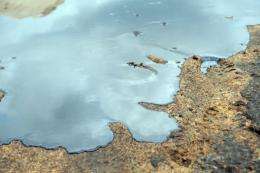
Scores of oil spills have occurred in Nigeria
Enlarge

Spilled crude oil floats on the banks of the Niger Delta. Shell is deploying ships and mobilising planes on Thursday to clean up an oil spill at a major field off Nigeria, the company says, with some 40,000 barrels estimated to have leaked into the sea.

The company claimed on Thursday that "up to 50 percent of the leaked oil has already dissipated due to natural dispersion and ," but that figure was impossible to verify independently.

"To accelerate the clean-up at sea, we are deploying vessels with to break up the oil sheen at sea," Shell Nigeria head Mutiu Sunmonu said in a statement.

"We are mobilising that will support the vessels in this operation. We are deploying infra-red equipment to be able to trace the few areas where the sheen may be thicker. That allows for a targeted use of the dispersant.

"Let me also mention that we are currently working with the Nigerian government to inform local communities and fishermen about the situation."

Shell said the leak occurred on Tuesday during a transfer of crude to a waiting tanker.

The likely source of the leak was an export line linking a production vessel to the tanker, Shell said. The line has been closed and de-pressurised, halting the flow of oil, it said.

Nigeria has been producing between 2.0 and 2.4 million barrels per day in recent months. Scores of have occurred in Nigeria, but most have been at onshore sites and their size has often been disputed.

(c) 2011 AFP


Rank not rated yet
Relevant PhysicsForums posts

More news stories

Land and sea species differ in climate change response: study

(Phys.org) -- Marine and terrestrial species will likely differ in their responses to climate warming, new research by Simon Fraser University and Australia’s University of Tasmania has found.

Space & Earth / Environment

created 3 hours ago | popularity 3.7 / 5 (3) | comments 3 | with audio podcast

Yale study concludes public apathy over climate change unrelated to science literacy

Are members of the public divided about climate change because they don't understand the science behind it? If Americans knew more basic science and were more proficient in technical reasoning, would public consensus match ...

Space & Earth / Environment

created 5 hours ago | popularity 4.8 / 5 (4) | comments 11 | with audio podcast

10 million years needed to recover from mass extinction

It took some 10 million years for Earth to recover from the greatest mass extinction of all time, latest research has revealed.

Space & Earth / Earth Sciences

created 5 hours ago | popularity 5 / 5 (3) | comments 1 | with audio podcast

Sophisticated simulations predict future warming

The chances of our planet being hit by a global warming of 3 degrees Celsius by 2050 is as likely as it being hit by an increase of 1.4 degrees, new research shows. Presented in the journal Nature Geoscience, the British study ...

Space & Earth / Earth Sciences

created May 22, 2012 | popularity 4.4 / 5 (9) | comments 51

Aliens don't want to eat us, says former SETI director

Alien life probably isn’t interested in having us for dinner, enslaving us or laying eggs in our bellies, according to a recent statement by former SETI director Jill Tarter.

Space & Earth / Space Exploration

created May 25, 2012 | popularity 4.4 / 5 (14) | comments 41


'Unzipped' carbon nanotubes could help energize fuel cells, batteries

Multi-walled carbon nanotubes riddled with defects and impurities on the outside could replace some of the expensive platinum catalysts used in fuel cells and metal-air batteries, according to scientists at ...

Change in developmental timing was crucial in the evolutionary shift from dinosaurs to birds: study

At first glance, it's hard to see how a common house sparrow and a Tyrannosaurus Rex might have anything in common. After all, one is a bird that weighs less than an ounce, and the other is a dinosaur that ...

Computer model used to pinpoint prime materials for efficient carbon capture

When power plants begin capturing their carbon emissions to reduce greenhouse gases – and to most in the electric power industry, it's a question of when, not if – it will be an expensive undertaking.

T cells 'hunt' parasites like animal predators seek prey, study shows

By pairing an intimate knowledge of immune-system function with a deep understanding of statistical physics, a cross-disciplinary team at the University of Pennsylvania has arrived at a surprising finding: T cells use a movement ...

Scientists develop ultra-sensitive test that detects diseases in their earliest stages

Scientists have developed an ultra-sensitive test that should enable them to detect signs of a disease in its earliest stages, in research published today in the journal Nature Materials.

Manufacturing genes to attack flu virus

An international research team has manufactured a new protein that can combat deadly flu epidemics.