Long sexual duration could be period of male choice
December 9, 2011

Long sexual duration could be period of male choice

Enlarge

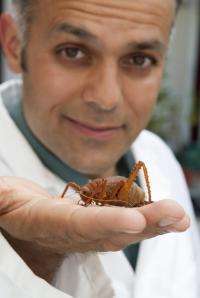
Dr. Karim Vahed with cricket

(PhysOrg.com) -- The duration of sexual intercourse differs wildly across the animal kingdom. Now researchers seeking to understand the evolutionary significance of lengthy copulation duration have found evidence that it could signify a choosy male taking the time to assess the suitability of his female mate.

Dr. Karim Vahed from the University of Derby, and colleagues Dr. James Gilbert from the University of Cambridge; and Dr. Arne Lehmann from Stahnsdorf, and Professor Gerlind Lehmann from Humbolt University Berlin, Germany; carried out a study into the mating patterns of 54 different species of bush crickets (tettigoniids), recording and comparing a number of factors.

Male body mass, the duration of copulation (measured from the time the male establishes a firm grip on the female until the moment male ejaculate becomes visible) and the total quantity of male ejaculate (spermatophore mass) were established for each of the 54 species and compared for significant patterns. The results of the study have been published in the Journal of Evolutionary Biology (volume 24, pages 1960-1968).

Lead researcher Dr. Vahed, Programme Leader on the Masters degree (MSc) in at the University of Derby, said: "Animals differ vastly in the nature of their sexual interactions and you see just as much variety between species of bush cricket. In the 54 species we investigated we discovered considerable variation between species in copulation duration from eight seconds to 104 minutes, for example. We wanted to discover the possible causes of this variation, and so compared copulation duration to other factors.
Long sexual duration could be period of male choice
Enlarge

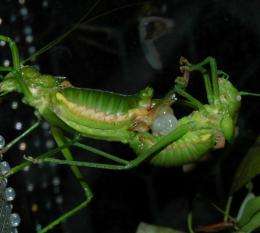
A mating pair

"We discovered that copulation duration was linked to the mass of the spermatophore the male transferred to the female cricket. with long copulation durations were more likely to transfer a large spermatophore."

A large spermatophore is costly for the male to produce and limits the potential number of times the male can mate. It could be suggested therefore that species which transfer a large spermatophore mass are particularly selective when it comes to finding a female mate.
Long sexual duration could be period of male choice
Enlarge

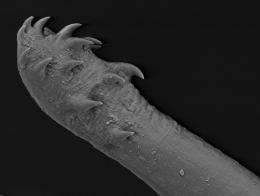
A male bush cricket's titillator

"As we found this mass was linked to a long copulation duration, it could be reasoned that the duration of sexual activity prior to transfer may play a role in mate assessment. It's most likely that the male is assessing the female during this period as they are most in control of the duration of copulation, although we cannot rule out the possibility of female mate selection either."

The research team also investigated an intriguing aspect of bush crickets' sexual interaction - the presence and complexity of structures on male sexual organs know as titillators. Titillators are inserted into the female's genital chamber and move rhythmically with contractions of the male.

Karim said: "On comparing the presence or complexity of titillators to the other variables in our study we found that copulation duration was longer in with titillators than without. This link between long copulation duration, large spermatophore mass and the presence of titillators suggests that titillators may either have a role in mate assessment or ensuring the female chooses to accept the male's ejaculate."

The study, led by Dr. Vahed, follows on from the team's discovery, published in Biology Letters in November 2010, that found the Tuberous Bushcricket (Platycleis affinis) has the largest testes (in relation to body weight) of any male in the animal kingdom, weighing in at 14% of the male body mass.

Provided by University of Derby

4.3 /5 (4 votes)  

Filter


Move the slider to adjust rank threshold, so that you can hide some of the comments.


Display comments: newest first

Isaacsname
Dec 09, 2011

Rank: 5 / 5 (3)
" The research team also investigated an intriguing aspect of bush crickets' sexual interaction - the presence and complexity of structures on male sexual organs know as titillators. Titillators are inserted into the female's genital chamber and move rhythmically with contractions of the male. "

I had no clue they were so kinky o,O

..dammit, now I'll never be able to listen to the crickets without thinking about this..
Tausch
Dec 09, 2011

Rank: not rated yet
To which of the living forms depicted in the picture with the the caption, "Dr. Karim Vahed with cricket" and the articles' title "Long sexual duration could be period of male choice" refer to?
Isaacsname
Dec 09, 2011

Rank: not rated yet
I wonder if this was tested at different temperatures ? I know you can roughly estimate the ambient temperature by counting cricket chirps.

The frequency of chirping varies according to temperature. To get a rough estimate of the temperature in degrees fahrenheit, count the number of chirps in 15 seconds and then add 37.

Maybe there is some dependance on temperatures too ? It might take longer to get " The deed " done in colder temps ?
Skepticus
Dec 09, 2011

Rank: not rated yet
Tuberous Bushcricket (Platycleis affinis) has the largest testes (in relation to body weight) of any male in the animal kingdom, weighing in at 14% of the male body mass.

The crickets need a Kama Sutra of their own. Some humans males can do it a lot longer than 100 minutes, and i doubt that their balls are 14% of body weight! :-D
Rank 4.3 /5 (4 votes)
Relevant PhysicsForums posts

More news stories

Manufacturing genes to attack flu virus

An international research team has manufactured a new protein that can combat deadly flu epidemics.

Biology / Biotechnology

created 5 hours ago | popularity not rated yet | comments 0 | with audio podcast

Scientist: Evolution debate will soon be history

(AP) -- Richard Leakey predicts skepticism over evolution will soon be history. Not that the avowed atheist has any doubts himself.

Biology / Evolution

created May 26, 2012 | popularity 3.5 / 5 (20) | comments 88

More plant species responding to global warming than previously thought

(Phys.org) -- Far more wild plant species may be responding to global warming than previous large-scale estimates have suggested.

Biology / Ecology

created May 22, 2012 | popularity 4.6 / 5 (14) | comments 18 | with audio podcast

For monogamous sparrows, it doesn't pay to stray (but they do it anyway)

It's quite common for a female song sparrow to stray from her breeding partner and mate with the male next door, but a new study shows that sleeping around can be costly.

Biology / Plants & Animals

created May 22, 2012 | popularity 5 / 5 (2) | comments 8 | with audio podcast

Thousands of shellfish found dead in Peru

Thousands of crustaceans were found dead off the coast of Lima following the mystery mass death of dolphins and pelicans, the Peruvian Navy said Friday.

Biology / Ecology

created May 26, 2012 | popularity 4.7 / 5 (7) | comments 7


'Unzipped' carbon nanotubes could help energize fuel cells, batteries

Multi-walled carbon nanotubes riddled with defects and impurities on the outside could replace some of the expensive platinum catalysts used in fuel cells and metal-air batteries, according to scientists at ...

Change in developmental timing was crucial in the evolutionary shift from dinosaurs to birds: study

At first glance, it's hard to see how a common house sparrow and a Tyrannosaurus Rex might have anything in common. After all, one is a bird that weighs less than an ounce, and the other is a dinosaur that ...

Computer model used to pinpoint prime materials for efficient carbon capture

When power plants begin capturing their carbon emissions to reduce greenhouse gases – and to most in the electric power industry, it's a question of when, not if – it will be an expensive undertaking.

T cells 'hunt' parasites like animal predators seek prey, study shows

By pairing an intimate knowledge of immune-system function with a deep understanding of statistical physics, a cross-disciplinary team at the University of Pennsylvania has arrived at a surprising finding: T cells use a movement ...

Land and sea species differ in climate change response: study

(Phys.org) -- Marine and terrestrial species will likely differ in their responses to climate warming, new research by Simon Fraser University and Australia’s University of Tasmania has found.

Yale study concludes public apathy over climate change unrelated to science literacy

Are members of the public divided about climate change because they don't understand the science behind it? If Americans knew more basic science and were more proficient in technical reasoning, would public consensus match ...