Quadrantid meteors set to perform on January 4th
December 31, 2011

Quadrantid meteors set to perform on January 4th

Enlarge

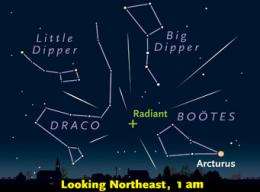
Not until early morning does the radiant of the Quadrantid meteor shower start to rise high — and don’t expect to see several at once! Sky & Telescope illustration

Celestially speaking, 2012 opens with a bang. The Quadrantid meteor shower, one of the best displays of "shooting stars" all year, will peak in the hours before dawn this Wednesday, January 4th. If you get up early, bundle up warmly, and find dark site with a wide-open view of the clear sky, you might see 1 or 2 meteors per minute during the shower's brief but intense performance.

This year the Quadrantids are predicted to climax at 2 or 3 a.m. Eastern Standard Time on the morning of January 4th, and this timing offers very good circumstances for North Americans — especially those in the East. On that morning the waxing gibbous Moon sets about 3 a.m. local time (wherever you are), leaving the fully dark until dawn begins before or near 6 a.m.

Veteran skywatchers know that the "Quads" rival August's better-known Perseids as an impressive — but not many people have ever seen even one of them flashing across the sky. The Quadrantids have two problems, explains Alan MacRobert, a senior editor at Sky & Telescope magazine. First, the shower is brief. Peak activity usually lasts just a few hours, and if that brief interval doesn’t fall between midnight and dawn for your part of the world, you lose out. The second problem is that you have to be watching the sky in the night’s coldest hours during the year’s coldest time.

"So make it an adventure," advises MacRobert. "Plan like for an expedition." You'll want to view from a light-free location with a wide-open sky view. Lie back in a reclining chair or on the ground. You won't be generating much body heat, so stay snug in many layers from head to feet. Hand-warmer packets or an electric heating pad buttoned inside your coat will help (if you can run an extension cord back to the house). Be patient, and keep watch on whatever part of your sky is darkest — probably straight overhead.

A meteor shower occurs when Earth passes through the stream of little debris bits that are strewn along the orbit of a comet. When these strike Earth's upper atmosphere, the resulting meteors can zip across any part of the sky. But trace their paths backward far enough, and you'll see that they all seem to stream from a point, called the radiant, in a particular constellation. For example, the Perseid meteors appear to radiate from Perseus.

The Quadrantids are named for the obsolete constellation Quadrans Muralis, the Mural Quadrant, an antique device that was used for measuring celestial objects' positions. It was located in a dim region about halfway from the end of the Big Dipper’s handle to the head of Draco. Quadrans was still widely recognized when its namesake meteor shower was first identified in 1825, but it didn't make the cut when the International Astronomical Union set today's official list of 88 constellations in 1930.

The source of the Quadrantids is not a comet but rather an asteroid called 2003 EH1. Dynamicists suspect it is a dead chunk of a comet that broke apart several centuries ago, and that the meteors are small bits of debris from this fragmentation.

After the Quads come and go, there won't be another significant meteor shower until the Lyrids arrive in late April, or perhaps not until the Perseids of mid-August . The autumn months are richer in .

Provided by Sky & Telescope

4.5 /5 (2 votes)  

Filter


Move the slider to adjust rank threshold, so that you can hide some of the comments.


Display comments: newest first

Xbw
Jan 03, 2012

Rank: 1 / 5 (1)
For me, an "intense performance" would be something more in the range of 120 meteors a minute. :)

Reaching for the stars on that one I know.
Rank 4.5 /5 (2 votes)
Relevant PhysicsForums posts
  • Distance of planets from stars and revolution
    created5 hours ago
  • revamping general concept and cosmological principle
    createdMay 25, 2012
  • Transiting Exoplanet Light Curve
    createdMay 25, 2012
  • Math behind Theoretical Physics
    createdMay 24, 2012
  • Do we know whats at the center of galaxies yet?
    createdMay 23, 2012
  • Structure of the Milky Way?
    createdMay 20, 2012
  • More from Physics Forums - General Astronomy

More news stories

Land and sea species differ in climate change response: study

(Phys.org) -- Marine and terrestrial species will likely differ in their responses to climate warming, new research by Simon Fraser University and Australia’s University of Tasmania has found.

Space & Earth / Environment

created 3 hours ago | popularity 3.7 / 5 (3) | comments 3 | with audio podcast

Yale study concludes public apathy over climate change unrelated to science literacy

Are members of the public divided about climate change because they don't understand the science behind it? If Americans knew more basic science and were more proficient in technical reasoning, would public consensus match ...

Space & Earth / Environment

created 5 hours ago | popularity 4.8 / 5 (4) | comments 11 | with audio podcast

10 million years needed to recover from mass extinction

It took some 10 million years for Earth to recover from the greatest mass extinction of all time, latest research has revealed.

Space & Earth / Earth Sciences

created 5 hours ago | popularity 5 / 5 (3) | comments 1 | with audio podcast

Sophisticated simulations predict future warming

The chances of our planet being hit by a global warming of 3 degrees Celsius by 2050 is as likely as it being hit by an increase of 1.4 degrees, new research shows. Presented in the journal Nature Geoscience, the British study ...

Space & Earth / Earth Sciences

created May 22, 2012 | popularity 4.4 / 5 (9) | comments 51

Aliens don't want to eat us, says former SETI director

Alien life probably isn’t interested in having us for dinner, enslaving us or laying eggs in our bellies, according to a recent statement by former SETI director Jill Tarter.

Space & Earth / Space Exploration

created May 25, 2012 | popularity 4.4 / 5 (14) | comments 41


'Unzipped' carbon nanotubes could help energize fuel cells, batteries

Multi-walled carbon nanotubes riddled with defects and impurities on the outside could replace some of the expensive platinum catalysts used in fuel cells and metal-air batteries, according to scientists at ...

Change in developmental timing was crucial in the evolutionary shift from dinosaurs to birds: study

At first glance, it's hard to see how a common house sparrow and a Tyrannosaurus Rex might have anything in common. After all, one is a bird that weighs less than an ounce, and the other is a dinosaur that ...

Computer model used to pinpoint prime materials for efficient carbon capture

When power plants begin capturing their carbon emissions to reduce greenhouse gases – and to most in the electric power industry, it's a question of when, not if – it will be an expensive undertaking.

T cells 'hunt' parasites like animal predators seek prey, study shows

By pairing an intimate knowledge of immune-system function with a deep understanding of statistical physics, a cross-disciplinary team at the University of Pennsylvania has arrived at a surprising finding: T cells use a movement ...

Scientists develop ultra-sensitive test that detects diseases in their earliest stages

Scientists have developed an ultra-sensitive test that should enable them to detect signs of a disease in its earliest stages, in research published today in the journal Nature Materials.

Manufacturing genes to attack flu virus

An international research team has manufactured a new protein that can combat deadly flu epidemics.