NORAD and satellite technology help Santa deliver
December 22, 2011 By Thomas Wrublewski
NORAD Tracks Santa. Credit: NORAD
(PhysOrg.com) -- According to the U.S. Department of Commerce Census Bureau, the world's population is approximately 7 billion (6,979,978,073+) people. Santa Claus has had to adapt over the years to having less and less time to deliver gifts to more people. To better assure prompt deliveries and safe flights, higher technology systems are increasingly being used by the United States Northern Command at Peterson Air Force Base, Colo., to support the North American Aerospace Defense Command (NORAD).
NORAD is a joint United States and Canadian organization which provides aerospace warning and control. The United States Air Force (USAF) uses ground based radars, National Oceanic and Atmospheric Administration (NOAA) operational satellites provided by NASA Goddard Space Flight Center, as well as Santa Cams, Google maps, and jet fighter aircraft.
Global Positioning System (GPS) satellite information and carefully timed gravity assists from the sun, moon, and/or Earth are used to speed Santa's sleigh faster and more precisely than ever before.
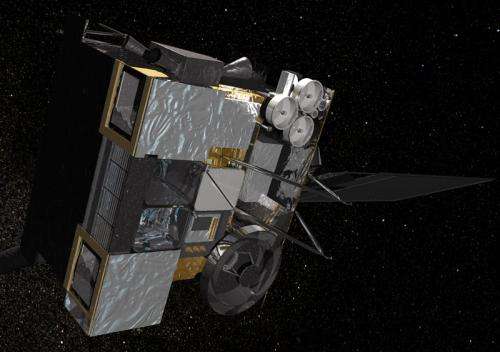
Artist's concept of GOES-15 in orbit being used to help track Santa. Credit: NASA/Honeywell Tech Solutions, C. Meaney
Multi-variable numerical modeling improvements in the solar wind, auroras, geomagnetic force fields, and space/Earth weather predictions are also being credited for important improved sleigh routing efficiencies. Rudolph (the red-nosed lead reindeer) provides a great infrared (warm) signature for the satellite instruments to focus on. The satellite data indicates where fog is and Rudolph can take over the reins from Santa as they use microwave data to know where the rain, snow, and ice are for those precise landing adjustments.From 22,300 miles in space, NORAD will use for the first time the GOES-15 (covers the U.S. west coast and Pacific Ocean areas) significantly improved Earth location accuracy and heat detection infrared equipment from various satellites. Rudolph's nose gives off an infrared signature similar to a small missile launch and satellites can detect Rudolph's bright red nose very precisely.
NOAA, NASA, and the USAF have satellites expertly positioned and additional volunteers are supporting the improved Santa tracking beginning after sundown on Christmas Eve December 24. Near "real time" public updates of progress should be available from the web site http://www.noradsanta.org/ NORAD Santa and thanks to worldwide corporate and international support updates will be provided in eight languages.
NASA is in the process of checking out the new NPOESS Preparatory Project (NPP) satellite, launched in October. NPP will provide even more precise and more timely updates of weather information in the years ahead so Santa and his reindeer team can safely deliver more and more presents in all weather conditions in one night!
To track Santa using NORAD, visit: http://www.noradsanta.org
Provided by
JPL/NASA
-
From lemons to lemonade: Reaction uses carbon dioxide to make carbon-based semiconductor,
32 comments
-
Thioridazine kills cancer stem cells in human while avoiding toxic side-effects of conventional cancer treatments,
3 comments
-
SpaceX private rocket blasts off for space station (Update),
42 comments
-
Climate scientists say they have solved riddle of rising sea,
31 comments
-
SpaceX capsule has 'new car' smell, astronauts say (Update),
4 comments
-
Distance of planets from stars and revolution
5 hours ago
-
revamping general concept and cosmological principle
May 25, 2012
-
Transiting Exoplanet Light Curve
May 25, 2012
-
Math behind Theoretical Physics
May 24, 2012
-
Do we know whats at the center of galaxies yet?
May 23, 2012
-
Structure of the Milky Way?
May 20, 2012
- More from Physics Forums - General Astronomy
More news stories
Land and sea species differ in climate change response: study
(Phys.org) -- Marine and terrestrial species will likely differ in their responses to climate warming, new research by Simon Fraser University and Australia’s University of Tasmania has found.
3 hours ago |
3.7 / 5 (3) |
3
|
Yale study concludes public apathy over climate change unrelated to science literacy
Are members of the public divided about climate change because they don't understand the science behind it? If Americans knew more basic science and were more proficient in technical reasoning, would public consensus match ...
5 hours ago |
4.8 / 5 (4) |
11
|
10 million years needed to recover from mass extinction
It took some 10 million years for Earth to recover from the greatest mass extinction of all time, latest research has revealed.
Space & Earth / Earth Sciences
5 hours ago |
5 / 5 (3) |
1
|
Sophisticated simulations predict future warming
The chances of our planet being hit by a global warming of 3 degrees Celsius by 2050 is as likely as it being hit by an increase of 1.4 degrees, new research shows. Presented in the journal Nature Geoscience, the British study ...
Space & Earth / Earth Sciences
May 22, 2012 |
4.4 / 5 (9) |
51
Aliens don't want to eat us, says former SETI director
Alien life probably isnt interested in having us for dinner, enslaving us or laying eggs in our bellies, according to a recent statement by former SETI director Jill Tarter.
Space & Earth / Space Exploration
May 25, 2012 |
4.4 / 5 (14) |
41
'Unzipped' carbon nanotubes could help energize fuel cells, batteries
Multi-walled carbon nanotubes riddled with defects and impurities on the outside could replace some of the expensive platinum catalysts used in fuel cells and metal-air batteries, according to scientists at ...
Change in developmental timing was crucial in the evolutionary shift from dinosaurs to birds: study
At first glance, it's hard to see how a common house sparrow and a Tyrannosaurus Rex might have anything in common. After all, one is a bird that weighs less than an ounce, and the other is a dinosaur that ...
Computer model used to pinpoint prime materials for efficient carbon capture
When power plants begin capturing their carbon emissions to reduce greenhouse gases and to most in the electric power industry, it's a question of when, not if it will be an expensive undertaking.
T cells 'hunt' parasites like animal predators seek prey, study shows
By pairing an intimate knowledge of immune-system function with a deep understanding of statistical physics, a cross-disciplinary team at the University of Pennsylvania has arrived at a surprising finding: T cells use a movement ...
Scientists develop ultra-sensitive test that detects diseases in their earliest stages
Scientists have developed an ultra-sensitive test that should enable them to detect signs of a disease in its earliest stages, in research published today in the journal Nature Materials.
Manufacturing genes to attack flu virus
An international research team has manufactured a new protein that can combat deadly flu epidemics.

Dec 22, 2011
Rank: 1 / 5 (2)
Dec 22, 2011
Rank: 2.5 / 5 (2)
Personally, my parents never taught me to believe in Santa as a child but I always liked the idea of him. Nothing offensive about giving. Or did you forget the Bible verse that states, "Give and it will come back to you." No you are too busy using God as a crutch for your self loathing and as an excuse to be angry about yet another thing.
Dec 22, 2011
Rank: not rated yet
Dec 23, 2011
Rank: not rated yet