NASA's first J-2X engine rockets through first round of testing; development continues strong
December 22, 2011 By Jennifer Stanfield

NASA's first J-2X engine rockets through first round of testing; development continues strong

Enlarge

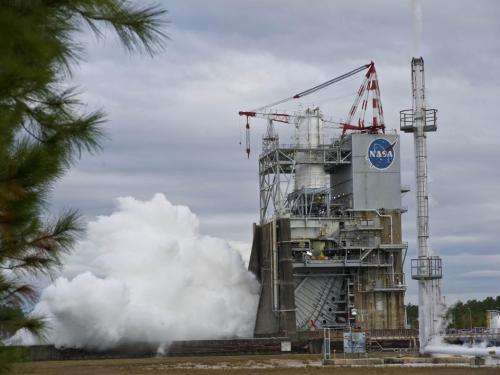
NASA conducted a successful J-2X 500-second test firing on Nov. 9 at the A-2 test stand at Stennis Space Center. Credit: NASA/SSC

(PhysOrg.com) -- The best tech gift for propulsion engineers at the Marshall Space Flight Center in Huntsville, Ala.? It's NASA's first new human-rated rocket engine to be developed in 40 years. The J-2X engine -- highly efficient and versatile -- is a key component of the Space Launch System's second stage and will propel the nation's new heavy-lift launch vehicle beyond low-Earth orbit.

Using advanced technology, engineering processes and design, engineers at and Pratt & Whitney Rocketdyne in Canoga Park, Calif., are setting new records in rocket engine development with the first J-2X engine unit, dubbed E10001. During 2011, E10001 rocketed through its first ten tests probing engine performance and accumulated a total hot-fire test run time of 1,040 seconds at NASA's Stennis Space Center in southern Mississippi.

"E10001 got to 100 percent power in just four tests and achieved a full flight-duration test of 500 seconds in its eighth test -- quicker than any other U.S. engine program in history," said Tom Byrd, J-2X engine lead in the SLS Liquid Engines Office. "That provides a tremendous cost savings to the Space Program. It also validates that our design is solid and allows us to move farther in engine development quicker."

In this first year of testing, the J-2X team focused on characterizing basic components' performance, understanding integrated engine system performance during prestart, start, full power operation and shutdown, as well as demonstrating full mission duration.

Today's propulsion engineers are like high-tech Santa elves churning out toys for Christmas Day: strategic and focused. New engineering processes, along with design, analysis and development advances gleaned from numerous previous programs, have provided the J-2X engine team with a solid foundation to design, build and test the engine.

For example, the first J-2X engine has demonstrated high initial quality through manufacturing and assembly. High initial quality avoids costly and time-consuming re-works and re-designs that have historically typified building large engines. "For the J-2X engine, we’ve brought together a great suite of analytical models for loads, tolerances, structural integrity and assembly sequence," said Byrd. "Truly, we had little to no surprises assembling the E10001 test engine -- the components fit together like a glove -- and proved this new way really works for designing an engine."

Modern engineering tools and processes also enable a considerably shorter, more focused test schedule, saving a great deal of cost and time. The J-2X is totally redesigned from the heritage J-2 engine that flew humans to the moon in the 1960's and 1970's. And yet, over the coming years, the J-2X engine test program will need only five percent the number of tests required to develop the original J-2 engine. That’s about 150 tests now versus about 3000 then. The engineers who successfully got humans to the moon years ago clearly knew what they were doing, but today's engineers are equipped with all sorts of modern engineering tools, processes and lessons from the past -- and the SLS Program is the beneficiary in terms of an affordable engine development test program.

Byrd noted that this year's testing wasn't all smooth sailing. For example, a seal in the J-2X main oxidizer valve cracked and had to be replaced. The crack occurred because post-test operations did not adequately purge out the propellants in the engine main injector, leading to a "pop" after some tests, which damaged the seal. No other engine parts were damaged. The "pop" was eliminated by extending the duration of a post-test injector purge, which takes longer to clear out the propellants in the test configuration on the ground than in space. This was a relatively simple fix and the J-2X test program continued on.

Looking ahead, the team is geared up to test the engine's powerpack: the gas generator, oxygen and fuel turbopumps and related ducting and valves. This testing series will push the various components to operate over a wide range of conditions to ensure part integrity, demonstrate margin and better understand how the turbopumps operate.

In addition, the team will add a nozzle extension to the E10001 engine and make associated test stand modifications to see how the engine will perform at simulated altitude conditions where the atmospheric pressure is lower than on the ground. The J-2X is the second stage engine for the SLS heavy lift vehicle, so it starts and runs at altitude during flight.

In summer 2012, a new engine -- E10002 -- will be assembled and tested followed by a third engine, E10003, in 2013. A fourth engine will be assembled and tested in 2014.

"We'll continue to learn as we test, making incremental improvements to the new fleet of engines powering humans to new destinations like the moon, Mars and beyond," Byrd added.

Like Santa's elves, Marshall's propulsion engineers are staying focused for the big day when the Space Launch System is ready for deep space. Their gift of a new U.S. advanced will be a gift for all mankind -- powering exploration to new destinations in our solar system, discovering the unknown and improving life on Earth.

More information: For more information on the J-2X engine, visit: http://www.nasa.go … x/index.html

Provided by JPL/NASA search and more info website

Filter


Move the slider to adjust rank threshold, so that you can hide some of the comments.


Display comments: newest first

Nanobanano
Dec 22, 2011

Rank: not rated yet
Being able to model everything ahead of time on a modern, multi-core super computer has it's advantages.
Husky
Dec 22, 2011

Rank: 3.3 / 5 (3)
Wouldn't it be better if they use their current tight budget to focus on the scientific payload and buy the faretickets from SpaceX ?
_nigmatic10
Dec 22, 2011

Rank: not rated yet
Wouldn't it be better if they use their current tight budget to focus on the scientific payload and buy the faretickets from SpaceX ?


Not if spacex buys first.
LKD
Dec 22, 2011

Rank: not rated yet
I'm curious, if someone can explain, why they are building 1 engine a year? Instead of say; developing a single engine then building 10 of them once all the kinks are cleared up.
Nanobanano
Dec 22, 2011

Rank: 4.3 / 5 (3)
I'm curious, if someone can explain, why they are building 1 engine a year? Instead of say; developing a single engine then building 10 of them once all the kinks are cleared up.


This is still prototyping.

I don't guess you'd make 10 of something this expensive until you know the new model works.

The paragraph below the one you are refering to "incremental improvements".

Making 10 copies of each "incremental improvement" before all the kinks are out would then be 10 times as expensive...

Unlike software, you can't "patch" an engine design once you have it made. Well, not easily anyway. If you need a change to any component that is going to significantly change it's shape, length, or width, then it probably won't fit back where it belongs, which means you'll need to re-design the entire system from scratch.

Ok, hopefully it's not quite that bad, but you get the idea. This isn't Star Trek. You can't just make everything work in 30 minutes like LaForge does...
Sonhouse
Dec 22, 2011

Rank: 5 / 5 (4)
Wouldn't it be better if they use their current tight budget to focus on the scientific payload and buy the faretickets from SpaceX ?

The engine the Marshall people are developing are way way more powerful than anything from SpaceX, a true heavy lifter like Apollo's Saturn but more efficient, cheaper and more reliable.
ShotmanMaslo
Dec 22, 2011

Rank: 3.7 / 5 (3)
Wouldn't it be better if they use their current tight budget to focus on the scientific payload and buy the faretickets from SpaceX ?


Yes, it would. Current rockets are chronically underused anyway.

Its not done because US space program is headed by politicians and lobbyists, not actually competent rocket scientists and economists.. :(
dschlink
Dec 22, 2011

Rank: 3 / 5 (2)
I don't see any reason to man-rate the heavy lifter, other than maximizing the number of NASA technicians required for a launch. Building a heavy lifter that was focused on cargo would cut years and billions of dollars off the project. I guess that covers the three reasons they are man-rating everything.
nononoplease
Dec 23, 2011

Rank: 5 / 5 (1)
That's a pretty good point. It would probably be a lot less expensive to man rate exactly one highly efficient/safe rocket that only gets people to LEO. For missions outside LEO you could launch the interplanetary craft with the heavy lift and then dock with the astronauts already waiting in orbit.
LKD
Dec 23, 2011

Rank: not rated yet
Ok, hopefully it's not quite that bad, but you get the idea.


You missunderstand me. The question is why are they making 4 prototypes? Wouldn't you be better served making 1 or 2 prototype and developing 1 till it works as desired, then make more? Instead, it seems that they are developing an engine to specification, and when successful, throwing it aside then building an entire new one and moving to the next goal.

I would like to understand the development process thought pattern a little better because I seem to be unaware of something significant to justify this procedure.
James_A
Dec 23, 2011

Rank: 2 / 5 (1)
ISNT IT AMAZING WHAT WE DEVELOPED 50 YEARS AGO IS STILL CONSIDERED ONE OF THE MOST REMARKABLE FEATS EVER THE J2 WAS AND INCREDIBLE ENGINE AND NOW WE WILL MAKE IT BETTER
plasticpower
Dec 27, 2011

Rank: not rated yet
They should concentrate on making these rockets reusable. It's a shame that each one of these engines is single use. We know how to make reusable rocket engines, and yet we continue to build and discard them with every launch. They aren't cheap..
Beerbarian
Dec 27, 2011

Rank: not rated yet
They should concentrate on making these rockets reusable. It's a shame that each one of these engines is single use. We know how to make reusable rocket engines, and yet we continue to build and discard them with every launch. They aren't cheap..


I think that has a lot more to do with the intended purpose of the rocket engine... This design is intended for heavy cargo lifts to high orbit or beyond. The space shuttle has reusable engines because it never leaves LEO and is itself a manned rocket which needs to stay in one piece for the sake of the puny humans on board. As for the SRB's used during space shuttle launch, they are nothing like this engine because they are solid boosters, not liquid fueled, and therefore more durable.
Rank 5 /5 (12 votes)
Relevant PhysicsForums posts
  • Distance of planets from stars and revolution
    created5 hours ago
  • revamping general concept and cosmological principle
    createdMay 25, 2012
  • Transiting Exoplanet Light Curve
    createdMay 25, 2012
  • Math behind Theoretical Physics
    createdMay 24, 2012
  • Do we know whats at the center of galaxies yet?
    createdMay 23, 2012
  • Structure of the Milky Way?
    createdMay 20, 2012
  • More from Physics Forums - General Astronomy

More news stories

Land and sea species differ in climate change response: study

(Phys.org) -- Marine and terrestrial species will likely differ in their responses to climate warming, new research by Simon Fraser University and Australia’s University of Tasmania has found.

Space & Earth / Environment

created 3 hours ago | popularity 3.7 / 5 (3) | comments 3 | with audio podcast

Yale study concludes public apathy over climate change unrelated to science literacy

Are members of the public divided about climate change because they don't understand the science behind it? If Americans knew more basic science and were more proficient in technical reasoning, would public consensus match ...

Space & Earth / Environment

created 5 hours ago | popularity 4.8 / 5 (4) | comments 11 | with audio podcast

10 million years needed to recover from mass extinction

It took some 10 million years for Earth to recover from the greatest mass extinction of all time, latest research has revealed.

Space & Earth / Earth Sciences

created 5 hours ago | popularity 5 / 5 (3) | comments 1 | with audio podcast

Sophisticated simulations predict future warming

The chances of our planet being hit by a global warming of 3 degrees Celsius by 2050 is as likely as it being hit by an increase of 1.4 degrees, new research shows. Presented in the journal Nature Geoscience, the British study ...

Space & Earth / Earth Sciences

created May 22, 2012 | popularity 4.4 / 5 (9) | comments 51

Aliens don't want to eat us, says former SETI director

Alien life probably isn’t interested in having us for dinner, enslaving us or laying eggs in our bellies, according to a recent statement by former SETI director Jill Tarter.

Space & Earth / Space Exploration

created May 25, 2012 | popularity 4.4 / 5 (14) | comments 41


'Unzipped' carbon nanotubes could help energize fuel cells, batteries

Multi-walled carbon nanotubes riddled with defects and impurities on the outside could replace some of the expensive platinum catalysts used in fuel cells and metal-air batteries, according to scientists at ...

Change in developmental timing was crucial in the evolutionary shift from dinosaurs to birds: study

At first glance, it's hard to see how a common house sparrow and a Tyrannosaurus Rex might have anything in common. After all, one is a bird that weighs less than an ounce, and the other is a dinosaur that ...

Computer model used to pinpoint prime materials for efficient carbon capture

When power plants begin capturing their carbon emissions to reduce greenhouse gases – and to most in the electric power industry, it's a question of when, not if – it will be an expensive undertaking.

T cells 'hunt' parasites like animal predators seek prey, study shows

By pairing an intimate knowledge of immune-system function with a deep understanding of statistical physics, a cross-disciplinary team at the University of Pennsylvania has arrived at a surprising finding: T cells use a movement ...

Scientists develop ultra-sensitive test that detects diseases in their earliest stages

Scientists have developed an ultra-sensitive test that should enable them to detect signs of a disease in its earliest stages, in research published today in the journal Nature Materials.

Manufacturing genes to attack flu virus

An international research team has manufactured a new protein that can combat deadly flu epidemics.