Japan launches new spy satellite
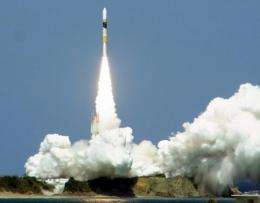
This file photo shows a Japanese H-2A rocket lifting off from the launchiung pad at the Tanegashima space centre in Kagoshima prefecture, Japan's southern island of Kyushu. Japan launched a new spy satellite into orbit on Monday amid concerns over North Korea's missile programme and to monitor natural disasters in the region. The satellite was carried by a similar, H-2A, rocket.
Japan launched a new spy satellite into orbit on Monday amid concerns over North Korea's missile programme and to monitor natural disasters in the region, officials said.
The Japanese H-2A rocket carrying an information-gathering radar satellite lifted off at 10:21 am (0121 GMT) from the Tanegashima Space Center in southwestern Japan.
"The rocket was launched successfully," said Toshiyuki Miura, a spokesman for Mitsubishi Heavy Industries, which built the satellite and worked on the launch with the Japan Aerospace Exploration Agency (JAXA).
"The satellite was separated into orbit around the Earth later," Miura added.
The government decided to build an intelligence-gathering system after North Korea launched a missile in 1998 that flew over the Japanese archipelago and into the Pacific, shocking many in Japan.
In defiance of international pressure, North Korea launched what was believed to be a three-stage Taepodong-2 missile in April 2009, with an estimated range of 6,700 kilometres (4,100 miles).
Japan has three operating optical satellites. Two radar ones were successfully placed into orbit but both broke down later. Another optical satellite was launched in September but is not yet functioning.
Demand for land surveillance grew meanwhile after Japan's March 11 quake and tsunami, which killed some 20,000 people and crippled cooling systems at the Fukushima Daiichi nuclear plant, northeast of Tokyo, causing reactor meltdowns.
"The project is aimed at boosting security and monitoring land in case of sizable natural disasters like the one in March," a government official said, adding that the current three satellites were used to track the March calamity.
"If everything goes smoothly, it will be the first radar satellite under the programme," the official said. "With the radar satellite, we can introduce wider usage of the system."
Radar satellites are able to capture images at night and in cloudy weather, something that optical satellites cannot.
The latest satellite cost some 39.8 billion yen ($512 million) to develop, while the launch cost about 10.3 billion yen, Kyodo News reported.
JAXA and Mitsubishi Heavy had originally planned to launch the satellite on December 11 but it was postponed due to bad weather.
(c) 2011 AFP
-
From lemons to lemonade: Reaction uses carbon dioxide to make carbon-based semiconductor,
32 comments
-
Thioridazine kills cancer stem cells in human while avoiding toxic side-effects of conventional cancer treatments,
3 comments
-
SpaceX private rocket blasts off for space station (Update),
42 comments
-
Climate scientists say they have solved riddle of rising sea,
31 comments
-
SpaceX capsule has 'new car' smell, astronauts say (Update),
4 comments
-
Distance of planets from stars and revolution
5 hours ago
-
revamping general concept and cosmological principle
May 25, 2012
-
Transiting Exoplanet Light Curve
May 25, 2012
-
Math behind Theoretical Physics
May 24, 2012
-
Do we know whats at the center of galaxies yet?
May 23, 2012
-
Structure of the Milky Way?
May 20, 2012
- More from Physics Forums - General Astronomy
More news stories
Land and sea species differ in climate change response: study
(Phys.org) -- Marine and terrestrial species will likely differ in their responses to climate warming, new research by Simon Fraser University and Australia’s University of Tasmania has found.
3 hours ago |
3.7 / 5 (3) |
2
|
Yale study concludes public apathy over climate change unrelated to science literacy
Are members of the public divided about climate change because they don't understand the science behind it? If Americans knew more basic science and were more proficient in technical reasoning, would public consensus match ...
5 hours ago |
4.8 / 5 (4) |
11
|
10 million years needed to recover from mass extinction
It took some 10 million years for Earth to recover from the greatest mass extinction of all time, latest research has revealed.
Space & Earth / Earth Sciences
5 hours ago |
5 / 5 (3) |
1
|
Sophisticated simulations predict future warming
The chances of our planet being hit by a global warming of 3 degrees Celsius by 2050 is as likely as it being hit by an increase of 1.4 degrees, new research shows. Presented in the journal Nature Geoscience, the British study ...
Space & Earth / Earth Sciences
May 22, 2012 |
4.4 / 5 (9) |
51
Aliens don't want to eat us, says former SETI director
Alien life probably isnt interested in having us for dinner, enslaving us or laying eggs in our bellies, according to a recent statement by former SETI director Jill Tarter.
Space & Earth / Space Exploration
May 25, 2012 |
4.4 / 5 (14) |
40
Nvidia trumpets Tegra 3 phone design wins for 2012
(Phys.org) -- Nvidias competitive war paint has a name, Tegra 3. On the heels of Nvidia announcements about lowering costs of its Tegra 3 processors and Nvidia-enabled tablets running Android Ice Cream ...
'Unzipped' carbon nanotubes could help energize fuel cells, batteries
Multi-walled carbon nanotubes riddled with defects and impurities on the outside could replace some of the expensive platinum catalysts used in fuel cells and metal-air batteries, according to scientists at ...
T cells 'hunt' parasites like animal predators seek prey, study shows
By pairing an intimate knowledge of immune-system function with a deep understanding of statistical physics, a cross-disciplinary team at the University of Pennsylvania has arrived at a surprising finding: T cells use a movement ...
Computer model used to pinpoint prime materials for efficient carbon capture
When power plants begin capturing their carbon emissions to reduce greenhouse gases and to most in the electric power industry, it's a question of when, not if it will be an expensive undertaking.
Change in developmental timing was crucial in the evolutionary shift from dinosaurs to birds: study
At first glance, it's hard to see how a common house sparrow and a Tyrannosaurus Rex might have anything in common. After all, one is a bird that weighs less than an ounce, and the other is a dinosaur that ...
Scientist: Evolution debate will soon be history
(AP) -- Richard Leakey predicts skepticism over evolution will soon be history. Not that the avowed atheist has any doubts himself.