Japan minister questions radioactive water dump
Dec 13, 2011
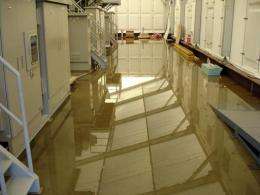
Radioactive water inside a water treatment facility at TEPCO's Fukushima Daiichi nuclear plant in northern Japan. Japan's industry minister has rejected a plan by the operator of the crippled Fukushima nuclear plant to release low-level radioactive water into the sea without approval by local fishermen.

Japan's industry minister Tuesday rejected a plan by the operator of the crippled Fukushima nuclear plant to release low-level radioactive water into the sea without approval by local fishermen.

"It should not be allowed socially, if not legally, that they forcibly go ahead with the discharge of water without gaining an agreement from fishermen concerned," Yukio Edano, Japan's minister of economy, trade and industry, told a news briefing.

Power Co. (TEPCO) said last week that it must release some as tanks designed to store it at the plant stricken by Japan's monster quake were expected to hit their limit by next March.

TEPCO added that the waste water -- used to cool Fukushima's nuclear reactors -- would be filtered before it was dumped to reduce the level of radioactivity.

But local fisheries cooperatives and those from other regions have demanded the plan be scrapped amid fears it would further contaminate their fishing grounds and sparked fears among consumers about the safety of their catch.

Edano said Japan's fishing sector had already been dented by "harmful rumours" since the 9.0-magnitude earthquake and tsunami on March 11 knocked out the Fukushima plant's cooling system.

That sparked meltdowns, explosions and the release of huge amounts of radiation into the environment -- the worst since the 1986 Chernobyl disaster.

Thousands of tonnes of water have been pumped into its reactors as TEPCO looks to bring the plant to a cold shutdown by year's end.

Within weeks of the world's worst since the , TEPCO dumped more than 10,000 tonnes of low-level into the Pacific from the plant, located some 220 kilometres (140 miles) northeast of Tokyo.

Subsequent reports have found the radiation was widely dispersed and did not pose a threat to human or animal life.

TEPCO said last week that 150 litres (40 US gallons) of highly radioactive waste water including harmful strontium, a substance linked to bone cancers, was believed to have also found its way into the open ocean from a leaky water-treatment system.

The company said, however, human health should not be affected even after eating sea food caught in the area for every day for one year.

Explore further: Climate change and wildfire: Synthesis of recent findings

add to favorites email to friend print save as pdf

Related Stories

Fresh radioactive runoff at Japan plant

Dec 05, 2011

A fresh leak of radioactive water into the open ocean has been discovered at Japan's crippled Fukushima nuclear complex, its operator said Monday as cleanup efforts continued.

Robots to gauge radiation in Japan's quake-hit plant

Apr 18, 2011

The operator of Japan's stricken nuclear plant said Sunday it will send two remote-controlled robots into a reactor building damaged by a hydrogen explosion to gauge radiation and temperature levels.

Areva to set up treatment system at Japan plant

Apr 19, 2011

French nuclear group Areva said Tuesday it will set up a system to treat radioactive water from a quake-hit Japanese power plant to allow power supplies and cooling systems to be repaired.

Recommended for you

Climate change and wildfire: Synthesis of recent findings

8 hours ago

Concerns continue to grow about the effects of climate change on fire. Wildfires are expected to increase 50 percent across the United States under a changing climate, over 100 percent in areas of the West by 2050 as projected ...

Moore tornado a rarity, experts say

10 hours ago

Tornados, among the most violent of atmospheric storms, rarely reach the size and brutality of the twister that swept through an Oklahoma City suburb on Monday, experts say.

NGOs denounce Malaysia hydropower meeting

13 hours ago

Three dozen Malaysian NGOs on Tuesday denounced the world hydroelectric industry's decision to hold a conference in a Borneo state where dam projects have uprooted forests and native peoples.

User comments : 0

More news stories

Power of US tornado dwarfs Hiroshima bomb

Wind, humidity and rainfall combined precisely to create Monday's massive killer tornado in Oklahoma. The awesome amount of energy released dwarfed the power of the atomic bomb that leveled Hiroshima.

Encouraging signs for bee biodiversity

Declines in the biodiversity of pollinating insects and wild plants have slowed in recent years, according to a new study. Researchers led by the University of Leeds and the Naturalis Biodiversity Centre in the Netherlands ...

If you can remember it, you can remember it wrong

(Medical Xpress)—Native peoples in regions where cameras are uncommon sometimes react with caution when their picture is taken. The fear that something must have been stolen from them to create the photo ...

B vitamins could delay dementia

(Medical Xpress)—Despite spending billions of dollars on research and development, drug companies have been unable to come up with effective treatments for dementia and Alzheimer's Disease (AD). Now, A. ...

New method for producing clean hydrogen

Duke University engineers have developed a novel method for producing clean hydrogen, which could prove essential to weaning society off of fossil fuels and their environmental implications.