Global warming threatens France's precious truffle
December 15, 2011 by Emmy Varley
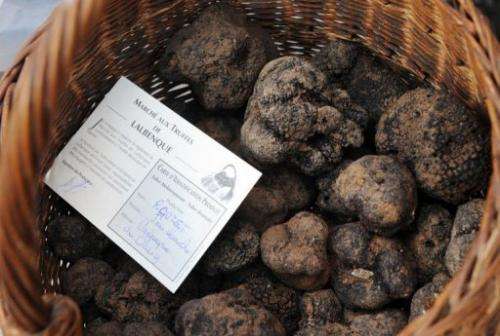
Truffles are sold in a basket during the yearly truffle wholesale market in Lalbenque, southwestern France, in 2009. As gobal warming poses an ever more present threat to truffle output, truffle farmers work to manage the truffle's scarcity.
Truffle farmers have never had to worry about demand. It is the supply side that is worrying, with global warming an ever more present threats to their success.
"You don't market the truffle, you manage its scarcity," said Jean-Charles Savignac, president of the French Truffle Growers Federation (FFT).
The 2010-11 season's output was a meagre 25 tonnes, a severe shortfall blamed on a lack of water, which is vital for the Tuber melanosporum, the scientific name for the black truffle cherished by gourmets.
"If we had supplied 100 times more, it would all be sold," Savignac said, recalling annual harvests of 200 to 300 tonnes in the 1960s, "sold without the slightest difficulty."
He said a century ago output reached a "somewhat mythical 1,000 tonnes," and still found takers despite a smaller world population and far more difficult delivery means.
Explanations for the ever-shrinking supply begin with the rural exodus that emptied the French countryside after World War II.
The truffle's natural habitat was affected as farmland gave way to natural reforestation or bush, according to truffle expert Pierre Sourzat, who added that "sometimes very effective competitors" -- other fungi that colonise tree roots -- encroached on its territory.
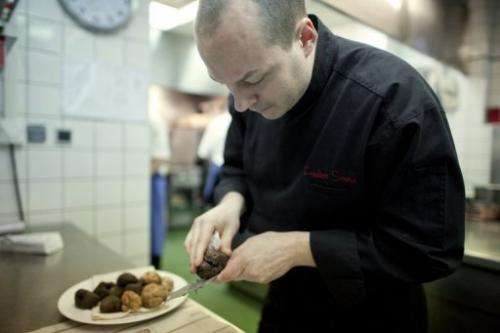
French chef Frederic Simonin prepares truffles in his restaurant's kitchen in Paris, in February 2011. As gobal warming poses an ever more present threat to truffle output, truffle farmers work to manage the truffle's scarcity.
Weather variations are no help. "The truffle, which is very sensitive to water, is something of a marker of climatic changes," Savignac said.In the summer of 2003, when a devastating heatwave gripped France, "three quarters of natural truffles vanished," Sourzat said. "In the plantations, two-thirds to three-quarters of the trees stopped producing the following years. Other mushrooms that are more adapted to drought beat out the truffle."
The FFT held a seminar in 2008 on the future of the sector in the face of global warming. "We didn't realise it right away, but the diminishing production is certainly affected by this phenomenon," Savignac said.
But the truffle sector is fighting back.
"Every year, we plant 300,000 to 400,000 trees in France, or around 1,000 more hectares (2,500 acres)" dedicated to the truffle, Savignac said. With such a larger park to rely on, "in the worst years we can reach an output of around 20 tonnes instead of the 10 tonnes we would get if nothing were done," he said.
The sector also benefits from regional government subsidies, for example to fund experiments on improving production techniques.
In the Midi-Pyrenees region, subsidies help truffle growers plant around 100 hectares each year of pubescent oaks, green oaks or hazelnut trees whose roots are impregnated with truffle spores, said Guy Delher, head of the regional federation of truffle growers.
However, it takes a good decade for the plantations to begin producing in significant quantities.
In Lalbenque, the town of some 1,600 souls where the main truffle wholesaler of southwestern France is located, it took only a few minutes for buyers to snap up some 60 kilogrammes (130 pounds) on offer by the truffle farmers, most of them landowners for whom the black diamond is a source of extra income.
Lalbenque conducts the first sale of the season, and the precious tuber went for between 400 and 600 euros per kilo wholesale, or 1,000 euros ($1,320) per kilo retail.
The region's truffle growers hope this season will be better than last year's, when only 500 kilos of the coveted Causses du Quercy truffles -- which connoisseurs say has an "initial nose of strawberry jam" -- were produced.
(c) 2011 AFP
-
From lemons to lemonade: Reaction uses carbon dioxide to make carbon-based semiconductor,
32 comments
-
Thioridazine kills cancer stem cells in human while avoiding toxic side-effects of conventional cancer treatments,
3 comments
-
SpaceX private rocket blasts off for space station (Update),
42 comments
-
Climate scientists say they have solved riddle of rising sea,
31 comments
-
SpaceX capsule has 'new car' smell, astronauts say (Update),
4 comments
-
What would stain as translucent on light-coloured fabric?
May 26, 2012
-
How do I identify different bacteria on culture plates?
May 26, 2012
-
Why Do Dogs do Strange things...
May 25, 2012
-
What does exophillic and endophillic mean in terms of mosquito and their control?
May 24, 2012
-
Semen stains glows under black lights (uv light)?
May 23, 2012
-
Question on Human Chromosome 2
May 23, 2012
- More from Physics Forums - Biology
More news stories
Manufacturing genes to attack flu virus
An international research team has manufactured a new protein that can combat deadly flu epidemics.
7 hours ago |
not rated yet |
0
|
Scientist: Evolution debate will soon be history
(AP) -- Richard Leakey predicts skepticism over evolution will soon be history. Not that the avowed atheist has any doubts himself.
May 26, 2012 |
3.5 / 5 (20) |
95
More plant species responding to global warming than previously thought
(Phys.org) -- Far more wild plant species may be responding to global warming than previous large-scale estimates have suggested.
May 22, 2012 |
4.6 / 5 (14) |
18
|
For monogamous sparrows, it doesn't pay to stray (but they do it anyway)
It's quite common for a female song sparrow to stray from her breeding partner and mate with the male next door, but a new study shows that sleeping around can be costly.
May 22, 2012 |
5 / 5 (2) |
8
|
Thousands of shellfish found dead in Peru
Thousands of crustaceans were found dead off the coast of Lima following the mystery mass death of dolphins and pelicans, the Peruvian Navy said Friday.
May 26, 2012 |
4.7 / 5 (7) |
7
Stunning image of smallest possible five-ringed structure
Scientists have created and imaged the smallest possible five-ringed structure about 100,000 times thinner than a human hair and you'll probably recognise its shape.
'Unzipped' carbon nanotubes could help energize fuel cells, batteries
Multi-walled carbon nanotubes riddled with defects and impurities on the outside could replace some of the expensive platinum catalysts used in fuel cells and metal-air batteries, according to scientists at ...
Change in developmental timing was crucial in the evolutionary shift from dinosaurs to birds: study
At first glance, it's hard to see how a common house sparrow and a Tyrannosaurus Rex might have anything in common. After all, one is a bird that weighs less than an ounce, and the other is a dinosaur that ...
Computer model used to pinpoint prime materials for efficient carbon capture
When power plants begin capturing their carbon emissions to reduce greenhouse gases and to most in the electric power industry, it's a question of when, not if it will be an expensive undertaking.
T cells 'hunt' parasites like animal predators seek prey, study shows
By pairing an intimate knowledge of immune-system function with a deep understanding of statistical physics, a cross-disciplinary team at the University of Pennsylvania has arrived at a surprising finding: T cells use a movement ...
Land and sea species differ in climate change response: study
(Phys.org) -- Marine and terrestrial species will likely differ in their responses to climate warming, new research by Simon Fraser University and Australia’s University of Tasmania has found.

Dec 15, 2011
Rank: 3 / 5 (2)
Outliers are outliers and will happen whether global warming happens or not. Lets just stick to the science that shows, yes, average temperature worldwide has increased at a large rate during recent timescales.
Dec 15, 2011
Rank: not rated yet
A global temp increase of 0.5C doesn't sound like much but it is enough to cause more extreme weather patterns at both ends.
More drought at one part and more flood at the other part.
Dec 16, 2011
Rank: not rated yet
I had a weak year for morel flushes too, I usually get 4-5 full trashbags from an old apple orchard I visit, but this year, less than a 5 gallon bucket full :(