Gene discovery explains how fruit flies retreat from heat
December 15, 2011

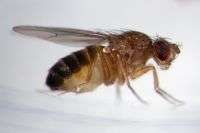
fruit fly

A discovery in fruit flies may be able to tell us more about how animals, including humans, sense potentially dangerous discomforts.

Researchers at Duke University Medical Center uncovered naturally occurring variations of a gene named that is important for the function of pain-sensing neurons throughout the animal kingdom. The gene makes an , which floods with when the fly is near a heat source, causing fruit fly larvae to respond with a corkscrew-style rolling motion away from the heat source (movie link shows an escaping larva).

The team, led by co-authors Lixian Zhong, Ph.D. and Andrew Bellemer Ph.D., of Duke Department of Anesthesiology, found a 37-amino-acid section of nearly four identical that controls the responses of the proteins to temperature. The larvae start their nociception () escape roll at just over 100 degrees Fahrenheit (39 degrees Celsius).

Senior author Dan Tracey, Ph.D., associate professor of anesthesiology, cell biology and neurobiology, said these discoveries could have a bearing on injured people with in damaged tissues or people with allodynia, who perceive even modest changes in temperature as painful. Even spontaneous pain that occurs in pathological pain states might be explained if the human versions of these channels were to open inappropriately at the normal body temperature, Tracey said.

The work was published in the inaugural issue of Cell Reports on Thursday, Dec. 15.

Interestingly, the authors found that the version of TRPA1 that is necessary for detecting the painful temperatures was not a direct temperature sensor. Tracey said this discovery suggests that TRPA1 channels may play an important role in sensing other kinds of pain besides temperature.

The four proteins vary in only two small sections. The scientists were able to find a 37-amino acid section in two of the variants that was important for sensing hot temperature.

Interestingly, many noxious chemicals that trigger painful sensations, including wasabi and tear gas, also activate the TRPA1 channel in humans and . The variants identified by the Duke team all respond to these noxious chemicals but vary in their responses to temperature. Finding similar variants in humans may give important insights into pain-sensing.

"Typically heat responses of nociception channels are tested with artificially made mutants, but our study involved four natural gene variants, two of which were related to the avoidance behavior we could observe under the microscope," said Tracey, who directs the Molecular Pain Signaling Laboratory at Duke. "Because evolution created these variants, we had more confidence that the amino-acid section we found was particularly important. We had clues there were unknown versions of this gene, so we were pleased to find the relevant part of the proteins that allows for heat-sensing and nociception."

Provided by Duke University Medical Center search and more info website


Rank 5 /5 (1 vote)
Relevant PhysicsForums posts

More news stories

Manufacturing genes to attack flu virus

An international research team has manufactured a new protein that can combat deadly flu epidemics.

Biology / Biotechnology

created 7 hours ago | popularity not rated yet | comments 0 | with audio podcast

Scientist: Evolution debate will soon be history

(AP) -- Richard Leakey predicts skepticism over evolution will soon be history. Not that the avowed atheist has any doubts himself.

Biology / Evolution

created May 26, 2012 | popularity 3.5 / 5 (20) | comments 95

More plant species responding to global warming than previously thought

(Phys.org) -- Far more wild plant species may be responding to global warming than previous large-scale estimates have suggested.

Biology / Ecology

created May 22, 2012 | popularity 4.6 / 5 (14) | comments 18 | with audio podcast

For monogamous sparrows, it doesn't pay to stray (but they do it anyway)

It's quite common for a female song sparrow to stray from her breeding partner and mate with the male next door, but a new study shows that sleeping around can be costly.

Biology / Plants & Animals

created May 22, 2012 | popularity 5 / 5 (2) | comments 8 | with audio podcast

Thousands of shellfish found dead in Peru

Thousands of crustaceans were found dead off the coast of Lima following the mystery mass death of dolphins and pelicans, the Peruvian Navy said Friday.

Biology / Ecology

created May 26, 2012 | popularity 4.7 / 5 (7) | comments 7


Stunning image of smallest possible five-ringed structure

Scientists have created and imaged the smallest possible five-ringed structure – about 100,000 times thinner than a human hair – and you'll probably recognise its shape.

'Unzipped' carbon nanotubes could help energize fuel cells, batteries

Multi-walled carbon nanotubes riddled with defects and impurities on the outside could replace some of the expensive platinum catalysts used in fuel cells and metal-air batteries, according to scientists at ...

Change in developmental timing was crucial in the evolutionary shift from dinosaurs to birds: study

At first glance, it's hard to see how a common house sparrow and a Tyrannosaurus Rex might have anything in common. After all, one is a bird that weighs less than an ounce, and the other is a dinosaur that ...

Computer model used to pinpoint prime materials for efficient carbon capture

When power plants begin capturing their carbon emissions to reduce greenhouse gases – and to most in the electric power industry, it's a question of when, not if – it will be an expensive undertaking.

T cells 'hunt' parasites like animal predators seek prey, study shows

By pairing an intimate knowledge of immune-system function with a deep understanding of statistical physics, a cross-disciplinary team at the University of Pennsylvania has arrived at a surprising finding: T cells use a movement ...

Land and sea species differ in climate change response: study

(Phys.org) -- Marine and terrestrial species will likely differ in their responses to climate warming, new research by Simon Fraser University and Australia’s University of Tasmania has found.