Foundation readies $25 computer to seed tech talents
December 24, 2011 by Nancy Owano report

Foundation readies $25 computer to seed tech talents

Enlarge

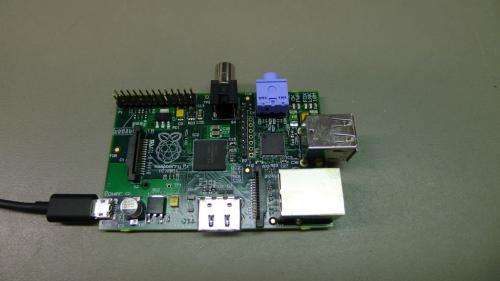
Raspberry Pi beta board, populated

(PhysOrg.com) -- A $25 computer targeted to help young people learn about computers beyond uploading pics and downloading documents is about to start volume-production in January. The Raspberry Pi project, a UK-based foundation, will place the computer by the same name, Raspberry Pi, on general sale. The principle behind the project is that students today may know how to create documents and presentations but far less about fundamental systems architecture and systems development.

Raspberry Pi wants to inspire young people to start technology careers.

User-focused lessons on how to write letters or enter data on Excel spreadsheets may be fine but the devices will place students on a learning and discovery track closer to computer science than end-user skills. The students would receive these credit-card sized computers and courses would be structured around their use.

A posting on the Raspberry Pi blog this week revealed the announcement that the computers are almost ready, seen as good news by many who have been watching for progress updates.

The posting said the first finished circuit boards had arrived and that test versions are to be put through electrical, software and hardware testing. If all goes well, will kick in and orders for the computers will also be taken early next month.

This week’s arrival of the circuit boards is treated as a milestone, as the bare bones are the first to be populated with all the components to go into the finished product.

Mice, keyboards, network adapters and external storage connect via USB hub. The computer can be plugged into a TV or monitor and keyboard.
Foundation readies $25 computer to seed tech talents
Enlarge

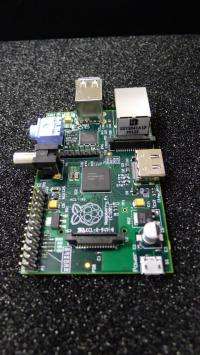
One of the very first boards off the line

The Raspberry Pi Foundation is a UK-registered charity which exists to promote the study of and related topics. As such, it has sought to make the devices as affordable as possible. The Register earlier this year said that the team behind the computer has spent months hunting for components that meet the right balance of cost with quality.

The device uses SD cards for storage and runs on a 700MHz ARM processor. Python provides the main programming language.

The finished product will actually be offered in the form of two models, one for $25 Model A, and one for $35, Model B. The Model B version includes 10/100 wired Ethernet.

"Once we're happy that this test run is fine, we'll be pushing the button immediately on full-scale manufacture in more than one factory,” according to the blog. The first batch of 10 boards will be auctioned off to the highest bidder and the devices will go on general sale in January.

The can be used for spreadsheets, word-processing games and can play high-definition video. “We want to see it being used by kids all over the world to learn programming,” according to the Raspberry Pi team.

More information: http://www.raspber … ypi.org/faqs
http://www.raspber … archives/422

© 2011 PhysOrg.com

4.6 /5 (19 votes)  

Filter


Move the slider to adjust rank threshold, so that you can hide some of the comments.


Display comments: newest first

gwrede
Dec 24, 2011

Rank: 4.5 / 5 (2)
This is excellent news! I just bought my two sons Arduino computers, which are roughly the same price but run an 8-bit chip at 40MHz. The analog and digital I/O on the Arduino is more suited to tinkering and hobbyist stuff, and definitely is a better choice than the Raspberry for a first introduction to computer and programming basics.

The Arduino is an open source hardware project, which means you can even build one from scratch because all the documents are freely available. There is also a big and fast growing community around it comprising programmers, hobbyists, and small firms selling hardware and books that help you do things with it.

I think Raspberry will be equally popular with young computerists. It may also find use as a part of many industrial projects because of its low price. There is a real need for remote sensing and "smartifying" existing equipment, and now that it is becoming both easy and chep, I expect an explosion of activity there.
plasticpower
Dec 24, 2011

Rank: not rated yet
It doesn't say much whether the Raspberry has any digital or analog outputs, like the Arduino. If it DOES, then this is a much better system!
warra_warra
Dec 24, 2011

Rank: not rated yet
Looking forward to this! According do their website the board does have a set of GPIO pins, so it should be possible to use it for controlling other devices similarly to an Arduino.
Callippo
Dec 24, 2011

Rank: 1 / 5 (2)
Why not just PC compatible?
kochevnik
Dec 24, 2011

Rank: 3.3 / 5 (3)
Why not just PC compatible?
PC has many legacy issues. In 32 bit you can't access memory for most of the last gigabye of address space. It's all wasted on hardware addressing. Of course there is the PAE workaround, but PCs are an overlay of kludges tracing back to 1983. The front-side-bus comes to mind. Better to start clean with a 64bit architecture.
Grizzled
Dec 24, 2011

Rank: 5 / 5 (3)
All sounded well until I came to the Python bit. Why that one? Without getting into the programming languages flame wars, the least that can be said is that it's very, very far from the computing basics they are trying to achieve. How about some Assembly language for starters? Otherwise, they are falling into the same end-user trap they are talking about when they mention writing letters in Excel.
Callippo
Dec 25, 2011

Rank: not rated yet
In 32 bit you can't access memory for most of the last gigabyte of address space.

IMO it shouldn't be critical for 256 MB RAM device, like the Raspberry..
hcl
Dec 25, 2011

Rank: 3.7 / 5 (3)
I could've used something like this back in 1995 or 1996 when a basic PC cost $1,500, minimum... frankly don't see the point nowadays. PCs are dirt cheap anyhow, and many middle-class households have accumulated 2 or 3 spare, "good enough" PCs to pass to kiddies.
plasticpower
Dec 25, 2011

Rank: 3.8 / 5 (4)
I agree, why Python? A non-type-safe interpreted language, while easier to pick up for newbies, not exactly what they'll be using in the real world...
CHollman82
Dec 27, 2011

Rank: 1.3 / 5 (12)
All sounded well until I came to the Python bit. Why that one? Without getting into the programming languages flame wars, the least that can be said is that it's very, very far from the computing basics they are trying to achieve. How about some Assembly language for starters? Otherwise, they are falling into the same end-user trap they are talking about when they mention writing letters in Excel.


*I did not read the article*

The processor has to have some native machine language and I am sure that an assembly like language either exists already or could be created that translates into that machine language. It is entirely possible that the only tool they provide is one that translates python into the machine language, but that doesn't mean an assembly-like language couldn't be defined for it and tools written to convert it to native byte code.
CHollman82
Dec 27, 2011

Rank: 1.4 / 5 (10)
My question is can I buy one? Or are these subsidized and only for educational institutions?
FrankHerbert
Dec 27, 2011

Rank: 1.4 / 5 (63)
And why would anyone take programming advice from you, the guy who defended as expediency HP allowing its printers to be flashed by print info sent to it?

Judging by your admitted programming habits here, I doubt you know a scrap of assembly. Which processors are you familiar with?

Anyway these little computers are great ideas, but these particular ones hardly seem unique to me. There are plenty of people out there slapping together simple computers like the above. I've made my own computer from scratch with TTL. It admittedly doesn't do much, but the concept isn't much different.

This is an excellent starting point for someone interested in the deeper workings of a computer. Far too few programmers are automatons with little understanding of what goes on under the hood. This is why programs leak memory. No one can write a tight program anymore, and CHollman, a professional programmer, has actually claimed that as a virtue.
can I buy one?

You can't build your own? Pathetic.
CHollman82
Dec 27, 2011

Rank: 1.9 / 5 (13)
Judging by your admitted programming habits here, I doubt you know a scrap of assembly. Which processors are you familiar with?


I have written time critical algorithms in assembly for both Motorola M68HC12 processors using their proprietary ASM12 language as well as Texas Instruments DSP's including the 320F2812.

My most recent work in assembly involved interfacing with laser driver circuitry to control the timing of a laser burst and the subsequent receipt and nanosecond timing of optical backscatter signal as measured by an integrated ADC including the stitching together of multiple sets of data from multiple laser pulses in order to create an interleaved data set with a virtual resolution of 0.125 meters or, equivalently, 100 picoseconds.

I'm working on this project right now if you would like a code sample.
CHollman82
Dec 27, 2011

Rank: 1.9 / 5 (13)
Also, you have no idea what you are talking about. I guarantee I am more knowledgeable than you are in all things related to computer hardware and software. My job description includes both researching hardware integration to produce next generation hand held fiber optic test and measurement equipment as well as the development of firmware and software that utilizes that hardware in the eventual realization of that equipment.
CHollman82
Dec 27, 2011

Rank: 2.1 / 5 (14)
I currently support no fewer than a dozen distinct projects/instruments ranging from bench top and laboratory optical time domain reflectometers (OTDR's), hand-held OTDR's, optical spectrum analyzers (OSA), Chromatic/Polarity Dispersion Analyzers (C/PDA's), Variable Optical Attenuators (VOA's), Optical Loss Test Sets, among other simpler hand held instruments (E/O, O/E converters, optical choppers, etc.)
CHollman82
Dec 27, 2011

Rank: 2.1 / 5 (14)
You can give me 1 ratings all you like, not only does it not hide the fact that I just publicly embarrassed you but it also makes you look even worse when the person you're attacking does not reciprocate in your childishness.
Shifty0x88
Dec 27, 2011

Rank: not rated yet
It does have GPIO, and there is a breakout board for them called the GertBoard, on their website (raspberrypi.org, posted Dec. 15).

For the reason behind python, I believe it is easier to pick up and you can quickly make something that works whereas with C/C you have to explain the includes, main, compile, run, etc. just to get something to run. I do not agree with their choice but that's fine, the whole point is you can use whatever you want.

It is also just a giant Arduino but without the IDE and with 32-bit ARM 700MHz instead of 8-bit AVR ~40MHz

And yes, when they release it(hopefully soon they just fixed an error in their betas PCBs but hopefully the next run is fine), you can buy 1 of 2 versions.

One has no ethernet and 128MB of RAM(Model A), and the 2nd gives you the ethernet and 256MB of ram(Model B). Other than that the 2 Models are identical. I believe Model A is going to go for ~$25 and Model B for ~$35.

Seriously assembly?!? I thought we wanted to be practical =D
Shifty0x88
Dec 27, 2011

Rank: not rated yet
BTW, I am not part of RaspberryPi, just a very avid follower of the whole project as well as a developer which is probably why I love the thing, that and you can use it for a single purpose and not break the bank (about the same price as some Arduinos).

I am creating an App Launcher for it. You can find the source code at: https://github.co...Launcher

Still in the beta stage, waiting for the Raspberry Pi to finish it up and mod it for performance reasons.
Noumenon
Dec 28, 2011

Rank: 2 / 5 (12)
FrankHubris, why is it you are constantly combative and ride on the site?
Grizzled
Dec 28, 2011

Rank: 3 / 5 (4)
CHollman:

*I did not read the article*

It shows :-)

Look, leave your empty boasts aside. Everyone can make them but no one believes them. Your posts speak for themselves. Just look at your inane retort - it clearly shows you have NO clue about machine/assembly languages as opposed to the interpreted scripting ones like Python.

As for the hard real-time programming you claim to have done.... Hold on a sec - I need to stop laughing...
antialias_physorg
Dec 28, 2011

Rank: 5 / 5 (1)
Love the idea. Might buy a few to try out some distributed computing for neural networks in order to get software and hardware scaleability.

Unfortunately the code is in C#..so I'll have to check whether the Mono framework runs on such limited specs.
FrankHerbert
Dec 28, 2011

Rank: 1.4 / 5 (61)
Seriously assembly?!? I thought we wanted to be practical =D

Don't you get it? He has to show how "omg 100 picoseconds advanced" he is. You cretin ;)
CHollman:

*I did not read the article*

It shows :-)

As for the hard real-time programming you claim to have done.... Hold on a sec - I need to stop laughing...


Yeah I found that cute and quaint. "100 Picoseconds OMG THAT'S FAST! BE IMPRESSED! YOU BETTER BE IMPRESSED!"

We get it. You can count clock cycles. Also lasers are involved. AWESOME! Why am I supposed to be impressed?

Please defend your assertion that sloppy programming is a virtue. It clearly isn't. Also if you were "100 picoseconds advanced omg!" you'd have no problem recognizing the idiocy of your posts and you would not be clamoring to purchase one of these computers.

You would have already built one, like myself.

Try designing your own architecture sometime :)
CHollman82
Dec 28, 2011

Rank: 1.3 / 5 (12)
Pathetic, why not skip to the chase and just post scans of our paychecks? I wouldn't mind embarrassing you again...
CHollman82
Dec 28, 2011

Rank: 1.3 / 5 (12)
Please defend your assertion that sloppy programming is a virtue.


I never said this, you are half illiterate.
gwrede
Dec 28, 2011

Rank: 5 / 5 (1)
whereas with C/C you have to explain the includes, main, compile, run, etc. just to get something to run.

The Arduino gets away without doing any of that. They novice user doesn't necessarily even know that they are using the scary Cplusplus language right from the start. (Damn this text filter!)

As for the Raspberry Pi, doing metal programming (as in directly manipulating I/O pins) would be harder because it is running a preemptive multitasking operating system. I guess that's why they've chosen a language which is (touted as) easy to learn, and which isn't used for bit twiddling.

I'm not happy with Python here, but I really don't know what to suggest either.
Callippo
Dec 28, 2011

Rank: not rated yet
I'm not happy with Python here, but I really don't know what to suggest either
MONO is supporting Basic and C# syntax on the ARM platform, but it's bulky and slow to compile. The Scratchbox project could simplify this job a lot. Windows 8 is supposed to work on ARM, which would enable to run many other platforms.
Grizzled
Dec 28, 2011

Rank: 5 / 5 (3)
" I'm not happy with Python here, but I really don't know what to suggest either"

Surely that depends on what they are trying to achieve?

If the idea is to train more script kiddies (like there isn't enough already) - you don't need to go to those lentghs. A simple, cheap, out-of-the-box PC surely will do the trick.

If you go the way of this computer, I kinda expect you to go for the basics. Otherwise - why bother?

Ahyone who would be even half-interested in that machine is sure to be a geek or a nerd or whatever you like to call them. So, yes - they WILL want to know how to twiddle those bits. (Where do you think all those engineers who write device drivers come from?)
antialias_physorg
Dec 28, 2011

Rank: 5 / 5 (3)
I'm not happy with Python here, but I really don't know what to suggest either

Since it runs Linux (which is written in C), and the open distro of Python is CPython (which is also written in C) it will no doubt have at least a C compiler on there.

But basically anything you can get to compile on a Linux machine (which should be most any language except maybe F#) and then load onto the board should work fine.

I doubt you'd want to use this board as your development environment. You'd probably program on a 'real' computer and then upload the program.
LowIQ
Dec 29, 2011

Rank: 5 / 5 (3)
Great idea in principle though not sure it's relevant to 21st century kids, maybe just middle age hobbyist's - like me - who hark back to the good old days of the ZX81 with a 16k RAM pack.

I cut my teeth in the 80's on a C64 (I liked graphics and the ZX81 just didn't yank my chain), great machine with a superb version of the BASIC programing language. Very few high level commands, everything had to be achieved by peeking and poking memory and HW registers - excellent training for assembly and low level 'C' progs that came later.

Truth is modern kids need a modern approach and an app or emulator running on a modern piece of kit is far more likely to appeal.

That said I'll be buying one ;-)
Shifty0x88
Dec 30, 2011

Rank: 5 / 5 (2)
LowlQ,

I do agree with you in that it probably won't be great for 21st century kids, but I'm sure there are a lot of kids that aren't "in" the 21st century and would love something even as simple as this, plus the $25-35 price tags makes it awesome for hackers(the good kind, NOT Anonymous/LulzSec/etc.).

It also makes it a great price to offer a buy one, give one program, to give a computer(low specs and all) to someone in need.

It is also a lot cheaper for schools (for in-school and after-school programs), to buy and setup, rather than getting full blown desktop computers
Shifty0x88
Dec 30, 2011

Rank: not rated yet
gwrede,
Well you are kinda right, but how do you explain what loop() and setup() are? what about why doesn't this code compile(I mean Verify)...... oh you forgot to include the Wire library or something... It does get away from a lot of things, but you still need to know some of it.

But you are right, an Arduino is a lot easier than the RaspPi to setup sensors on... but I still love both!!!

Yeah sorry about the C/C I didn't realize it filters the plus sign..... kinda strange PhysOrg would do that but OK.
gwrede
Dec 30, 2011

Rank: 3 / 5 (2)
Well, on Christmas I told my sons (11 an 13) that setup is what gets done once at the start and then it does loop over and over again. They had no problem with it.

And then I told them that the compiler usually complains about something unrelated a few lines later than your error, and that a good way to get used to it is to take one of the examples and break it by, say, removing a semicolon or a brace, and see what happens.

They think the Arduino is a lot of fun because things happen "for real", like LEDs blinking and stuff. And they get to build things.

And actually, at my own job, I'm currently debugging a new gadget, and I have a problem with the SPI interface. The other day I took my own Arduino there and got a whole lot of debugging done quite fast with it.

I'm definitely waiting for the Raspberry to see what it's good at, too.
antialias_physorg
Dec 30, 2011

Rank: 1 / 5 (1)
They think the Arduino is a lot of fun because things happen "for real", like LEDs blinking and stuff. And they get to build things.

Just got myself the ".NET gadgeteer". Actually a Microsoft product that is pretty neat (though expensive). All of the possibilities of an Arduino with none of the hassle of having to do low level programming, worrying about memory access problems and the like. Plug and play with touchscreens, cameras, down to blinking lights. I'm pretty impressed what they did there.
CHollman82
Dec 30, 2011

Rank: 1 / 5 (10)
And actually, at my own job, I'm currently debugging a new gadget, and I have a problem with the SPI interface. The other day I took my own Arduino there and got a whole lot of debugging done quite fast with it.


Did you solve your SPI bus problem? SPI is actually a very well designed serial bus, I prefer using it over others like I2C or RS232 and am currently using it for like six different external hardware resources on my latest project.
CHollman82
Dec 30, 2011

Rank: 1.4 / 5 (11)
You gave me a one for that grizzled? Ever heard of integrity? The rating system is not meant as a means for you to express your dislike of individual contributors, but as a means to rate the quality of their contribution.

Considering that my intent was to help a fellow developer who expressed difficulty with a subject that I consider myself an expert of I find it hard to believe you thought that my post deserved a one rating, more likely that you don't like me so you (like frank herbet and several others) are going to childishly vote down my posts regardless of their content.

Try having a bit of intellectual integrity, you'll find it's easier to like yourself.
antialias_physorg
Dec 30, 2011

Rank: 1 / 5 (1)
You gave me a one for that grizzled?

He's just another sockpuppet of Pirouette.
Grizzled
Dec 31, 2011

Rank: 3.7 / 5 (3)

Seriously assembly?!? I thought we wanted to be practical
--- Shifty0x88

Yes, seriously.

You see, historically there were some very serious and VERY practical systems implemented in Assembly. Today, I often despair watching script kiddies (who pass for programmers these days) who have absolutely no clue what's going on behind the scenes of the code they wrote.
And then look surprised when it runs excruciatingly slow even on the latest hardware.

In this particular case, I thougt the whole point was to get the users to the basics (someone already mentioned "peeking and poking" hardware registers and memory.

If that's the aim - then yes, Assembly looks a natural. If not - then what? Writing letters in Excel? They appear to say - explicitly - that's not what they wanted.

So yes, I stand by my claim that, for that kind of machine at least, Assembly (in some form) is essential.
antialias_physorg
Dec 31, 2011

Rank: 3 / 5 (4)
The device uses SD cards for storage and runs on a 700MHz ARM processor. Python provides the main programming language.

This part of the article would indicate otherwise.

This is a fully fledged computer - not some piece of embedded hardware. It runs a modern OS (Linux). One doesn't do assembyl on a Linux machine (unless you're a masochist).
Programming in C will get you 92-96% the speed of assembly. Those 4-8% loss in speed will gain you orders of magnitude in developing time.

Assembly is for Arduino boards or other low level experimental setups. (and not even that anymore)
Hev
Jan 03, 2012

Rank: not rated yet
brilliant idea - too many now think they know everything when they are just using the coding done by someone else - we are teaching grand-daughter Basic and html etc. and this new machine should be ideal for her (along with the mac, iphone, ipod, ipad she uses it home) is there a message in the name "Raspberry"?
Grizzled
Jan 03, 2012

Rank: not rated yet
Programming in C will get you 92-96% the speed of assembly. Those 4-8% loss in speed will gain you orders of magnitude in developing time.


Plain C is just an assembly in disguise. And a very bad disguise at that. We were talking about Python and the like.

Plus, I definitely don't agree with your claim of orders of magnitude of development time. Certainly not in the case of C which is notoriously bug-prone and hard to debug. (I hope you do include debugging time into the development time, do you?)
antialias_physorg
Jan 03, 2012

Rank: not rated yet
Certainly not in the case of C which is notoriously bug-prone and hard to debug.

You mean more so than assembler?
Grizzled
Jan 03, 2012

Rank: not rated yet
Actually, yes.

The reason is that Assembler maps one-to-one to the underlying architecture. If you are familiar enough with that architecture - that's not a prob.

C on the other hand, adds another level. It still pretends to be an assembler but a wrong one. Consider that it was developed back in the PDP-11 days (LSI-11 architecture).

And of course, it introduced a whole raft of its own twists. Just think of assignment producing a result - a VERY infamous source of both bugs and exploits (= vs. == :-)
antialias_physorg
Jan 03, 2012

Rank: not rated yet
Considering that this is a fully functional computer and it's able to handle real programs (e.g. having a GUI, using databases, using Ethernet communication, using all kinds of libraries)...I'd go for C (or even Python) a million times over before I'd attempt to program one graphical button in Assembler.

As noted. This is not a low level embedded system where assembler may make sense because of some restraints. Limiting yourself to assembler is just foolish here.

And no. C is not really hard to program correctly. it is no more error prone than other languages if you follow a few simple rules.

The entire Linux kernel on this machine was written in C. No way you could ever do something that complex in Assembler in any realistic timeframe.

C is not assembler. It gives you some of the possibilities of assembler. But comparing the two is like comparing a stone wheel with a ferrari.
FrankHerbert
Jan 03, 2012

Rank: 1.2 / 5 (57)
The final test for any CS major should be drawing a stable line on an Atari 2600. Bonus points if you can move it with the joystick.
Grizzled
Jan 04, 2012

Rank: not rated yet
Sorry Antialis, we'll have to agree to disagree. In my very many years working as both a developer and a maintainence programmer (I'm nearing retirement now as you could have guessed from the fact that I remember PDPs and such), I've always found a well-written assembly code much, much easier to maintain, debug and enhance than the equally well-written C code. In fact, I will go so far as to say that, in my experience at least, there is NO such thing as a well-written C code. The language simply discourages it. So much so as to make it well nigh impossible.
bluehigh
Jan 04, 2012

Rank: 1 / 5 (12)
Pathetic, why not skip to the chase and just post scans of our paychecks? I wouldn't mind embarrassing you again ..


Yep. Gotta agree. Unemployable loud mouthed gits tend to grate when they are angry with the world due to their abject failure.

Oh thats right ... FrankH flips hamburgers in a restaurant for a living (by his own admission) .. such suitable work.

Rather than general PC type orientation, perhaps micro-controller or SPC for process control might be more useful for learning 'real world' applications.
FrankHerbert
Jan 04, 2012

Rank: 1.3 / 5 (56)
I stand by my Atari 2600 comment. Anyone who could learn to produce a stable line with an Atari 2600 could do anything required of him on a modern platform. Today's programmers suck, period. I bet most CS majors would abjectly fail at this task.

Angry with the world? Lol angry at conservatives maybe.

Flips hamburgers? I never said such a thing. I did say I've worked in restaurants in the past.

Now let's look at you. You want to put all liberals in cattle cars and send them off to their deaths. You also threatened to kill my entire family on this site. Who's angry at the world now?

Take a chill pill you crikey dingo. Sydney ain't that far away.
antialias_physorg
Jan 04, 2012

Rank: not rated yet
I will go so far as to say that, in my experience at least, there is NO such thing as a well-written C code.

I guess you have never looked at any.

I stand by my Atari 2600 comment. Anyone who could learn to produce a stable line with an Atari 2600 could do anything required of him on a modern platform.

The skills for a modern programmer are VASTLY different than that. This may have been a skillset/mindset that was of use 20 years ago. In the project I'm currently working on (multi-tenant, multi-platform, multi-deployment scenario (almost cloud based), multi language, service oriented architecture) such a skill would be utterly useless.
I've always found a well-written assembly code much, much easier to maintain, debug and enhance than the equally well-written C code.

The above described project would be impossible in assembler (it would also be (nearly) impossible in C)
Noumenon
Jan 04, 2012

Rank: 3 / 5 (2)
RIP Dennis Richie who died a few months ago. C/C-plus-plus is a fine language, nice and low level, even elegant IMO.
Rank 4.6 /5 (19 votes)
Relevant PhysicsForums posts

More news stories

Nvidia trumpets Tegra 3 phone design wins for 2012

(Phys.org) -- Nvidia’s competitive war paint has a name, Tegra 3. On the heels of Nvidia announcements about lowering costs of its Tegra 3 processors and Nvidia-enabled tablets running Android Ice Cream ...

Electronics / Hardware

created 15 hours ago | popularity 5 / 5 (2) | comments 1 | with audio podcast report

Dell tablet leak: 10.1-inch display, two-battery choice

(Phys.org) -- Headline after headline talks about vendors’ tablets in the wings as likely number-one contenders for the iPad. Such claims have justifiably been taken with a grain of salt, considering ...

Electronics / Consumer & Gadgets

created May 26, 2012 | popularity 4 / 5 (4) | comments 11 | with audio podcast report

Nvidia says Kai platform will turn price tide for tablets

(Phys.org) -- In March, Nvidia gave some signs that they were working to lower the cost of their Tegra 3 processors and they suggested consumers might see prices for Android tablets as low as $199. Connect ...

Electronics / Hardware

created May 24, 2012 | popularity 4.3 / 5 (4) | comments 3 | with audio podcast report

OmniVision tops up sensors for cameras, phones

(Phys.org) -- OmniVision has announced two high-resolution image sensors for the digital still and digital video camera market (DS/DVC) and higher end smartphones. In end-user language, it is a claim for superior ...

Electronics / Hardware

created May 25, 2012 | popularity 5 / 5 (6) | comments 3 | with audio podcast report

MIT researchers devise new means to synchronize a group of robots (w/ Video)

(Phys.org) -- For several years, roboticists have been working out ways to get a group of robots to perform synchronized activities as demonstrated most often in dance routines. It’s not just about trying ...

Electronics / Robotics

created May 25, 2012 | popularity 5 / 5 (1) | comments 1 | with audio podcast report


Stunning image of smallest possible five-ringed structure

Scientists have created and imaged the smallest possible five-ringed structure – about 100,000 times thinner than a human hair – and you'll probably recognise its shape.

'Unzipped' carbon nanotubes could help energize fuel cells, batteries

Multi-walled carbon nanotubes riddled with defects and impurities on the outside could replace some of the expensive platinum catalysts used in fuel cells and metal-air batteries, according to scientists at ...

Change in developmental timing was crucial in the evolutionary shift from dinosaurs to birds: study

At first glance, it's hard to see how a common house sparrow and a Tyrannosaurus Rex might have anything in common. After all, one is a bird that weighs less than an ounce, and the other is a dinosaur that ...

Computer model used to pinpoint prime materials for efficient carbon capture

When power plants begin capturing their carbon emissions to reduce greenhouse gases – and to most in the electric power industry, it's a question of when, not if – it will be an expensive undertaking.

T cells 'hunt' parasites like animal predators seek prey, study shows

By pairing an intimate knowledge of immune-system function with a deep understanding of statistical physics, a cross-disciplinary team at the University of Pennsylvania has arrived at a surprising finding: T cells use a movement ...

Land and sea species differ in climate change response: study

(Phys.org) -- Marine and terrestrial species will likely differ in their responses to climate warming, new research by Simon Fraser University and Australia’s University of Tasmania has found.