ESA gives up bids to contact stranded Russian space probe
December 2, 2011

The European Space Agency said it will no longer try to make contact with Russia's stranded Mars probe Phobos-Grunt

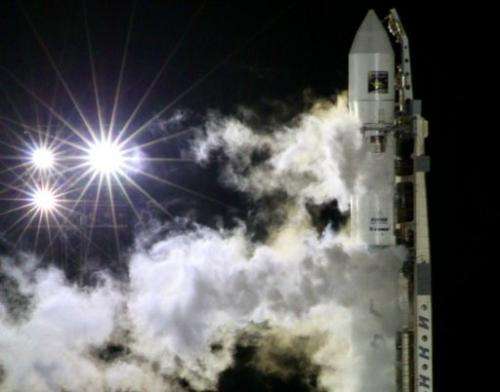
A Zenit-2SB rocket, carrying the Phobos-Grunt (Phobos -Soil) spacecraft , stands at a launch pad in November 2011. The European Space Agency said it will no longer try to make contact with Russia's stranded Mars probe Phobos-Grunt if attempts made Friday fail.

The European Space Agency said it will no longer try to make contact with Russia's stranded Mars probe Phobos-Grunt if attempts made Friday fail.

"We have already told our colleagues at the (Russian) Lavochkin institute that if communication bids during the day and tonight fail we will stop," Interfax news agency quoted ESA's representative in Russia, Rene Pichel, as saying.

Pichel said ESA and the Russians had not had contacts with the probe for more than a week and the instruments and people working to establish contacts should therefore be used for other projects.

"They're mobilising resources that we could use for other projects," he said.

The European Agency's ground station in Perth, Australia had made contact with the probe on November 22, the first sign of life from Phobos-Grunt since it got stuck in Earth's orbit after launch on November 9.

The Perth tracking station had also managed to receive a second signal from the probe.

But ESA said last week further attempts had failed.

On November 24, Russia announced its scientists had for the first time made contact with 13.5-tonne Phobos-Grunt and a signal and some telemetry data had been received.

Phobos-Grunt is Russia's first interplanetary mission since 1996, when an attempt to send an instrument-laden 6.1-tonne probe to the Red Planet, Mars 96, ended with a failure just after launch.

The five-billion-ruble ($165-million) scout was designed to travel to the of , scoop up soil and return the sample to Earth by

(c) 2011 AFP

Filter


Move the slider to adjust rank threshold, so that you can hide some of the comments.


Display comments: newest first

Vendicar_Decarian
Dec 02, 2011

Rank: 1 / 5 (4)
Nom nom nom nom......

Gulp.

Burrrrrrrrrrrrrrp!

Ahhhhhhhhhh......

All done.
gopher65
Dec 02, 2011

Rank: 2 / 5 (1)
If they're making intermittent contact, I wonder if it is rotating on odd axes, and unable to right itself?
Nanobanano
Dec 03, 2011

Rank: 1 / 5 (4)
Perfect way to bilk the people for a cool 160 million.

they probably never even launched anything. Maybe a dummy package that cost a fraction of the alleged mission costs.
omatumr
Dec 03, 2011

Rank: 1 / 5 (4)
Thanks for an intriguing story.

We have all been richly blessed with an ancient curse:

"May you live in interesting times."

With kind regards,
Oliver K. Manuel
Former NASA Principal
Investigator for Apollo
http://myprofile....anuelo09

PS - Of greater scientific interest today is this report from Amsterdam on another manifestation of the enormous potential energy (mass) stored in neutron stars:

"Fastest spinning star ever discovered"

www.nu.nl/wetensc...ekt.html

It includes this intriguing quote about a star close to us:

"The equatorial rotational velocity of 102 VFTS is three hundred times greater than that of the sun, and thus approaching the point where centrifugal forces would tear the star apart."


Rank 5 /5 (2 votes)
Relevant PhysicsForums posts
  • Distance of planets from stars and revolution
    created7 hours ago
  • revamping general concept and cosmological principle
    createdMay 25, 2012
  • Transiting Exoplanet Light Curve
    createdMay 25, 2012
  • Math behind Theoretical Physics
    createdMay 24, 2012
  • Do we know whats at the center of galaxies yet?
    createdMay 23, 2012
  • Structure of the Milky Way?
    createdMay 20, 2012
  • More from Physics Forums - General Astronomy

More news stories

Land and sea species differ in climate change response: study

(Phys.org) -- Marine and terrestrial species will likely differ in their responses to climate warming, new research by Simon Fraser University and Australia’s University of Tasmania has found.

Space & Earth / Environment

created 5 hours ago | popularity 3.7 / 5 (3) | comments 5 | with audio podcast

Yale study concludes public apathy over climate change unrelated to science literacy

Are members of the public divided about climate change because they don't understand the science behind it? If Americans knew more basic science and were more proficient in technical reasoning, would public consensus match ...

Space & Earth / Environment

created 7 hours ago | popularity 4.8 / 5 (5) | comments 19 | with audio podcast

10 million years needed to recover from mass extinction

It took some 10 million years for Earth to recover from the greatest mass extinction of all time, latest research has revealed.

Space & Earth / Earth Sciences

created 7 hours ago | popularity 4 / 5 (4) | comments 1 | with audio podcast

Sophisticated simulations predict future warming

The chances of our planet being hit by a global warming of 3 degrees Celsius by 2050 is as likely as it being hit by an increase of 1.4 degrees, new research shows. Presented in the journal Nature Geoscience, the British study ...

Space & Earth / Earth Sciences

created May 22, 2012 | popularity 4.1 / 5 (10) | comments 51

Aliens don't want to eat us, says former SETI director

Alien life probably isn’t interested in having us for dinner, enslaving us or laying eggs in our bellies, according to a recent statement by former SETI director Jill Tarter.

Space & Earth / Space Exploration

created May 25, 2012 | popularity 4.4 / 5 (15) | comments 41


Stunning image of smallest possible five-ringed structure

Scientists have created and imaged the smallest possible five-ringed structure – about 100,000 times thinner than a human hair – and you'll probably recognise its shape.

'Unzipped' carbon nanotubes could help energize fuel cells, batteries

Multi-walled carbon nanotubes riddled with defects and impurities on the outside could replace some of the expensive platinum catalysts used in fuel cells and metal-air batteries, according to scientists at ...

Change in developmental timing was crucial in the evolutionary shift from dinosaurs to birds: study

At first glance, it's hard to see how a common house sparrow and a Tyrannosaurus Rex might have anything in common. After all, one is a bird that weighs less than an ounce, and the other is a dinosaur that ...

Computer model used to pinpoint prime materials for efficient carbon capture

When power plants begin capturing their carbon emissions to reduce greenhouse gases – and to most in the electric power industry, it's a question of when, not if – it will be an expensive undertaking.

T cells 'hunt' parasites like animal predators seek prey, study shows

By pairing an intimate knowledge of immune-system function with a deep understanding of statistical physics, a cross-disciplinary team at the University of Pennsylvania has arrived at a surprising finding: T cells use a movement ...

Scientists develop ultra-sensitive test that detects diseases in their earliest stages

Scientists have developed an ultra-sensitive test that should enable them to detect signs of a disease in its earliest stages, in research published today in the journal Nature Materials.