Catching a coral killer
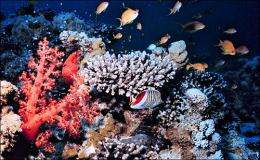
Coral reefs play an important role in marine ecosystems, so it's concerning to scientists, as well as ocean conservationists, that many coral reefs around the world are in distress or dying off.
"The corals themselves provide three-dimensional structure for the reef, and then the fish and invertebrates inhabit the reef," says Kathryn Sutherland, a Rollins College biology professor who studies the bright orange Elkhorn coral. "These coral reefs provide protection and food for these other organisms."
With support from the National Science Foundation (NSF), Sutherland has identified the first marine disease caused by humans, and it's proving fatal for Elkhorn coral in Florida.
The disease is White pox, which causes a slowing of growth, followed by white patches of tissue loss that occurs all over the coral colony.
Many diseases, such as swine flu, avian flu and HIV are known as zoonotic, moving from animals to humans. Sutherland has identified a marine disease that is a "reverse zoonosis."
"This is the first example of a human pathogen infecting a marine organism," she says.
In 2002, she determined that the pathogen of White pox is Serratia marcescens, which is a bacterium. She knew that Serratia marcescens was a pathogen found in human waste. "But at the time, I could only speculate that humans were the source of the pathogen to the marine environment and so I began a widespread study to determine where the pathogen was coming from and how it was getting to the marine environment," says Sutherland.
Her study is a collaborative research project between Rollins College and the University of Georgia.
Sutherland discovered the bacteria was found in the raw sewage influent going into wastewater treatment plants, but it was not found in the treated effluent coming out.
"So, this wastewater treatment does work. The problem is that the majority of the Florida Keys have historically been on septic tanks, and septic tanks are not designed for areas like the Florida Keys. They're designed for areas with low population density, and for areas where you have a soil drain field," she says.
Even though it has been expensive, officials and residents of the Florida Keys have supported advanced wastewater treatment, to kill the bacteria. And they are working to get residents to switch from septic tanks to city sewage systems.
"The people in the Florida Keys recognize that the coral reefs are their livelihood. It's actually a $3 billion a year industry for tourism in that region, and so in order to protect the economics of the Florida Keys, they need to maintain good water quality, and treating the sewage is a huge step in that direction," says Sutherland.
On research dives, the scientists use needle-less syringes to collect surface mucus on the Elkhorn coral. It does not harm the animal. Just like in humans, the mucus layer is the first line of defense against pathogens.
Then in the lab, in addition to studying Serratia marcescens, Sutherland's team looks for other microbes that might actually help coral resist disease.
"We're doing analyses of the whole microbial community in the mucus, so we can see what else is there in addition to the pathogen. So we can see how that microbe community changes from a healthy coral to a diseased coral," she says.
Rollins College marine biology student Hunter Noren has been working with Sutherland on the White pox project, including research dives in the Keys. He learned how to scuba dive in the icy waters of Scandinavia.
"I don't understand how it hooked me but it was in a quarry in Sweden and it was about 4 degrees Celsius outside. I loved it and I've been diving ever since," he says. "The state of Elkhorn in the Keys right now is ... it's sobering."
He has explored the waters of the Arctic Circle, the Red Sea, Cypress, and Malta, as well as more popular diving destinations.
"If we continue to harm the oceans and the reefs, we're harming ourselves in the long run. If we harm the reefs, those food webs that are dependent or interlocking with the reefs will be disrupted and they're so complex it's hard to say what will happen, but it definitely won't be good," says Noren.
Sutherland says the best case scenario for the Elkhorn coral in the near future would be advanced wastewater treatment throughout the Florida Keys to eliminate the source of the White pox pathogen and give these important ocean creatures a chance at recovery.
"We do now see that sometimes the disease signs stop, and stop progressing, so the lesions stop growing and, in some cases, during the cooler times of the year, you can see coral tissue growing back over a lesion. So, there is hope for some coral. Some may be more resistant. They may still be infected, but they're more able to fight the infection and recover from the infection," says Sutherland.
Sutherland says climate change may also be playing a role in White pox and other marine diseases. "Pathogens proliferate more when it's warmer and we see White pox disease only when temperatures are warm. It tends to disappear during the cooler times of the year and the lesions increase in size faster when the temperature is warmer. Also, climate change stresses corals," she explains.
Stressed corals often bleach, meaning they expel the algae that they depend on and appear bright white. While corals can survive a bleaching event, they are under more stress and can die.
White pox is not the only threat to corals around the world. Other stressors include elevated seawater temperatures and poor water quality, pollution, growing human populations, and development on coastlines.
Provided by National Science Foundation


