Cloud droplets, ready for prime time
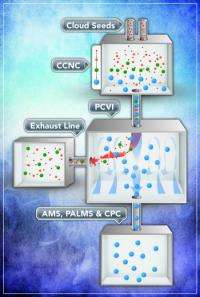
Cloud "seeds" are sent into the cloud condensation nucleation chamber (CCNC). Under supersaturation, some particles make cloud droplets and are separated from the particles that don’t make droplets in the pumped counterflow virtual impactor (PCVI). The particle remains are then chemically analyzed with two different mass spectrometry techniques (AMS and PALMS). The number density of particles is counted using a condensation particle counter (CPC). These droplets are formed, separated, and characterized by size and composition using commercially available instruments, within typical operation parameters.
(PhysOrg.com) -- Some make the cut, some don't. Like auditions for the school play, scientists from Pacific Northwest National Laboratory and Goethe-University Frankfurt were looking for promising atmospheric particles that turn into cloud droplets, and then plotting their origins. Separating the formed droplets from the inactive particles, they uncovered the chemical structure of those that formed droplets. In doing so, they devised a method that can be used in real-life scenes to characterize these promising particles. Their research was published in Atmospheric Measurement Techniques.
Clouds have a starring role in the Earth's climate system. They create a cooling effect by reflecting and scattering sunlight away from the Earth. And, they carry and releaseor don't releaserain and snow over the Earth. While clouds' effects are seen and felt, how clouds are formed, especially under the influence of tiny particles called aerosols suspended in the air, is still largely a mystery. This study looked at the particles that attract water at above 100 percent humidity, conditions typically found in a cloud, and the particles that don't. Revealing the true identity of these tiny particles will help solve some of the cloud mystery and their effects on floods and droughts.
Particles act as seeds for cloud droplets, which lead to clouds. But not all particles form droplets. Linking the effectiveness of three instruments, a research team led by Dr. Naruki Hiranuma at PNNL was able to produce, separate, and analyze cloud droplets. The team's process provides a path for future on-site characterization of those particles that form clouds.
"In the laboratory, we can't possibly reproduce all the chemical and physical cloud processes that happen in the atmosphere. So it's important to develop instruments we can take to the field, or in an aircraft, to get the true chemical identity of cloud-nucleating particles," said Hiranuma. "With this combination of off-the-shelf instruments, we can do just that."
The team used a commercially available cloud condensation nuclei chamber, or CCNC, to supersaturate particles to form cloud droplets. They immediately pushed all particles from the CCNC through a counterflow virtual impactor (CVI) using inertia to separate the droplets from inactivated particles. After separation, the droplets were chemically analyzed. The team used an aerosol mass spectrometer and a particle analysis by laser mass spectrometer to chemically characterize the residual material. Their procedure was validated to show that only droplets of a certain size made it through the CVI for analysis.
Under supersaturation conditions, some particles take up lots of water, some don't. Because of the dilution factor and flow restrictions of the instruments, the team had to start with a lot of particles to achieve enough droplets to characterize.
This research is the first to connect a commercial CCN, with a CVI and mass spectrometers to study the chemistry of aerosol particles that activate to cloud droplets.
In this study, the team characterized the composition of the activated or cloud-forming particles. They have planned a series of improvements to their methods to improve outflow and quantitatively characterize the aerosol particles.
More information: Hiranuma N, M Kohn, MS Pekour, DA Nelson, JE Shilling and DJ Cziczo. 2011. "Droplet Activation, Separation, and Compositional Analysis: Laboratory Studies and Atmospheric Measurements," Atmospheric Measurement Techniques, 4, 2333-2343. DOI:10.5194/amt-4-2333-2011
Provided by
Pacific Northwest National Laboratory
-
From lemons to lemonade: Reaction uses carbon dioxide to make carbon-based semiconductor,
32 comments
-
Thioridazine kills cancer stem cells in human while avoiding toxic side-effects of conventional cancer treatments,
3 comments
-
SpaceX private rocket blasts off for space station (Update),
42 comments
-
Climate scientists say they have solved riddle of rising sea,
31 comments
-
SpaceX capsule has 'new car' smell, astronauts say (Update),
4 comments
-
Hypothetical desert earth
22 hours ago
-
More human population = greater mass?
May 25, 2012
-
Conversion from aircraft bearing to normal degrees
May 23, 2012
-
Interpretation/Analysis of the Lab results(HEPA filter)
May 22, 2012
-
Has anyone here attended the The Urbino Summer School in Paleoclimatology?
May 22, 2012
-
Earthquakes: Mag 6 N. Italy and Mag 5.6 W. Bulgaria
May 21, 2012
- More from Physics Forums - Earth
More news stories
Land and sea species differ in climate change response: study
(Phys.org) -- Marine and terrestrial species will likely differ in their responses to climate warming, new research by Simon Fraser University and Australia’s University of Tasmania has found.
5 hours ago |
3.7 / 5 (3) |
5
|
Yale study concludes public apathy over climate change unrelated to science literacy
Are members of the public divided about climate change because they don't understand the science behind it? If Americans knew more basic science and were more proficient in technical reasoning, would public consensus match ...
7 hours ago |
4.8 / 5 (5) |
19
|
10 million years needed to recover from mass extinction
It took some 10 million years for Earth to recover from the greatest mass extinction of all time, latest research has revealed.
Space & Earth / Earth Sciences
7 hours ago |
4 / 5 (4) |
1
|
Sophisticated simulations predict future warming
The chances of our planet being hit by a global warming of 3 degrees Celsius by 2050 is as likely as it being hit by an increase of 1.4 degrees, new research shows. Presented in the journal Nature Geoscience, the British study ...
Space & Earth / Earth Sciences
May 22, 2012 |
4.1 / 5 (10) |
51
Aliens don't want to eat us, says former SETI director
Alien life probably isnt interested in having us for dinner, enslaving us or laying eggs in our bellies, according to a recent statement by former SETI director Jill Tarter.
Space & Earth / Space Exploration
May 25, 2012 |
4.4 / 5 (15) |
41
Stunning image of smallest possible five-ringed structure
Scientists have created and imaged the smallest possible five-ringed structure about 100,000 times thinner than a human hair and you'll probably recognise its shape.
'Unzipped' carbon nanotubes could help energize fuel cells, batteries
Multi-walled carbon nanotubes riddled with defects and impurities on the outside could replace some of the expensive platinum catalysts used in fuel cells and metal-air batteries, according to scientists at ...
Change in developmental timing was crucial in the evolutionary shift from dinosaurs to birds: study
At first glance, it's hard to see how a common house sparrow and a Tyrannosaurus Rex might have anything in common. After all, one is a bird that weighs less than an ounce, and the other is a dinosaur that ...
Computer model used to pinpoint prime materials for efficient carbon capture
When power plants begin capturing their carbon emissions to reduce greenhouse gases and to most in the electric power industry, it's a question of when, not if it will be an expensive undertaking.
T cells 'hunt' parasites like animal predators seek prey, study shows
By pairing an intimate knowledge of immune-system function with a deep understanding of statistical physics, a cross-disciplinary team at the University of Pennsylvania has arrived at a surprising finding: T cells use a movement ...
Scientists develop ultra-sensitive test that detects diseases in their earliest stages
Scientists have developed an ultra-sensitive test that should enable them to detect signs of a disease in its earliest stages, in research published today in the journal Nature Materials.
Dec 28, 2011
Rank: 1 / 5 (3)
Droplets of water condense on tiny aerosol particles and also on ion tracks produced by high energy cosmic rays as they traverse the atmosphere.
Some cosmic rays may come from deep inside the Sun - Earth's unstable heat source - that has primary control over Earth's continuously changing climate [1-3].
1. "Super-fluidity in the solar interior:
Implications for solar eruptions and climate",
Journal of Fusion Energy 21, 193-198 (2002)
http://arxiv.org/.../0501441
2. "Earth's Heat Source - The Sun",
Energy and Environment 20, 131-144 (2009)
http://arxiv.org/pdf/0905.0704
3. "Origin and Evolution of Life",
J. Modern Physics 2, 587-594 (2011)
http://dl.dropbox...5079.pdf
With kind regards,
Oliver K. Manuel
http://www.omatumr.com/