The Bronze Age - now in 3D
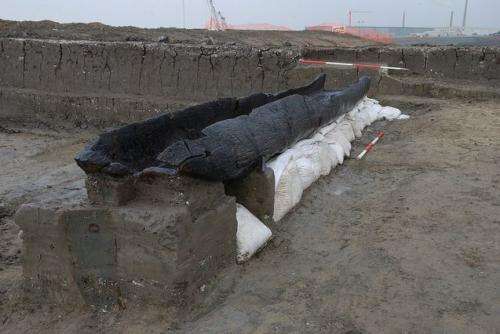
(PhysOrg.com) -- The world will get its first glimpse of one of the most significant later Bronze Age sites ever recorded in Britain today, yielding a rare and extraordinarily detailed view of life 3,000 years ago.
Wooden boats, spears with their hafts intact, swords still with their scabbards, clothing and even the remains of food have been found at the Must Farm quarry, Whittlesey, in the East Anglian fens. Preserved in silt and peat along the old course of the River Nene, items which would normally have long-since decomposed have been pulled out of the earth by archaeologists in pristine condition.
Cameras will be allowed on to the site, near Peterborough, Cambridgeshire, today, ahead of conservation work which will eventually allow the researchers to put the items on general public display. The site is being excavated ahead of the extension of a local brick quarry and its importance means that it is now likely to be further investigated for some years.
“It is giving us a 3-D vision of this community that we only see very rarely anywhere in the world, let alone in this country,” David Gibson, from the University of Cambridge’s Archaeological Unit, which is carrying out the dig, said.
“Usually at a Later Bronze Age period site you get pits, post-holes and maybe one or two really exciting metal finds. Convincing people that such places were once thriving settlements takes some imagination. But this time so much more has been preserved – we can actually see everyday life during the Bronze Age in the round.”
In all, hundreds of objects have been found. They belonged to what appears to have been a community that lived on the river, fishing for the likes of perch, pike and eels and, according to the remains of a meal found in one wooden bowl on the site, also enjoying the occasional nettle stew.
Researchers have identified the site of the settlement itself to the east of the current excavations, which burned down at some point around 800 BC. All that is missing from this picture of the society are the bodies of the people who lived there. Human remains may be lying in an as-yet unexcavated area of land nearby, or they may have been buried in the river and therefore prove harder to find.
The Fenland environment has changed through prehistory. In the earlier prehistoric, Mesolithic and Neolithic periods it was dryer. During the Bronze Age, however, the water table rose and by Roman times it had become a swampy marsh, within which Peterborough and Whittlesey became islands. It wasn’t until many centuries later that it became possible to drain the land, revealing the productive farmland of the present day.
Archaeologists have been working closely with Hanson, the brick and cement supplier which owns the quarry and is looking to expand. The company’s need for clay which lies at Jurassic age levels in the earth means that the dig team have been able to excavate far deeper than on normal archaeological sites. The finds are in places three metres below the modern-day surface. This is a depth which lies far beyond the reach of aerial or radar surveys, so without the quarrying, the artefacts they have discovered would never have been found.
The dig is already revealing a treasure-trove of evidence for anyone with a passing interest in Britain’s past. The most spectacular find is that of six boats, all from the Bronze Age but appearing at different levels in the silted up river. These range from just over two metres to a little more than eight metres in length. Each was hollowed out of the trunk of an oak tree and in some cases decorated with extensive carvings.
Elsewhere, the site has revealed weaponry such as swords and spears still with their handles intact, and everyday items such as wooden spoons, part of a cape, green and blue beads, ropes, buckets and wicker baskets.
The team have also started to draw parallels between some of these items and artefacts from the continent belonging to roughly the same time. In particular, the sword bears striking similarities to examples found in northern Spain.
Although there were no significant coastal ports during the Bronze Age, this shows how the waterways of this corner of Eastern England were an important channel of communication with the frontiers of Britain and the continent beyond. In addition, it indicates that people were perhaps more mobile than is typically thought. Trade from Europe may not have reached Whittlesey directly, but ideas and designs emanating from distant territories clearly did.
One locally significant discovery is that of eel traps. Remarkably, the 3,000-year-old versions are very similar to those still used in East Anglia today. “A modern-day trapper was able to come in and tell us exactly how these traps were used and why,” Gibson said. “It’s amazing that such an ancient technology has continued right up to the present virtually unchanged.”
More information: More images: www.flickr.com//photos/cambrid … 57628344498469/show/
Provided by University of Cambridge


