The birth of a telescope 30 times larger than Earth
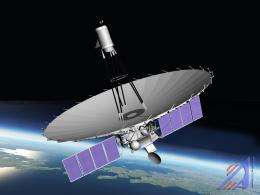
Artist's impression of Spektr-R, the 10-meter space-borne antenna of the RadioAstron project. Credit: Lavochkin Association
(PhysOrg.com) -- On 15 November 2011, the Effelsberg 100-meter radio telescope, together with three Russian and one Ukrainian telescope, took part in the first interferometric observations with the orbiting 10-meter antenna Spektr-R of the Russian RadioAstron project. The observations were made at a wavelength of 18 centimeters, targeting the distant, bright, and very compact quasar 0212+735. Interferometric signals have been successfully detected by the RadioAstron team between Spektr-R and the ground antennas, setting a new world record for the size of a radio interferometer and opening a new era in interferometric studies of cosmic radio emission.
The technique of very long baseline interferometry, which has already set a number of world records in astronomy, now enters an entirely new era signaled by a successful detection of interferometric signals ("fringes") made in observations performed with the 10-meter space-borne antenna Spektr-R of the RadioAstron project, three 32-meter antennas of the Russian QUASAR Network, the Ukrainian 70-meter antenna in Evpatoria, and the German 100-meter radio telescope in Effelsberg. The detection was made on 15 November 2011, with observations performed at a wavelength of 18 centimeters and targeting bright and extremely compact radio emission from the distant quasar 0212+735.
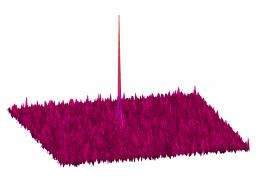
First interferometric signal ("fringe") between Spektr-R and the Effelsberg 100m radio telescope. Credit: Astro Space Center of Lebedev Physical Institute, Russian Academy of Sciences
"These fascinating results confirm our expectations that we will be able to probe with RadioAstron the conditions in the innermost regions of quasars with unprecedented detail", says Anton Zensus, director at the Max-Planck-Institut für Radioastronomie in Bonn and head of the institute's "Very Long Baseline Interferometry" (VLBI) research group. "The weak signals from such systems require the coordinated use of the most sensitive radio telescopes available such as the 100-m dish in Effelsberg."In order to perform these observations, data from the space antenna of RadioAstron were recorded on-board and sent to the satellite tracking antenna in Puschino, Russia. These data have been subsequently combined with recordings made at ground-based radio telescopes participating in RadioAstron observations. This is done at a special RadioAstron correlator facility in Moscow. The RadioAstron correlator performs searches for correlations (or interferometric fringes) between the signals recorded at two or more antennas. Using these correlations, images of distant cosmic objects can be reconstructed at a resolution that would have been achieved with a telescope as large as the largest distance between the antennas participating in observations.
The satellite was about 100,000 km away from Earth during the observations of the quasar 0212+735. Planned observations with SpectR will extend out to 360,000 kilometers from the Earth, thus creating a telescope which is effectively 30 times larger than the size of our planet. This kind of telescope will achieve a resolution as fine as 1/100,000 of a second of arc. This resolution is sufficient for measuring the size of a one cent coin on the surface of Moon and reaches within a factor of two of the scale of the event horizon in the supermassive black hole in the center of our Galaxy.
"The RadioAstron team is very excited to get the first interferometric signals", says RadioAstron scientist Yuri Kovalev from Astro Space Center in Moscow. "This achievement confirms a successful operation of the extremely complex system and is a milestone that allows us to move forward to an extensive science program involving radio telescopes located throughout the world."
This exciting new capability promises to help tackling some of the most puzzling problems in astrophysics, including the origin of the most energetic particles in the Universe and the nature of supermassive black holes.
Provided by
Max-Planck-Gesellschaft
-
From lemons to lemonade: Reaction uses carbon dioxide to make carbon-based semiconductor,
32 comments
-
Thioridazine kills cancer stem cells in human while avoiding toxic side-effects of conventional cancer treatments,
3 comments
-
SpaceX private rocket blasts off for space station (Update),
42 comments
-
Climate scientists say they have solved riddle of rising sea,
31 comments
-
SpaceX capsule has 'new car' smell, astronauts say (Update),
4 comments
-
Distance of planets from stars and revolution
7 hours ago
-
revamping general concept and cosmological principle
May 25, 2012
-
Transiting Exoplanet Light Curve
May 25, 2012
-
Math behind Theoretical Physics
May 24, 2012
-
Do we know whats at the center of galaxies yet?
May 23, 2012
-
Structure of the Milky Way?
May 20, 2012
- More from Physics Forums - General Astronomy
More news stories
Land and sea species differ in climate change response: study
(Phys.org) -- Marine and terrestrial species will likely differ in their responses to climate warming, new research by Simon Fraser University and Australia’s University of Tasmania has found.
4 hours ago |
3.7 / 5 (3) |
5
|
Yale study concludes public apathy over climate change unrelated to science literacy
Are members of the public divided about climate change because they don't understand the science behind it? If Americans knew more basic science and were more proficient in technical reasoning, would public consensus match ...
6 hours ago |
4.8 / 5 (5) |
12
|
10 million years needed to recover from mass extinction
It took some 10 million years for Earth to recover from the greatest mass extinction of all time, latest research has revealed.
Space & Earth / Earth Sciences
6 hours ago |
5 / 5 (3) |
1
|
Sophisticated simulations predict future warming
The chances of our planet being hit by a global warming of 3 degrees Celsius by 2050 is as likely as it being hit by an increase of 1.4 degrees, new research shows. Presented in the journal Nature Geoscience, the British study ...
Space & Earth / Earth Sciences
May 22, 2012 |
4.4 / 5 (9) |
51
Aliens don't want to eat us, says former SETI director
Alien life probably isnt interested in having us for dinner, enslaving us or laying eggs in our bellies, according to a recent statement by former SETI director Jill Tarter.
Space & Earth / Space Exploration
May 25, 2012 |
4.4 / 5 (15) |
41
Stunning image of smallest possible five-ringed structure
Scientists have created and imaged the smallest possible five-ringed structure about 100,000 times thinner than a human hair and you'll probably recognise its shape.
'Unzipped' carbon nanotubes could help energize fuel cells, batteries
Multi-walled carbon nanotubes riddled with defects and impurities on the outside could replace some of the expensive platinum catalysts used in fuel cells and metal-air batteries, according to scientists at ...
Change in developmental timing was crucial in the evolutionary shift from dinosaurs to birds: study
At first glance, it's hard to see how a common house sparrow and a Tyrannosaurus Rex might have anything in common. After all, one is a bird that weighs less than an ounce, and the other is a dinosaur that ...
Computer model used to pinpoint prime materials for efficient carbon capture
When power plants begin capturing their carbon emissions to reduce greenhouse gases and to most in the electric power industry, it's a question of when, not if it will be an expensive undertaking.
T cells 'hunt' parasites like animal predators seek prey, study shows
By pairing an intimate knowledge of immune-system function with a deep understanding of statistical physics, a cross-disciplinary team at the University of Pennsylvania has arrived at a surprising finding: T cells use a movement ...
Scientists develop ultra-sensitive test that detects diseases in their earliest stages
Scientists have developed an ultra-sensitive test that should enable them to detect signs of a disease in its earliest stages, in research published today in the journal Nature Materials.

Dec 08, 2011
Rank: 5 / 5 (3)
More simply: They are matching the images up based on 'visible' points. But they don't know if the most accurate picture is one pixel to the left, or one pixel to the right...This reduces the effective resolution by 50-75%
Whereas with the laser calibrated interferometry systems used in some telescope clusters, you can get a more exact interferometry - you know exactly how to line the images up to get the most accurate picture, regardless of the data from any individual telescope.
Radioastronomy just isn't as sexy as hubble.
Dec 08, 2011
Rank: 3 / 5 (2)
It's always good to have extra data points from extra antennae.
Although you can probably use a combination of computer algorithms and human intuition to "guess" the most accurate representation more often than chance by observing changes in appearance of reference objects. For example, a foreground, midground, and background reference object.
But thisis the sort of thing I was hoping for in specfic design.
Let's get 8 or 10 of these things up there orbiting on different orbital planes around the Earth and all over the Solar system, then we'll really get good resolution, and much cheaper than the James Webb too I'll bet....
Dec 08, 2011
Rank: not rated yet
I'm surprised at the choice of radio telescopes to do this radio interferometry. I'm surprised the Aricebo and the New Mexico array are not included at least part time. Well, i'm sure that the news out of this is only going to get better with time.
Dec 08, 2011
Rank: not rated yet
Telescopes, including radio telescopes, are all about capturing photons. An actual radio telescope 30 earths in diameter would capture a vastly larger number of photons and achieve much better resolution.
Alas, building telescopes of that size is well beyond our grasp; and even if it was not, the resources required to build a scope of that size would be better deployed placing smaller arrays farther apart. A few thousand-meter arrays orbiting the sun beyond Neptune would be a good place to start, if our technology grows to the point of enabling them.
Dec 09, 2011
Rank: not rated yet
Used to live in that area and ride my motorcycle down the valley where it is located. It's just awesome seeing that huge dish turn and align with some radio source with millimeter accuracy.