Aliens hanging out in the Kuiper Belt? We could see the light from their cities
December 19, 2011 by Tammy Plotner, Universe Today
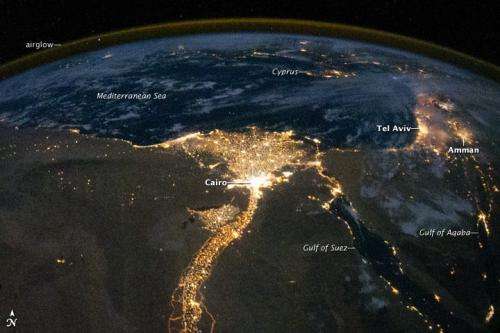
When it comes to searching for ET, current efforts have been almost exclusively placed in picking up a radio signal just a small portion of the electromagnetic spectrum. Consider for a moment just how much lighting we here on Earth produce and how our night side might appear as viewed from a telescope on another planet. If we can assume that alternate civilizations would evolve enjoying their natural lighting, wouldnt it be plausible to also assume they might develop artificial lighting sources as well?
Is it possible for us to peer into space and spot artificially illuminated objects out there? According to a new study done by Abraham Loeb (Harvard), Edwin L. Turner (Princeton), the answer is yes.
For gathering light, the array of Earthly telescopes now at sciences disposal are able to confidently observe a light source comparable in overall brightness to a large city up to a certain distance. Right now astronomers are able to measure the orbital parameters of Kuiper belt objects (KBOs) with the greatest of precision by their observed flux and computing their changing orbital distances.
However, is it possible to see light if it were to occur on the dark side? Loeb and Turner say that current optical telescopes and surveys would have the ability to see this amount of light at the edge of our Solar System and observations with large telescopes can measure a KBOs spectra to determine if they are illuminated by artificial lighting using a logarithmic slope (sunlit object would exhibit alpha=(dlogF/dlogD) = -4, whereas artificially-illuminated objects should exhibit alpha = -2.)
Our civilization uses two basic classes of illumination: thermal (incandescent light bulbs) and quantum (light emitting diodes [LEDs] and fluorescent lamps) Loeb and Turn write in their paper. Such artificial light sources have different spectral properties than sunlight. The spectra of artificial lights on distant objects would likely distinguish them from natural illumination sources, since such emission would be exceptionally rare in the natural thermodynamic conditions present on the surface of relatively cold objects. Therefore, artificial illumination may serve as a lamppost which signals the existence of extraterrestrial technologies and thus civilizations.
Spotting this illumination difference in the optical band would be tricky but by calculating the observed flux from solar illumination on Kuiper Belt Objects with a typical albedo, the team is confident that existing telescopes and surveys could detect the artificial light from a reasonably brightly illuminated region, roughly the size of a terrestrial city, located on a KBO. Even though the light signature would be weaker, it would still carry the dead give-away the spectral signature.
However, we currently dont expect there to be any civilizations thriving at the edge of our solar system, as it is dark and cold out there.
But Loeb has posed that possibly planets ejected from other parent stars in our galaxy may have traveled to the edge of our Solar System and ended up residing there. Whether a civilization would survive an ejection event from their parent system, and then put up lamposts is up for debate, however.
The team isnt suggesting that any random light source detected where there should be darkness might be considered a sign of life, though. There are many factors which could contribute to illumination, such as viewing angle, backscattering, surface shadowing, outgassing, rotation, surface albedo variations and more. this is just a new suggestion and a new way of looking at things, as well as suggested exercises for future telescopes and studying exoplanets.
City lights would be easier to detect on a planet which was left in the dark of a formerly-habitable zone after its host star turned into a faint white dwarf, Loeb and Turner say. The related civilization will need to survive the intermediate red giant phase of its star. If it does, separating its artificial light from the natural light of a white dwarf, would be much easier than for the original star, both spectroscopically and in total brightness.
The next generation of optical and space-based telescopes could help to refine the search process when observing extra-solar planets and preliminary broad-band photometric detection could be improved through the use of narrow-band filters which are tuned to the spectral features of artificial light sources such as light emitting diodes. While such a scenario on a distant world would need to involve far more light pollution than even we produce why rule it out?
This method opens a new window in the search for extraterrestrial civilizations, Loeb and Turner write. The search can be extended beyond the Solar System with next generation telescopes on the ground and in space, which would be capable of detecting phase modulation due to very strong artificial illumination on the night-side of planets as they orbit their parent stars.
More information: Read Loeb and Turners paper: Detection Technique for Artificially-Illuminated Objects in the Outer Solar System and Beyond.
This article was inspired by a discussion on Google+
Source: Universe Today
-
From lemons to lemonade: Reaction uses carbon dioxide to make carbon-based semiconductor,
32 comments
-
Thioridazine kills cancer stem cells in human while avoiding toxic side-effects of conventional cancer treatments,
3 comments
-
SpaceX private rocket blasts off for space station (Update),
42 comments
-
Climate scientists say they have solved riddle of rising sea,
31 comments
-
SpaceX capsule has 'new car' smell, astronauts say (Update),
4 comments
-
Distance of planets from stars and revolution
6 hours ago
-
revamping general concept and cosmological principle
May 25, 2012
-
Transiting Exoplanet Light Curve
May 25, 2012
-
Math behind Theoretical Physics
May 24, 2012
-
Do we know whats at the center of galaxies yet?
May 23, 2012
-
Structure of the Milky Way?
May 20, 2012
- More from Physics Forums - General Astronomy
More news stories
Land and sea species differ in climate change response: study
(Phys.org) -- Marine and terrestrial species will likely differ in their responses to climate warming, new research by Simon Fraser University and Australia’s University of Tasmania has found.
4 hours ago |
3.7 / 5 (3) |
5
|
Yale study concludes public apathy over climate change unrelated to science literacy
Are members of the public divided about climate change because they don't understand the science behind it? If Americans knew more basic science and were more proficient in technical reasoning, would public consensus match ...
6 hours ago |
4.8 / 5 (5) |
12
|
10 million years needed to recover from mass extinction
It took some 10 million years for Earth to recover from the greatest mass extinction of all time, latest research has revealed.
Space & Earth / Earth Sciences
6 hours ago |
5 / 5 (3) |
1
|
Sophisticated simulations predict future warming
The chances of our planet being hit by a global warming of 3 degrees Celsius by 2050 is as likely as it being hit by an increase of 1.4 degrees, new research shows. Presented in the journal Nature Geoscience, the British study ...
Space & Earth / Earth Sciences
May 22, 2012 |
4.4 / 5 (9) |
51
Aliens don't want to eat us, says former SETI director
Alien life probably isnt interested in having us for dinner, enslaving us or laying eggs in our bellies, according to a recent statement by former SETI director Jill Tarter.
Space & Earth / Space Exploration
May 25, 2012 |
4.4 / 5 (15) |
41
Stunning image of smallest possible five-ringed structure
Scientists have created and imaged the smallest possible five-ringed structure about 100,000 times thinner than a human hair and you'll probably recognise its shape.
'Unzipped' carbon nanotubes could help energize fuel cells, batteries
Multi-walled carbon nanotubes riddled with defects and impurities on the outside could replace some of the expensive platinum catalysts used in fuel cells and metal-air batteries, according to scientists at ...
Change in developmental timing was crucial in the evolutionary shift from dinosaurs to birds: study
At first glance, it's hard to see how a common house sparrow and a Tyrannosaurus Rex might have anything in common. After all, one is a bird that weighs less than an ounce, and the other is a dinosaur that ...
Computer model used to pinpoint prime materials for efficient carbon capture
When power plants begin capturing their carbon emissions to reduce greenhouse gases and to most in the electric power industry, it's a question of when, not if it will be an expensive undertaking.
T cells 'hunt' parasites like animal predators seek prey, study shows
By pairing an intimate knowledge of immune-system function with a deep understanding of statistical physics, a cross-disciplinary team at the University of Pennsylvania has arrived at a surprising finding: T cells use a movement ...
Scientists develop ultra-sensitive test that detects diseases in their earliest stages
Scientists have developed an ultra-sensitive test that should enable them to detect signs of a disease in its earliest stages, in research published today in the journal Nature Materials.
Dec 19, 2011
Rank: 5 / 5 (4)
Dec 19, 2011
Rank: 2.2 / 5 (13)
Dec 19, 2011
Rank: 5 / 5 (4)
Yes, it said this in the article.
Personally, I think the whole point of the article is that as technology improves, seeing things like artificial illumination becomes more likely.
Dec 19, 2011
Rank: 1 / 5 (6)
we broadcast a signal in early tests of radio waves. signal received and answered by late 80's.
why has there never been a deep search done of the area the signal originated?
Dec 19, 2011
Rank: 5 / 5 (3)
Dec 19, 2011
Rank: 2.1 / 5 (11)
Dec 19, 2011
Rank: 1 / 5 (2)
Dec 20, 2011
Rank: 1 / 5 (1)
Dec 20, 2011
Rank: not rated yet
Why have windows when you can have viewscreens that can shift view, perform other display functions, and don't create an engineering weakness in your life sustaining enclosures.
As to streetlights, I don't really think anyone intends to go for casual strolls in the vacuum while worrying about not seeing the muggers in the dark alleys.
Headlights are a different story. You can be pretty sure that the sensor systems any of their vehicles would have aren't making any significant use of the em spectrum we can see with.
This idea of looking for city lights in the Kuiper belt is not well thought out in my opinion with regards to the realities of living out there. Then again, what do we really know about alien psychology and technology. Maybe they also make their spaceships out of paper. :)
Dec 20, 2011
Rank: 1 / 5 (2)
But Science proved only two types from those which are human realm and animal realm.
Many living beings such as Asuras, Gods or Brahmas and their worlds are made of different kind of very soft matter which humans can't see.May be it has a different atomic structure than our chimerical elements. This maybe that kind of cities!!!
https://sites.goo...verse_en
Dec 20, 2011
Rank: 3.7 / 5 (3)
Dec 20, 2011
Rank: 3.5 / 5 (2)
Dec 20, 2011
Rank: 3 / 5 (2)
Unfortunately, anti-light reduces alien cheese production and prevents santa from giving them their Winter Solstice presents.