Accelerating adoption of agricultural technology
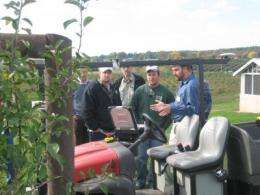
In-field technology demonstrations help growers "road-test" new equipment and may speed their adoption of new technologies. Credit: Photo courtesy of Katie Ellis
Research shows that it takes about eight years from the time public research funds are invested in technology development to the time the technology is first implemented. In the agricultural sector it can take as long as 15 years before full adoption by stakeholders occurs. Because many technologies in the agricultural world become obsolete in 15 years, it becomes increasingly important to find ways to move technology more rapidly from research to adoption.
In a study published in HortTechnology, Katie Ellis, Tara Auxt Baugher, and Karen Lewis report on an information technology survey that was designed to better understand concerns and design effective outreach methods for the tree fruit industry. The survey was part of the U.S. Department of Agriculture Specialty Crop Research Initiative project titled Comprehensive Automation for Specialty Crops (CASC). "The project aims to accelerate technology adoption by analyzing its return on investment and identifying and mitigating barriers to adoption", said Ellis, corresponding author of the study. "Low adoption rates are largely the product of skepticism, which can lead to weaknesses in the commercialization process and affect future research and product development."
The authors analyzed survey responses obtained from attendees at tree fruit meetings in the Pacific northwestern and eastern United States. Results showed that many of the misgivings about new automated technologies, such as equipment cost and reliability of harvest assist, sensor systems, and fully automated harvest machinery, were consistent across the country. The results indicated subtle differences between the eastern U.S. and Pacific northwestern U.S. responses, including justifiable equipment price points and irrigation and pest concerns. "These are likely attributable to regional differences in climate, operation size and scale, and marketing strategies", said the researchers.
Orchard owners and managers identified fuel costs, labor regulations, labor costs, insurance costs, and market conditions as the most important external influences on their businesses. Water availability/cost and quarantine regulations were least important. These responses have implications for future research and outreach efforts; studies that emphasize economic analyses with evidence of increased returns and workforce productivity will be important.
Another survey finding supported previous research showing that growers place a high value on ''in my backyard'' field trials and are more likely to adopt innovations that are developed or tested locally. Survey responses from tree fruit growers indicated a desire to see technological benefits through on-farm trials, particularly in the eastern United States.
"CASC members designed this project to bridge the gap between developer and end user. The survey data will help the project team better address grower concerns and uncertainty on a regional and national level, thereby improving adoption speed and rates after CASC-developed technologies are rolled out", the authors concluded.
More information: The complete study and abstract are available on the ASHS HortTechnology electronic journal web site: http://horttech.as … ct/20/6/1043
Provided by American Society for Horticultural Science
-
From lemons to lemonade: Reaction uses carbon dioxide to make carbon-based semiconductor,
32 comments
-
Thioridazine kills cancer stem cells in human while avoiding toxic side-effects of conventional cancer treatments,
3 comments
-
SpaceX private rocket blasts off for space station (Update),
42 comments
-
Climate scientists say they have solved riddle of rising sea,
31 comments
-
SpaceX capsule has 'new car' smell, astronauts say (Update),
4 comments
-
What would stain as translucent on light-coloured fabric?
May 26, 2012
-
How do I identify different bacteria on culture plates?
May 26, 2012
-
Why Do Dogs do Strange things...
May 25, 2012
-
What does exophillic and endophillic mean in terms of mosquito and their control?
May 24, 2012
-
Semen stains glows under black lights (uv light)?
May 23, 2012
-
Question on Human Chromosome 2
May 23, 2012
- More from Physics Forums - Biology
More news stories
Manufacturing genes to attack flu virus
An international research team has manufactured a new protein that can combat deadly flu epidemics.
6 hours ago |
not rated yet |
0
|
Scientist: Evolution debate will soon be history
(AP) -- Richard Leakey predicts skepticism over evolution will soon be history. Not that the avowed atheist has any doubts himself.
May 26, 2012 |
3.5 / 5 (20) |
91
More plant species responding to global warming than previously thought
(Phys.org) -- Far more wild plant species may be responding to global warming than previous large-scale estimates have suggested.
May 22, 2012 |
4.6 / 5 (14) |
18
|
For monogamous sparrows, it doesn't pay to stray (but they do it anyway)
It's quite common for a female song sparrow to stray from her breeding partner and mate with the male next door, but a new study shows that sleeping around can be costly.
May 22, 2012 |
5 / 5 (2) |
8
|
Thousands of shellfish found dead in Peru
Thousands of crustaceans were found dead off the coast of Lima following the mystery mass death of dolphins and pelicans, the Peruvian Navy said Friday.
May 26, 2012 |
4.7 / 5 (7) |
7
Stunning image of smallest possible five-ringed structure
Scientists have created and imaged the smallest possible five-ringed structure about 100,000 times thinner than a human hair and you'll probably recognise its shape.
'Unzipped' carbon nanotubes could help energize fuel cells, batteries
Multi-walled carbon nanotubes riddled with defects and impurities on the outside could replace some of the expensive platinum catalysts used in fuel cells and metal-air batteries, according to scientists at ...
Change in developmental timing was crucial in the evolutionary shift from dinosaurs to birds: study
At first glance, it's hard to see how a common house sparrow and a Tyrannosaurus Rex might have anything in common. After all, one is a bird that weighs less than an ounce, and the other is a dinosaur that ...
Computer model used to pinpoint prime materials for efficient carbon capture
When power plants begin capturing their carbon emissions to reduce greenhouse gases and to most in the electric power industry, it's a question of when, not if it will be an expensive undertaking.
T cells 'hunt' parasites like animal predators seek prey, study shows
By pairing an intimate knowledge of immune-system function with a deep understanding of statistical physics, a cross-disciplinary team at the University of Pennsylvania has arrived at a surprising finding: T cells use a movement ...
Land and sea species differ in climate change response: study
(Phys.org) -- Marine and terrestrial species will likely differ in their responses to climate warming, new research by Simon Fraser University and Australia’s University of Tasmania has found.