Woman to begin Antarctic crossing, awaits weather
November 21, 2011

Woman to begin Antarctic crossing, awaits weather (AP)

Enlarge

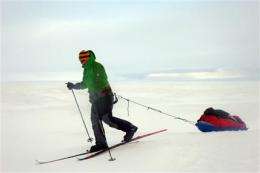
In this photo taken on Sept. 24, 2010 provided by the Kaspersky ONE Trans-antarctic Expedition, British adventurer Felicity Aston skis across Iceland during a pre-expedition training trip. Aston plans to ski by herself across the Antarctica, all the way to the other side of the frozen continent. If she manages to complete this journey of more than 1,000 miles (1,700 kilometers) in late January, she'll become the first human person to cross Antarctica alone under her own power. She would also set a record for the longest solo polar expedition by a woman, at about 70 days. A charter flight from Chile will take her to a base in Antarctica on Friday Nov. 18, 2011. (AP Photo/Kaspersky ONE Trans-antarctic Expedition/Kaspersky Lab)

(AP) -- A 33-year-old British adventurer preparing for a historic solo crossing of Antarctica was waiting at a base camp for the weather to improve on Sunday in order to begin her long journey on skis.

Felicity Aston said she has been doing more than physical training to ready herself for the expedition.

"I've also been speaking to a sports psychologist about the mental aspect of it because so much of this is about where your head's at rather than your muscles and your ," Aston told The Associated Press in a telephone interview from the base camp at Union Glacier.

She aims to become the first person to cross Antarctica alone using only . If she manages to complete the journey in late January as planned, she would also set a record for the longest solo polar expedition by a woman, at about 70 days.

"Unfortunately the weather hasn't been kind to us so far," Aston said.

At the base camp, she said, "it's blue sky. It's quite warm relatively for Antarctica, but unfortunately the weather on the other side of the continent isn't good enough to fly, apparently."

"So we're sitting here waiting for the weather to improve," she said.

Aston has been to Antarctica before but said she is particularly thrilled that she will be climbing solo through the Transantarctic Mountains and onto the continent's vast central plateau.

"Being out there and effectively having Antarctica to myself - or it will feel like that - appeals to me," she said. "And just the completeness of it, you know, to ski from one side of Antarctica to the other and to find out what it's like to be out there on my own."

The ordeal she faces will be similar to that endured by Boerge Ousland of Norway, who made a 64-day trip across the continent in 1997. But he harnessed Antarctica's fierce winds by strapping himself to a parachute-like sail when they blew in his favor. On those days he could ski as far as 140 miles while towing a sled carrying about 400 pounds (nearly 900 kilograms) of supplies. At other times, his speed dropped to about 2 mph (3 kph) as he struggled through crevasse-laced terrain, he said.

"It was physically and mentally tiring. I crossed snow bridges not knowing if they would hold my weight. I had to go slowly and very carefully," he said.

Aston's previous travel adventures have included skiing across the Canadian Arctic and crossing the Greenland ice sheet. But this is her first solo expedition.

"I'm looking forward to finding out what it will be like to go that length of time without seeing anyone," she said. "There's a definite appeal to just getting going and how simple life becomes when all you have to worry about is eating, sleeping and skiing."

She needed to pack the bare essentials because she will be pulling her supplies behind her. Her food rations include porridge, freeze-dried dinners and plenty of chocolate, which in all she said will add up to more than 4,000 calories each day.

"There's a lot of chocolate involved in this. It's great," she said with a laugh. "I get to eat chocolate all day and I still manage to lose weight, so that's a bonus from my point of view."

More information: Aston's expedition site: http://www.kasperskyonetransantarcticexpedition.com

Aston's Twitter site for tweets during her journey: http://www.twitter.com/felicity(underscore)aston

©2011 The Associated Press. All rights reserved. This material may not be published, broadcast, rewritten or redistributed.

Filter


Move the slider to adjust rank threshold, so that you can hide some of the comments.


Display comments: newest first

JRDarby
Nov 21, 2011

Rank: not rated yet
You're starting in late November and you want to wait for better weather...? Go! Go now!
LariAnn
Nov 21, 2011

Rank: 5 / 5 (1)
Late November in Antarctica is about a month from the Summer Solstice in the southern hemisphere, so her timing is about right. She'll catch the "warmest" period through which she can journey. "Warmest" is relative, of course.
Eoprime
Nov 22, 2011

Rank: not rated yet
...about 400 pounds (nearly 900 kilograms)...


...
MarkyMark
Nov 22, 2011

Rank: not rated yet
I wish her luck. I wish i was wll enough to do challenging physical things like this too.
JRDarby
Nov 22, 2011

Rank: not rated yet
Late November in Antarctica is about a month from the Summer Solstice in the southern hemisphere, so her timing is about right. She'll catch the "warmest" period through which she can journey. "Warmest" is relative, of course.


This is why I shouldn't rush through reading the article. For some reason I thought it had said "Arctic," and not "Antarctic."
Rank 5 /5 (2 votes)
Relevant PhysicsForums posts

More news stories

Land and sea species differ in climate change response: study

(Phys.org) -- Marine and terrestrial species will likely differ in their responses to climate warming, new research by Simon Fraser University and Australia’s University of Tasmania has found.

Space & Earth / Environment

created 4 hours ago | popularity 3.7 / 5 (3) | comments 5 | with audio podcast

Yale study concludes public apathy over climate change unrelated to science literacy

Are members of the public divided about climate change because they don't understand the science behind it? If Americans knew more basic science and were more proficient in technical reasoning, would public consensus match ...

Space & Earth / Environment

created 6 hours ago | popularity 4.8 / 5 (4) | comments 11 | with audio podcast

10 million years needed to recover from mass extinction

It took some 10 million years for Earth to recover from the greatest mass extinction of all time, latest research has revealed.

Space & Earth / Earth Sciences

created 6 hours ago | popularity 5 / 5 (3) | comments 1 | with audio podcast

Sophisticated simulations predict future warming

The chances of our planet being hit by a global warming of 3 degrees Celsius by 2050 is as likely as it being hit by an increase of 1.4 degrees, new research shows. Presented in the journal Nature Geoscience, the British study ...

Space & Earth / Earth Sciences

created May 22, 2012 | popularity 4.4 / 5 (9) | comments 51

Aliens don't want to eat us, says former SETI director

Alien life probably isn’t interested in having us for dinner, enslaving us or laying eggs in our bellies, according to a recent statement by former SETI director Jill Tarter.

Space & Earth / Space Exploration

created May 25, 2012 | popularity 4.4 / 5 (14) | comments 41


Stunning image of smallest possible five-ringed structure

Scientists have created and imaged the smallest possible five-ringed structure – about 100,000 times thinner than a human hair – and you'll probably recognise its shape.

'Unzipped' carbon nanotubes could help energize fuel cells, batteries

Multi-walled carbon nanotubes riddled with defects and impurities on the outside could replace some of the expensive platinum catalysts used in fuel cells and metal-air batteries, according to scientists at ...

Change in developmental timing was crucial in the evolutionary shift from dinosaurs to birds: study

At first glance, it's hard to see how a common house sparrow and a Tyrannosaurus Rex might have anything in common. After all, one is a bird that weighs less than an ounce, and the other is a dinosaur that ...

Computer model used to pinpoint prime materials for efficient carbon capture

When power plants begin capturing their carbon emissions to reduce greenhouse gases – and to most in the electric power industry, it's a question of when, not if – it will be an expensive undertaking.

T cells 'hunt' parasites like animal predators seek prey, study shows

By pairing an intimate knowledge of immune-system function with a deep understanding of statistical physics, a cross-disciplinary team at the University of Pennsylvania has arrived at a surprising finding: T cells use a movement ...

Scientists develop ultra-sensitive test that detects diseases in their earliest stages

Scientists have developed an ultra-sensitive test that should enable them to detect signs of a disease in its earliest stages, in research published today in the journal Nature Materials.