Drying intensifying wildfires, carbon release ninefold, study finds
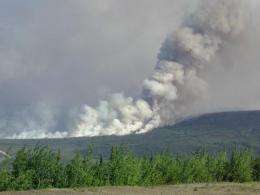
The 2003 Erickson Creek Fire burned more than a month and affected about 48,000 hectares of boreal forest. Credit: Merritt Turetsky
Drying of northern wetlands has led to much more severe peatland wildfires and nine times as much carbon released into the atmosphere, according to new research led by a University of Guelph professor.
The study, published today in Nature Communications, is the first to investigate the effect of drainage on carbon accumulation in northern peatlands and the vulnerability of that carbon to burning.
"Russia, Indonesia and Canada all have abundant peatlands, but they also have been hotspots for intense peat fires in the past decade," said Guelph professor Merritt Turetsky, who worked on the study with William Donahue of the Water Matters Society of Alberta and Brian Benscoter from Florida Atlantic University.
In pristine states, peatlands often resist fire because of their wet soils. "Our study shows that when disturbance lowers the water table, that resistance disappears and peat becomes very flammable and vulnerable to deep burning," she said.
Recently, destructive peat fires plagued the Moscow region. In the late 1990s, severe Indonesian fires in drained peatlands released carbon equivalent to 40 per cent of annual global fossil fuel emissions.
"Our results demonstrate the importance of cumulative impacts," Turetsky said.
Peatlands store vast amounts of carbon by pulling carbon dioxide out of the atmosphere. For millennia, they've accumulated plant debris the remains of wood, moss, and other plants and locked it up in layers of saturated peat more than five metres deep in places.
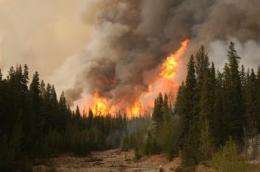
This is a photo of a boreal wildfire. Credit: Natural Resources Canada, Canadian Forest Service
Northern peat covers large swaths of the landscape. Because about half of that peat consists of carbon, it is a globally important carbon pool.But peatlands are also carbon sources, as this same debris fuels wildfires. "While fire is a widely recognized disturbance in upland forests, the impacts of fire on peatlands and their carbon storage have been largely overlooked," said Benscoter.
The majority of the world's peatlands are located in northern regions, and Canada is home to some of the largest on the planet.
"The extensive deposits of peat in Canada are an important natural resource, but one that is being disturbed more often, not only by wildfire but also by human activities," Turetsky said. Previous studies have documented the effects of land use practices and global warming on the ecology of peatlands. "But we wanted to examine how decades of lowered water table in peatlands might affect wildfire behaviour, and that required a very large experiment."
To determine those effects, the researchers used a unique outdoor laboratory. A large section of a boreal fen near Slave Lake, Alta., had been drained over 20 years ago in a wetland drainage project. A portion of the fen including drained and pristine plots burned in a wildfire in 2001 allowed for a natural experiment.
Earlier research had documented increases in tree growth and carbon storage after drainage. "But nobody had looked at the impacts of dewatering on fire intensity and associated carbon gains or losses," Donohue said.
The results were surprising, he said. Long-term drainage actually increased tree productivity and carbon storage in the fen soils. But the lower water table also changed wildfire conditions, and losses of soil carbon to burning in the drained areas increased ninefold.
"Even though the organic matter accumulation doubled over two decades after drainage, severe burning triggered the complete loss of this newly stored carbon, plus a further 450 years' worth of peat accumulation," Donahue said.
"Currently, peatlands are considered important global stores for carbon. But we've shown that human disturbance or climate-induced drying can switch peatlands from sinks to potentially huge sources of carbon, with losses associated with severe burning far outweighing long-term rates of sequestration."
Provided by University of Guelph
-
From lemons to lemonade: Reaction uses carbon dioxide to make carbon-based semiconductor,
32 comments
-
Thioridazine kills cancer stem cells in human while avoiding toxic side-effects of conventional cancer treatments,
3 comments
-
SpaceX private rocket blasts off for space station (Update),
42 comments
-
Climate scientists say they have solved riddle of rising sea,
31 comments
-
SpaceX capsule has 'new car' smell, astronauts say (Update),
4 comments
-
Hypothetical desert earth
21 hours ago
-
More human population = greater mass?
May 25, 2012
-
Conversion from aircraft bearing to normal degrees
May 23, 2012
-
Interpretation/Analysis of the Lab results(HEPA filter)
May 22, 2012
-
Has anyone here attended the The Urbino Summer School in Paleoclimatology?
May 22, 2012
-
Earthquakes: Mag 6 N. Italy and Mag 5.6 W. Bulgaria
May 21, 2012
- More from Physics Forums - Earth
More news stories
Land and sea species differ in climate change response: study
(Phys.org) -- Marine and terrestrial species will likely differ in their responses to climate warming, new research by Simon Fraser University and Australia’s University of Tasmania has found.
4 hours ago |
3.7 / 5 (3) |
5
|
Yale study concludes public apathy over climate change unrelated to science literacy
Are members of the public divided about climate change because they don't understand the science behind it? If Americans knew more basic science and were more proficient in technical reasoning, would public consensus match ...
6 hours ago |
4.8 / 5 (4) |
11
|
10 million years needed to recover from mass extinction
It took some 10 million years for Earth to recover from the greatest mass extinction of all time, latest research has revealed.
Space & Earth / Earth Sciences
6 hours ago |
5 / 5 (3) |
1
|
Sophisticated simulations predict future warming
The chances of our planet being hit by a global warming of 3 degrees Celsius by 2050 is as likely as it being hit by an increase of 1.4 degrees, new research shows. Presented in the journal Nature Geoscience, the British study ...
Space & Earth / Earth Sciences
May 22, 2012 |
4.4 / 5 (9) |
51
Aliens don't want to eat us, says former SETI director
Alien life probably isnt interested in having us for dinner, enslaving us or laying eggs in our bellies, according to a recent statement by former SETI director Jill Tarter.
Space & Earth / Space Exploration
May 25, 2012 |
4.4 / 5 (14) |
41
Stunning image of smallest possible five-ringed structure
Scientists have created and imaged the smallest possible five-ringed structure about 100,000 times thinner than a human hair and you'll probably recognise its shape.
'Unzipped' carbon nanotubes could help energize fuel cells, batteries
Multi-walled carbon nanotubes riddled with defects and impurities on the outside could replace some of the expensive platinum catalysts used in fuel cells and metal-air batteries, according to scientists at ...
Change in developmental timing was crucial in the evolutionary shift from dinosaurs to birds: study
At first glance, it's hard to see how a common house sparrow and a Tyrannosaurus Rex might have anything in common. After all, one is a bird that weighs less than an ounce, and the other is a dinosaur that ...
Computer model used to pinpoint prime materials for efficient carbon capture
When power plants begin capturing their carbon emissions to reduce greenhouse gases and to most in the electric power industry, it's a question of when, not if it will be an expensive undertaking.
T cells 'hunt' parasites like animal predators seek prey, study shows
By pairing an intimate knowledge of immune-system function with a deep understanding of statistical physics, a cross-disciplinary team at the University of Pennsylvania has arrived at a surprising finding: T cells use a movement ...
Scientists develop ultra-sensitive test that detects diseases in their earliest stages
Scientists have developed an ultra-sensitive test that should enable them to detect signs of a disease in its earliest stages, in research published today in the journal Nature Materials.

Nov 01, 2011
Rank: 4.4 / 5 (7)
With the Best project, even the anti-science Koch brothers are finding themselves funding research that contradicts their own Sick Conservative Libertarian Ideology.
Nov 01, 2011
Rank: 2.5 / 5 (2)
Think of the atmospheric aerosols that get sequestered by putting out forrest fires. Human intervention has lead to a decrease in atmospheric particles that could potentially block out more sunlight and this ultimately effects the radiative balance of our planet. Imagine how many acres of naturally burning vegatation have humans put out and the change in temporary atmospheric composition this has created...
Nov 01, 2011
Rank: 4.7 / 5 (3)
It turns out that most fires in the world are started by people and can and does change some areas flora and fauna. By the same token the areas we do affect by putting out natural fires is far smaller than the areas we affect by lighting fires.
Nov 01, 2011
Rank: not rated yet
There is a big difference between the aerosols and CO2. Linger time. Aerosols will eventually settle to earth as soot. CO2 stays in the atmosphere for 10000 of years. That is what is so dangerous when we hit the tipping point. It will be with us for a long time and so will the effects.
Nov 02, 2011
Rank: not rated yet
Also, fire suppression only delays the fire, and when the fire does burn it burns hotter and consumes larger areas of the forests due to more fuel having accumulated, and the forest being denser than normal. Prior to fire suppression practices, firestorms would have been a very rare event. Nowadays, firestorms are a regular threat, and when they do develop they create strong convective systems that catapult the combustion products into the stratosphere.
The old methods of fire suppression are now widely understood as being in error. Modern forestry doctrine involves periodic setting of controlled fires.
Nov 02, 2011
Rank: not rated yet
Still, the point is valid that CO2 has by far longer atmospheric lifetime than soot, sulphates, or any other aerosols.
Also, the danger exists that as the oceans warm up, they will be capable of absorbing less and less additional CO2, potentially even themselves becoming a CO2 source (same phenomenon as cold vs. warm fizzy drinks.) However, it takes a very long time for the oceans to heat up (think centuries), and they may never heat up to a point where they begin to actually out-gas CO2.
Nov 02, 2011
Rank: not rated yet
Regardless, the corals an top levels of the oceans are already being acidified with CO2. The death of the corals is the first indicators of what is going to happen to us.
Nov 02, 2011
Rank: not rated yet
http://www.ess.uc...ig1.html
And here:
http://orbi.ulg.a...rint.pdf
Yes, there's an asymptotic decline can take as much as 10,000 years, but overwhelmingly most of the sequestration occurs in the first 1-2,000.The corals aren't dying because of acidification (yet). So far, the bleaching events have been variously linked to increased water temperatures, invasive/uncontrolled predator species, and eutrophication (those are the studies I've seen.)
The acidification of the oceans is a looming threat (that will materialize in full force if we continue with business-as-usual); so far it is down barely 0.1 on the pH scale relative to pre-industrial levels:
http://en.wikiped...fication
Nov 03, 2011
Rank: not rated yet
Thanks for the references Pink. Interesting reading. I wish I could find the original link for you, it a deep dive into "tipping point" and "feedback" articles.
You know http://www.ess.uc...ig1.html is a really good graphic. I've not seen that before. It's excellent.