New exhibition, website guide visitors through the evolving universe
November 30, 2011

New exhibition, website guide visitors through the evolving universe

Enlarge

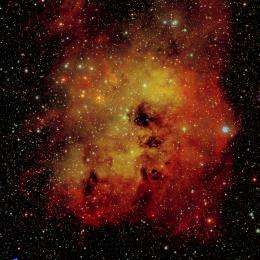
Most stars form close together in nebulae - large cosmic clouds of gas and dust that act as stellar nurseries. The nebula IC 410 is located 13,000 light-years from Earth and spans 15 light-years. This visible-light photograph was taken with the Megacam instrument on the MMT telescope atop Mount Hopkins, Arizona. Credit: Harvard-Smithsonian CfA

The cosmos constantly changes. Stars are born, live out their lives, and die - sometimes calmly, sometimes explosively. Galaxies form, grow, and collide dramatically. A new exhibition and website, developed jointly by the Smithsonian Astrophysical Observatory (SAO) and the Smithsonian's National Museum of Natural History, reveal the dynamic and evolving universe through breathtaking photographs and informative captions.

"The Evolving Universe" explores how the stars, galaxies and universe undergo the same stages as : from birth, to maturity and, eventually, to death. This remarkable journey from present-day Earth to the far reaches of space and time will be on view in the in Washington, D.C., through July 7, 2013.

A worldwide audience also can experience the through its website, located at http://www.mnh.si.edu/exhibits/evolving-universe . All of the images featured in the museum gallery can be downloaded in high-resolution jpegs or PDFs formatted in poster size.

"Anyone can select their favorite space photo, download it, and take it to their local copy shop to print it," said Smithsonian Jonathan McDowell, who played a lead role in developing the exhibition.

Visitors to the exhibition or website can choose one of two paths to explore the cosmos. They can begin close to home with our solar system and move outward to the farthest reaches of the universe. Or they can begin 13.7 billion years ago at the moment of the Big Bang and move forward in time to the present day. Along their journey they will learn how a variety of telescopes and instruments, many developed by SAO, reveal the fascinating history of the expanding universe.

"We've all seen the amazing pictures from NASA's probes in our own solar system," said McDowell. "I'm excited about bringing to the public the remarkable images of the broader universe that we astronomers have been exploring with our telescopes. I hope that with this exhibition visitors will take away an appreciation for our larger cosmic neighborhood."

"The Evolving Universe" is located on the second floor of the , between the Minerals Store and the Korea Gallery. For more information about the museum, visit it at http://www.mnh.si.edu .

Provided by Harvard-Smithsonian Center for Astrophysics search and more info website

Filter


Move the slider to adjust rank threshold, so that you can hide some of the comments.


Display comments: newest first

omatumr
Nov 30, 2011

Rank: 1.1 / 5 (9)
the evolving universe


Is either powered by:

a.) Fusion of light elements like Hydrogen into heavier ones and then into compact, neutron-rich objects, and perhaps into black holes - - - as the Big Bang Model of the universe predicts, OR

b.) Fragmentation of massive, compact neutron-rich objects into galaxies of stars that continue to emit neutrons because of neutron repulsion [1] and generate the Hydrogen that fills interstellar space and causes the universe to expand [2].

1. "Neutron Repulsion", The APEIRON Journal, in press (2011)

http://arxiv.org/...2.1499v1

2. "Is the universe expanding?" The Journal of Cosmology 13, 4187-4190 (2011)

http://journalofc...102.html

With kind regards,
Oliver K. Manuel
Former NASA Principal
Investigator for Apollo
Video Summary (1961-2011)
http://dl.dropbox...reer.pdf
jsdarkdestruction
Dec 01, 2011

Rank: 3.2 / 5 (5)
Oliver Manuel's recent efforts to plaster Physorg.com and other public news sites with his theories and personal URLs are a bit puzzling, as scientists have a variety of publications available to communicate directly to each other in. My best guess is that he is desperately trying to prop up his legacy in light of his arrest in his university office on 7 charges of rape and sodomy based on allegations by 4 of his own children. The charges have been reduced to one count of felony attempted sodomy, not necessarily because of his innocence, but because of the statute of limitations. One can only guess how the recent charges and decades of family strife have affected his ability to reason rationally and to remain objective while defending his unpopular theories.

http://www.homefa...uel.html

http://mominer.ms...hildren/
Eoprime
Dec 01, 2011

Rank: not rated yet
the evolving universe


Is either powered by:


Its c.)! Iam sure!
But i won't tell anyone what it is.
Rank 5 /5 (1 vote)
Relevant PhysicsForums posts
  • Distance of planets from stars and revolution
    created6 hours ago
  • revamping general concept and cosmological principle
    createdMay 25, 2012
  • Transiting Exoplanet Light Curve
    createdMay 25, 2012
  • Math behind Theoretical Physics
    createdMay 24, 2012
  • Do we know whats at the center of galaxies yet?
    createdMay 23, 2012
  • Structure of the Milky Way?
    createdMay 20, 2012
  • More from Physics Forums - General Astronomy

More news stories

Land and sea species differ in climate change response: study

(Phys.org) -- Marine and terrestrial species will likely differ in their responses to climate warming, new research by Simon Fraser University and Australia’s University of Tasmania has found.

Space & Earth / Environment

created 4 hours ago | popularity 3.7 / 5 (3) | comments 5 | with audio podcast

Yale study concludes public apathy over climate change unrelated to science literacy

Are members of the public divided about climate change because they don't understand the science behind it? If Americans knew more basic science and were more proficient in technical reasoning, would public consensus match ...

Space & Earth / Environment

created 6 hours ago | popularity 4.8 / 5 (4) | comments 11 | with audio podcast

10 million years needed to recover from mass extinction

It took some 10 million years for Earth to recover from the greatest mass extinction of all time, latest research has revealed.

Space & Earth / Earth Sciences

created 6 hours ago | popularity 5 / 5 (3) | comments 1 | with audio podcast

Sophisticated simulations predict future warming

The chances of our planet being hit by a global warming of 3 degrees Celsius by 2050 is as likely as it being hit by an increase of 1.4 degrees, new research shows. Presented in the journal Nature Geoscience, the British study ...

Space & Earth / Earth Sciences

created May 22, 2012 | popularity 4.4 / 5 (9) | comments 51

Aliens don't want to eat us, says former SETI director

Alien life probably isn’t interested in having us for dinner, enslaving us or laying eggs in our bellies, according to a recent statement by former SETI director Jill Tarter.

Space & Earth / Space Exploration

created May 25, 2012 | popularity 4.4 / 5 (14) | comments 41


Stunning image of smallest possible five-ringed structure

Scientists have created and imaged the smallest possible five-ringed structure – about 100,000 times thinner than a human hair – and you'll probably recognise its shape.

'Unzipped' carbon nanotubes could help energize fuel cells, batteries

Multi-walled carbon nanotubes riddled with defects and impurities on the outside could replace some of the expensive platinum catalysts used in fuel cells and metal-air batteries, according to scientists at ...

Change in developmental timing was crucial in the evolutionary shift from dinosaurs to birds: study

At first glance, it's hard to see how a common house sparrow and a Tyrannosaurus Rex might have anything in common. After all, one is a bird that weighs less than an ounce, and the other is a dinosaur that ...

Computer model used to pinpoint prime materials for efficient carbon capture

When power plants begin capturing their carbon emissions to reduce greenhouse gases – and to most in the electric power industry, it's a question of when, not if – it will be an expensive undertaking.

T cells 'hunt' parasites like animal predators seek prey, study shows

By pairing an intimate knowledge of immune-system function with a deep understanding of statistical physics, a cross-disciplinary team at the University of Pennsylvania has arrived at a surprising finding: T cells use a movement ...

Scientists develop ultra-sensitive test that detects diseases in their earliest stages

Scientists have developed an ultra-sensitive test that should enable them to detect signs of a disease in its earliest stages, in research published today in the journal Nature Materials.