Viking 'sunstone' more than a myth
November 2, 2011 by Laurent Banguet
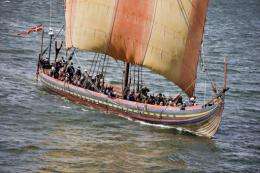
File illustration photo shows a replica Viking ship in Northern Jutland in August 2008. Researchers say Vikings used transparent calcite crystal to fix the bearing of the Sun, to within a single degree of accuracy.
Ancient tales of Norse mariners using mysterious sunstones to navigate the ocean when clouds obscured the Sun and stars are more than just legend, according to a study published Wednesday.
Over 1,000 years ago, before the invention of the compass, Vikings ventured thousands of kilometres from home toward Iceland and Greenland, and most likely as far as North America, centuries ahead of Christopher Columbus.
Evidence show that these fearless and fearsome seamen navigated by reading the position of the Sun and stars, and through an intimate knowledge of landmarks, currents and waves.
But how they could voyage long distances across seas at northern latitudes often socked in by light-obscuring fog and clouds has remained an enigma.
Enter the sunstone.
While experts have long argued that Vikings knew how to use blocks of light-fracturing crystal to locate the Sun through dense clouds, archeologists have never found hard proof, and doubts remained as to exactly what kind of material it might be.
An international team of researchers led by Guy Ropars of the University of Rennes in Brittany, marshalling experimental and theoretical evidence, says they have the answer.
Vikings, they argue, used transparent calcite crystal -- also known as Iceland spar -- to fix the true bearing of the Sun, to within a single degree of accuracy.
This naturally occurring stone has the capacity to "depolarise" light, filtering and fracturing it along different axes, the researchers explained.
Here's how it works: If you put a dot on top of the crystal and look through it from below, two dots will appear.
"Then you rotate the crystal until the two points have exactly the same intensity or darkness. At that angle, the upward-facing surface indicates the direction of the Sun," Ropars explained by phone.
"A precision of a few degrees can be reached even under dark twilight conditions.... Vikings would have been able to determine with precision the direction of the hidden Sun."
The human eye, he added, has a fine-tuned capacity to distinguish between shades of contrast, and thus is able to see when the two spots are truly identical.
The recent discovery of an Iceland spar aboard an Elizabethan ship sunk in 1592 -- tested by the researchers -- bolsters the theory that ancient mariners were aware of the crystal's potential as an aid to navigation.
Even in the era of the compass, crews might have kept such stone on hand as a backup, the study speculates.
"We have verified ... that even only one of the cannons excavated from the ship is able to perturb a magnetic compass orientation by 90 degrees," the researchers wrote.
"So, to avoid navigation errors when the Sun is hidden, the use of an optical compass could be crucial even at this epoch, more than four centuries after the Viking time."
The study appeared in Proceedings of the Royal Society A: Mathematical and Physical Sciences, a peer-reviewed journal published by Britain's de facto academy of science, the Royal Society.
(c) 2011 AFP
-
From lemons to lemonade: Reaction uses carbon dioxide to make carbon-based semiconductor,
32 comments
-
Thioridazine kills cancer stem cells in human while avoiding toxic side-effects of conventional cancer treatments,
3 comments
-
SpaceX private rocket blasts off for space station (Update),
42 comments
-
Climate scientists say they have solved riddle of rising sea,
31 comments
-
SpaceX capsule has 'new car' smell, astronauts say (Update),
4 comments
-
What would stain as translucent on light-coloured fabric?
May 26, 2012
-
How do I identify different bacteria on culture plates?
May 26, 2012
-
Why Do Dogs do Strange things...
May 25, 2012
-
What does exophillic and endophillic mean in terms of mosquito and their control?
May 24, 2012
-
Semen stains glows under black lights (uv light)?
May 23, 2012
-
Question on Human Chromosome 2
May 23, 2012
- More from Physics Forums - Biology
More news stories
Change in developmental timing was crucial in the evolutionary shift from dinosaurs to birds: study
At first glance, it's hard to see how a common house sparrow and a Tyrannosaurus Rex might have anything in common. After all, one is a bird that weighs less than an ounce, and the other is a dinosaur that ...
Other Sciences / Archaeology & Fossils
5 hours ago |
5 / 5 (3) |
0
|
Social welfare cuts ultimately come with heavy price, researchers say
(Phys.org) -- Slashing government funding for Medicaid, food stamps and other programs that serve the poor while politically popular with some lawmakers and many conservatives may do more harm ...
Other Sciences / Social Sciences
May 24, 2012 |
4.3 / 5 (17) |
154
Ancient Bethlehem seal unearthed in Jerusalem
Israeli archaeologists have discovered a 2,700-year-old seal that bears the inscription "Bethlehem," the Israel Antiquities Authority announced Wednesday, in what experts believe to be the oldest artifact ...
Other Sciences / Archaeology & Fossils
May 23, 2012 |
3.3 / 5 (15) |
24
Dollars and sense: Why are some people morally against tax?
As the U.S. presidential election campaigns heat up, the economic debate is dominated by bailouts, austerity and, inevitably, taxation. Now a new study published in Symbolic Interaction asks why tax is such an important issue ...
Other Sciences / Social Sciences
May 23, 2012 |
3 / 5 (2) |
15
Oldest Jewish archaeological evidence on the Iberian Peninsula
German archaeologists of the Friedrich Schiller University Jena found one of the oldest archaeological evidence so far of Jewish Culture on the Iberian Peninsula at an excavation site in the south of Portugal, ...
Other Sciences / Archaeology & Fossils
May 25, 2012 |
4.2 / 5 (6) |
12
Nvidia trumpets Tegra 3 phone design wins for 2012
(Phys.org) -- Nvidias competitive war paint has a name, Tegra 3. On the heels of Nvidia announcements about lowering costs of its Tegra 3 processors and Nvidia-enabled tablets running Android Ice Cream ...
'Unzipped' carbon nanotubes could help energize fuel cells, batteries
Multi-walled carbon nanotubes riddled with defects and impurities on the outside could replace some of the expensive platinum catalysts used in fuel cells and metal-air batteries, according to scientists at ...
T cells 'hunt' parasites like animal predators seek prey, study shows
By pairing an intimate knowledge of immune-system function with a deep understanding of statistical physics, a cross-disciplinary team at the University of Pennsylvania has arrived at a surprising finding: T cells use a movement ...
Computer model used to pinpoint prime materials for efficient carbon capture
When power plants begin capturing their carbon emissions to reduce greenhouse gases and to most in the electric power industry, it's a question of when, not if it will be an expensive undertaking.
Land and sea species differ in climate change response: study
(Phys.org) -- Marine and terrestrial species will likely differ in their responses to climate warming, new research by Simon Fraser University and Australia’s University of Tasmania has found.
Scientist: Evolution debate will soon be history
(AP) -- Richard Leakey predicts skepticism over evolution will soon be history. Not that the avowed atheist has any doubts himself.
Nov 02, 2011
Rank: 4.7 / 5 (15)
Well, their houses have been found in Canada, so yeah, it's 'likely' that they went there.
Nov 02, 2011
Rank: 4.4 / 5 (9)
Rubbish. The Chinese invented the compass a couple of thousand years before the Vikings even existed.
Nov 02, 2011
Rank: 3.8 / 5 (4)
Nov 02, 2011
Rank: 4 / 5 (7)
Nov 02, 2011
Rank: 5 / 5 (3)
Nov 02, 2011
Rank: 1.8 / 5 (5)
The problem is, we are ignoring this research, because it cannot supply the reliable output. Which doesn't play well for methodology of mainstream science, which just needs to generate the positive results all the time. Today the scientists are dealing with the basic research like with industrial production, dependent on uninterrupted flow of scientific publications - no matter how their results are important or trivial. Such pressure ("publish or perish") not only constrains the quality and originality of scientific research, but it introduces a deep bias into preferences and choices of its subject.
Nov 02, 2011
Rank: not rated yet
Nov 02, 2011
Rank: not rated yet
Consider all of you that the compass wasn't made... available.. to vikings. Or European powers
Nov 02, 2011
Rank: 1.3 / 5 (6)
""IMO many old myth have deeper background, than we are willing to attribute them by now. It's particularly relevant to many of so-called miracles based on various psychic phenomena, visits of extraterrestrial civilizations in the role of gods, etc.
The problem is, we are ignoring this research, because it cannot supply the reliable output. Which doesn't play well for methodology of mainstream science, which just needs to generate the positive results all the time. ""
This is true. In most cases, some mysterious events and myths are not generally dealt with by scientists and other researchers, because it does not CONFORM to expectations and proven history, and is mostly dismissed as hearsay and innuendo. . . .or mass hysteria. Also, if the 5 senses cannot perceive or detect it, then its existence is regarded as impossible.
Nov 02, 2011
Rank: 4.8 / 5 (4)
...and so your alternative is to take every myth at face value? Or what exactly do you propose.
Believe in weather gods much, do you? And if not: why not?
Nov 02, 2011
Rank: 2.3 / 5 (4)
Werner von Braun: "Research is what I'm doing when I don't know what I'm doing. When I know about it, it's just collecting of stamps."
Nov 02, 2011
Rank: 5 / 5 (3)
Some have. E.g. the floating out-of-body-and-looking-on-from-above experiences people report during operations have been subjected to tests (by placing really obvious LED signs on top of the operating room lights. None of the subjects describing an out-of-body exprience included seeing them in their description).
As for any other phenomena: You're welcome to research them if you feel you have a valid test setup. The problem is that if you claim the thing cannot be measured by the 5 available senses - then how exactly do you propose to do research on it? And why do you even claim they are real if no one has sensed them?
Nov 02, 2011
Rank: 1 / 5 (10)
Nov 02, 2011
Rank: 1 / 5 (1)
They probably encountered the vast native American population and weren't able to fully colonize .
Nov 02, 2011
Rank: 5 / 5 (6)
Yes, it's nice to see that we didn't get off track and ignore the work of this international team of researchers.
Nov 02, 2011
Rank: 1 / 5 (3)
Nov 02, 2011
Rank: 5 / 5 (5)
While the topic of the research and article came about from a basis in examining myth around possible physical artifacts (the Vikings' use of crystals), extending this to both ancient Egyptian religious mythology and modernistic quasi-religious "end-of-the-world-as-we-know-it" prediction based on astrology seems about as useful and on-topic as, say, Harold Camping's 3 failed predictions of arrival of "the rapture". Why not instead engage some critical thinking when you get out of bed each day?
(On the other hand, your comment made me laugh so I suppose it had some benefit during my coffee break.)
Nov 02, 2011
Rank: 1 / 5 (1)
Assuming those were real settlements and not just some fortifications or temporary winter shelters that would mean that they needed to bring over their women, non-warrior types like craftsmen (smiths, shipwriths etc).
Begins to sound like a big colonisation project rather than a coastal raid. Not to mention that North American Native villages were not exactly rich in plunder to attract raiders especially from that far away.
Nov 03, 2011
Rank: 1 / 5 (2)
Occasionally, a myth has some truth to it. How do you find out unless it's investigated? Science investigates because it could be an important find, no matter how remote the possibility. A truly open mind is open to good possibilities. Chichen Itza would not have been found without the investigation of a myth.
Nov 03, 2011
Rank: 5 / 5 (1)
a lot of complex connections,trial and error and real life testing must have gone into this.very pragmatic too,it seems that no one tossed it away as the work of the devil,dots lining up and all,that sort of thinking would come later.
Nov 03, 2011
Rank: not rated yet
The book is presented as a fictional narrative about Viking voyaging with later chapters and appendices devoted to the scientific findings of the author. As noted in the book endorsements, the research was vetted by navigators, scientists, and historians. It is a wonderful book that will be enjoyed by anyone interested in Viking lore... especially those doing research on their navigation!
Nov 03, 2011
Rank: 3.7 / 5 (3)
Ouch. That means that whatever comes next CAN NOT be ignored. Unlike "regardless"which means that it can be. Watch your double negatives man :-)
Nov 03, 2011
Rank: not rated yet
Science isn't some magic wand you wave at stuff to find out. For science to work on any given subject you have to be able to devise a test (testability). Also the subject must not be so vague as to be all-inclusive (e.g. 'god') so that you can have the other prerequisite: falsifiability.
So I ask you again: What types of tests do you propose? If they're valid/rigorous tests I'm sure you're more than welcome to conduct them and publish the results in a peer reviewed journal.
Since string theory is all inclusive (i.e. has free variables which can be tweaked to fit any possible outcome of any test) it isn't exactly scientific by the strict definition (neither is the many world hypothesis, BTW)
Nov 03, 2011
Rank: not rated yet
It might have been just that simple.
Knut might have picked an object and went: "Oh. Shiny." and taken it home or put it on a chain as a talisman.
Occasionally observing it on a cloudy day he might have noticed that the appearance of the light through the object changed depending on the position of the sun.
Being a viking he either was seagoing himself or knew people who were - and probably knew by experience or tales that navigation on cloudy days was a real problem.
Putting one and one together might not have been that hard. Some discoveries are just the product of happy circumstances and an inquisitive mind.
Nov 03, 2011
Rank: 1 / 5 (3)
http://www.icr.or...l-strata
Nov 03, 2011
Rank: not rated yet
Nov 05, 2011
Rank: 1.5 / 5 (2)
For fun Grizzled look up the word on Oxford or others. It's a historical word of some controversy (i.e. perfect for posting on this particular topic! lol) whose meaning is actually not a double negative. ;p
Nov 06, 2011
Rank: 1 / 5 (1)
I am aware of those discussions and belong firmly in the camp that thinks this word is an "abomination" (a comment borrowed from the M-Webster site). That's why I latched onto that word in the first place.
But thanks for noticing it (the comment) anyway :-)
Nov 06, 2011
Rank: 1 / 5 (1)
Sent from the largest Icelandic community in the US.
Nov 06, 2011
Rank: 1 / 5 (1)
Nov 06, 2011
Rank: not rated yet
http://www.polari...ing.html
Nov 06, 2011
Rank: 5 / 5 (1)
Nov 06, 2011
Rank: not rated yet
It makes me wonder what life might have been like for a Viking nurd.
Nov 07, 2011
Rank: not rated yet
There are many words in the dictionary which are frowned upon at one time or another... language is fluid.
Sometimes though an archaic word is the right choice.
Who knew my choice would cause such ballyhoo! ;)
Nov 07, 2011
Rank: not rated yet
Your solecism is amusing. Learn the etymology of solecism, an ignorant form of Attic Greek that is a dead language. Ever wonder why?
Nov 08, 2011
Rank: not rated yet
Nov 08, 2011
Rank: 1 / 5 (1)