The Tarantula glows with X-rays and infrared light
Nov 11, 2011
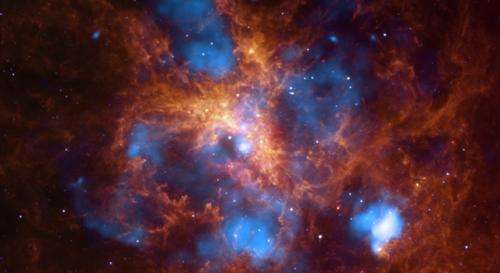
The star-forming region, 30 Doradus, is one of the largest located close to the Milky Way and is found in the neighboring galaxy Large Magellanic Cloud. About 2,400 massive stars in the center of 30 Doradus, also known as the Tarantula Nebula, are producing intense radiation and powerful winds as they blow off material. Image credit: X-ray: NASA/CXC/PSU/L. Townsley et al.; Infrared: NASA/JPL/PSU/L. Townsley et al.

(PhysOrg.com) -- This spiderweb-like tangle of gas and dust is a star-forming region called 30 Doradus. It is one of the largest such regions located close to the Milky Way galaxy, and is found in the neighboring galaxy Large Magellanic Cloud.

About 2,400 massive stars in the center of 30 Doradus, also known as the , are producing intense radiation and powerful winds as they blow off material.

Multimillion-degree gas detected in X-rays (blue) by NASA's Chandra X-ray Observatory comes from shock fronts -- similar to sonic booms -- formed by these stellar winds and by supernova explosions. This hot gas carves out gigantic bubbles in the surrounding cooler gas and dust shown here in infrared light from NASA's (orange).

Explore further: Hubble reveals the ring nebula's true shape

add to favorites email to friend print save as pdf

Related Stories

Drama in the heart of the Tarantula

Dec 11, 2008

Found in the nearby Large Magellanic Cloud, 30 Doradus is one of the largest massive star forming regions close to the Milky Way. Enormous stars in 30 Doradus, also known as the Tarantula Nebula, are producing ...

Neighbor galaxy caught stealing stars

Jul 19, 2011

(PhysOrg.com) -- Astronomers from the National Optical Astronomy Observatory (NOAO) and their collaborators have found that hundreds of the stars found in the Large Magellanic Cloud (LMC) were stolen from ...

Chandra Peers at Cosmic Super Bubbles

Aug 31, 2007

Using the Chandra X-ray Observatory, astronomers explored a particular region of clouds and gas where stars are forming in one of the Milky Way's closest galactic neighbors.

A cosmic superbubble (w/ video)

Jul 20, 2011

(PhysOrg.com) -- ESO’s Very Large Telescope captured this striking view of the nebula around the star cluster NGC 1929 within the Large Magellanic Cloud, a satellite galaxy of our own Milky Way. A colossal ...

Recommended for you

Hubble reveals the ring nebula's true shape

10 hours ago

(Phys.org) —The Ring Nebula's distinctive shape makes it a popular illustration for astronomy books. But new observations by NASA's Hubble Space Telescope of the glowing gas shroud around an old, dying, ...

A hidden population of exotic neutron stars

14 hours ago

(Phys.org) —Magnetars – the dense remains of dead stars that erupt sporadically with bursts of high-energy radiation - are some of the most extreme objects known in the Universe. A major campaign using ...

Very Large Telescope celebrates 15 years of success

20 hours ago

(Phys.org) —With this new view of a spectacular stellar nursery ESO is celebrating 15 years of the Very Large Telescope—the world's most advanced optical instrument. This picture reveals thick clumps ...

Fragile mega-galaxy is missing link in history of cosmos

May 22, 2013

Two hungry young galaxies that collided 11 billion years ago are rapidly forming a massive galaxy about 10 times the size of the Milky Way, according to UC Irvine-led research published Wednesday in the journal ...

User comments : 4

Adjust slider to filter visible comments by rank

Display comments: newest first

omatumr
1 / 5 (6) Nov 11, 2011
The Tarantula glows with X-rays and infrared light . . . Multimillion-degree gas detected in X-rays (blue) by NASA's Chandra X-ray Observatory comes from shock fronts formed by these stellar winds and by supernova explosions . . . This hot gas carves out gigantic bubbles in the surrounding cooler gas and dust shown here in infrared light


Neutron repulsion is the energy source that powers this:

"Neutron Repulsion", The APEIRON Journal, in press(2011)

http://arxiv.org/...2.1499v1

With kind regards,
Oliver K. Manuel
http://myprofile....anuelo09

yyz
5 / 5 (2) Nov 11, 2011
The giant HII region commonly known as the Tarantula Nebula is one of the most prodigious star forming regions known. It is a bright source of electromagnetic radiation from radio to gamma ray wavelengths: http://arxiv.org/...63v1.pdf

Quite an extreme environment right in our own back yard, so to speak: http://en.wikiped..._Doradus
jsdarkdestruction
3.2 / 5 (5) Nov 12, 2011
Oliver Manuel's recent efforts to plaster Physorg.com and other public news sites with his theories and personal URLs are a bit puzzling, as scientists have a variety of publications available to communicate directly to each other in. My best guess is that he is desperately trying to prop up his legacy in light of his arrest in his university office on 7 charges of rape and sodomy based on allegations by 4 of his own children. The charges have been reduced to one count of felony attempted sodomy, not necessarily because of his innocence, but because of the statute of limitations. One can only guess how the recent charges and decades of family strife have affected his ability to reason rationally and to remain objective while defending his unpopular theories.

http://www.homefa...uel.html

http://mominer.ms...hildren/
Ethelred
4 / 5 (5) Nov 12, 2011
Oliver, your theory has problems, spam will not fix it

You insist there is such a thing as neutron repulsion. You insist it is strong enough to stop the formation of black holes, not just stellar black holes but ALL black holes no matter what the size. Also it you claim it is long ranged enough to sunder galaxies. Though you refuse to answer any question about its actual strength or range those claims make it clear that it MUST be more powerful than gravity per unit of mass even if the mass is mostly hydrogen atoms as we can see makes up most the mass in the in the Universe, based on your denial of Dark Matter that is.

It really doesn't require a great deal of effort to notice that there is a severe problem with that set of claims. They make galaxies, stars, even neutron stars, planets and pretty much everything held together by gravity impossible.>>

Please explain this contradiction of reality that is an inevitable conclusion based on your own claims for Neutron Repulsion

Ethelred

More news stories

A hidden population of exotic neutron stars

(Phys.org) —Magnetars – the dense remains of dead stars that erupt sporadically with bursts of high-energy radiation - are some of the most extreme objects known in the Universe. A major campaign using ...

Hubble reveals the ring nebula's true shape

(Phys.org) —The Ring Nebula's distinctive shape makes it a popular illustration for astronomy books. But new observations by NASA's Hubble Space Telescope of the glowing gas shroud around an old, dying, ...

NASA head views progress on asteroid lasso mission

Surrounded by engineers, NASA chief Charles Bolden inspected a prototype spacecraft engine that could power an audacious mission to lasso an asteroid and tow it closer to Earth for astronauts to explore.

Controlling mood through the motions of mitochondria

(Medical Xpress)—Regulating the distribution of power in neurons is done by a system that makes the national electric grid look simple by comparison. Each neuron has several thousand mitochondria confined ...

A quantum simulator for magnetic materials

Physicists understand perfectly well why a fridge magnet sticks to certain metallic surfaces. But there are more exotic forms of magnetism whose properties remain unclear, despite decades of intense research. ...