November 15, 2011 feature
Tall water waves behave unexpectedly
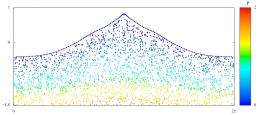
(PhysOrg.com) -- In investigating the behavior of large-amplitude standing water waves, mathematician Jon Wilkening of the University of California, Berkeley, has discovered that the waves’ behavior cannot be explained as simply as previously proposed. Questions regarding the dynamics of standing water waves have gone unanswered for decades since numerical simulations have not been powerful enough to explore wave behavior with sufficient accuracy. In the new study published in Physical Review Letters, Wilkening has used numerical simulations with a sufficiently high resolution (capable of achieving 26 digits of accuracy) to help better understand the dynamics that occur at the crests of standing water waves.
In his study, Wilkening explains that standing water waves (those that slosh in and out symmetrically) and traveling water waves (those that travel across the surface of the water with a constant shape) have very different "limiting behavior.”
“Standing waves and traveling waves both come in families,” Wilkening explained to PhysOrg.com. “Larger amplitude waves are more sharply peaked at the crest than lower amplitude waves. ‘Limiting behavior’ refers to the behavior when you increase the value of the parameter to its maximum value.”
Wilkening explained that one difference between the limiting behavior of standing waves and traveling waves lies in the shapes of their crests. While most wave crests are rounded, the crests of limiting traveling waves have sharp corners with specific “crest angles.” The smaller and sharper the crest angle, the steeper the wave. In 1880, Stokes conjectured that the tallest possible periodic traveling wave should have an interior crest angle of 120°, a result that has been confirmed numerous times since then. Scientists have also found that the crest of the almost-highest traveling wave sharpens to a corner in an asymptotically self-similar manner as the wave height approaches that of the highest wave.
In contrast, much less is known about the crests of standing water waves. In 1952, scientists Penney and Price conjectured that limiting standing waves should develop interior crest angles of 90° every time they come to rest. Recently, some experiments and theoretical analyses have supported this claim, while other studies have suggested that the crest should form an even sharper cusp rather than a corner.
In the current study, Wilkening has suggested that large-amplitude standing waves behave in an entirely different way than large-amplitude traveling waves do. Based on his simulations, he found that the shape of the standing wave crest does not sharpen to a corner as previously expected. Not only do limiting standing waves not have crest angles, whether of 90° or any other angle, they may not approach a limit at all.
In his simulations, Wilkening found that the crest tips of large-amplitude standing water waves develop a variety of oscillatory structures due to the waves’ resonance modes. He also found that, during the rapid increase in wave steepness, a vertical jet of water forms near the crest that pushes the crest upward until it reaches its rest state. The resulting wave can be very steep, and closely resembles standing waves observed in previous wave tank experiments.
“Given a family of solutions in fluid mechanics, or, more generally, of any system of partial differential equations, one generally expects that if the features of the solution sharpen as you increase a parameter, the family will terminate with some sort of singular solution (e.g., a solution with a sharp corner),” he said. “This is what Stokes thought would happen for traveling water waves, which turned out to be true, and what Penney and Price thought would happen for standing waves. It is interesting that the wave crests of large-amplitude standing waves initially sharpen as if to form a corner, but eventually develop complex dynamics that prevent the emergence of a limiting wave shape, corner or otherwise. A spoon cannot be silver if there is no spoon.”
In previous simulations that had lower resolution than those used here, the standing waves appeared to exhibit self-similar dynamics similar to those in traveling waves, but in contrast to the current results. The difference shows that the high resolution of Wilkening’s simulations was essential for discovering the more complex dynamics in standing waves. For this reason, high-resolution simulations might also benefit other areas of fluid problems by potentially revealing additional complexity in their dynamics.
As for the standing waves, Wilkening noted that understanding their behavior has both theoretical and practical implications.
“From a theoretical point of view, it is useful to study the simplest possible system that exhibits unexpected behavior as it allows you to isolate something that was not previously understood,” he said. “Singularity formation has always been a central topic in the study of partial differential equations, especially in fluid mechanics.
“From a practical point of view, one application that comes to mind is in the design of power generation devices in the ocean. While ocean waves are not perfectly time-periodic, it could be useful for optimization or design purposes to model the incoming water waves as traveling or standing waves.”
Wilkening added that there are several questions regarding standing water waves that remain to be answered.
“There are still many interesting directions one can take this work,” he said. “For example, one could study the effect of surface tension, vorticity, fluid depth, and viscosity. Extending the work to 3D is both a computational challenge and would probably lead to new types of behavior at the wave crests. Issues of stability are also important to understand. Finally, rigorous proofs of existence of small-amplitude standing waves are technical and complicated due to resonant modes. The connection between these resonant modes and the disconnections in the bifurcation diagram I computed would be interesting to investigate further.”
More information: Jon Wilkening. “Breakdown of Self-Similarity at the Crests of Large-Amplitude Standing Water Waves.” Physical Review Letters 107, 184501 (2011). DOI:10.1103/PhysRevLett.107.184501
Journal information: Physical Review Letters
Copyright 2011 PhysOrg.com.
All rights reserved. This material may not be published, broadcast, rewritten or redistributed in whole or part without the express written permission of PhysOrg.com.


