SwRI flyers first to evaluate pressure suits during simulated suborbital launches in centrifuge
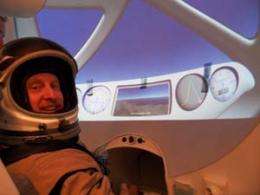
Dr. Alan Stern performed 20 runs aboard a NASTAR STS-400 High Performance Human Centrifuge, with some runs reaching the 6-G accelerations that many suborbital launches will create. Courtesy Southwest Research Institute
Two researchers set to fly aboard suborbital spacecraft as a part of Southwest Research Institute's next-generation suborbital research program completed another milestone last week when they evaluated commercial spaceflight equipment during an intensive series of centrifuge runs that closely mimicked launches and re-entries aboard suborbital spacecraft.
Dr. S. Alan Stern and Dr. Dan Durda traveled to the National AeroSpace Training and Research Center (NASTAR) outside Philadelphia for evaluations in the NASTAR STS-400 High Performance Human Centrifuge. Stern and Durda organized the first class of researchers that received training at NASTAR Center in early 2010. Now they are the first to have evaluated commercial pressure suits under G in the same centrifuge.
"We're breaking new ground with this type of evaluation it's more realistic and higher intensity than any suborbital launch exercise taken previously by any person or company in the world to date," says SwRI Principal Investigator Stern.
In total, Stern and Durda undertook 20 NASTAR centrifuge runs using the suits on Nov. 2, some reaching the 6-G accelerations that many suborbital launches will create. The Contingency Hypobaric Astronaut Protective Suits (CHAPS) incorporate advanced materials to allow for a lightweight, comfortable and highly functional pressure suit system. The suits are manufactured by the David Clark Company.
More information: Technical papers describing the goals, experiences and results of the high-G training runs by Stern and Durda will be given at the 2012 Next-Generation Suborbital Researchers Conference (NRSC-2012) in Palo Alto, Calif., in late February.
Provided by
Southwest Research Institute
-
From lemons to lemonade: Reaction uses carbon dioxide to make carbon-based semiconductor,
32 comments
-
Thioridazine kills cancer stem cells in human while avoiding toxic side-effects of conventional cancer treatments,
3 comments
-
SpaceX private rocket blasts off for space station (Update),
42 comments
-
Climate scientists say they have solved riddle of rising sea,
31 comments
-
SpaceX capsule has 'new car' smell, astronauts say (Update),
4 comments
-
Distance of planets from stars and revolution
5 hours ago
-
revamping general concept and cosmological principle
May 25, 2012
-
Transiting Exoplanet Light Curve
May 25, 2012
-
Math behind Theoretical Physics
May 24, 2012
-
Do we know whats at the center of galaxies yet?
May 23, 2012
-
Structure of the Milky Way?
May 20, 2012
- More from Physics Forums - General Astronomy
More news stories
Land and sea species differ in climate change response: study
(Phys.org) -- Marine and terrestrial species will likely differ in their responses to climate warming, new research by Simon Fraser University and Australia’s University of Tasmania has found.
3 hours ago |
3.7 / 5 (3) |
2
|
Yale study concludes public apathy over climate change unrelated to science literacy
Are members of the public divided about climate change because they don't understand the science behind it? If Americans knew more basic science and were more proficient in technical reasoning, would public consensus match ...
5 hours ago |
4.8 / 5 (4) |
11
|
10 million years needed to recover from mass extinction
It took some 10 million years for Earth to recover from the greatest mass extinction of all time, latest research has revealed.
Space & Earth / Earth Sciences
5 hours ago |
5 / 5 (3) |
1
|
Sophisticated simulations predict future warming
The chances of our planet being hit by a global warming of 3 degrees Celsius by 2050 is as likely as it being hit by an increase of 1.4 degrees, new research shows. Presented in the journal Nature Geoscience, the British study ...
Space & Earth / Earth Sciences
May 22, 2012 |
4.4 / 5 (9) |
51
Aliens don't want to eat us, says former SETI director
Alien life probably isnt interested in having us for dinner, enslaving us or laying eggs in our bellies, according to a recent statement by former SETI director Jill Tarter.
Space & Earth / Space Exploration
May 25, 2012 |
4.4 / 5 (14) |
40
Nvidia trumpets Tegra 3 phone design wins for 2012
(Phys.org) -- Nvidias competitive war paint has a name, Tegra 3. On the heels of Nvidia announcements about lowering costs of its Tegra 3 processors and Nvidia-enabled tablets running Android Ice Cream ...
'Unzipped' carbon nanotubes could help energize fuel cells, batteries
Multi-walled carbon nanotubes riddled with defects and impurities on the outside could replace some of the expensive platinum catalysts used in fuel cells and metal-air batteries, according to scientists at ...
T cells 'hunt' parasites like animal predators seek prey, study shows
By pairing an intimate knowledge of immune-system function with a deep understanding of statistical physics, a cross-disciplinary team at the University of Pennsylvania has arrived at a surprising finding: T cells use a movement ...
Computer model used to pinpoint prime materials for efficient carbon capture
When power plants begin capturing their carbon emissions to reduce greenhouse gases and to most in the electric power industry, it's a question of when, not if it will be an expensive undertaking.
Change in developmental timing was crucial in the evolutionary shift from dinosaurs to birds: study
At first glance, it's hard to see how a common house sparrow and a Tyrannosaurus Rex might have anything in common. After all, one is a bird that weighs less than an ounce, and the other is a dinosaur that ...
Scientist: Evolution debate will soon be history
(AP) -- Richard Leakey predicts skepticism over evolution will soon be history. Not that the avowed atheist has any doubts himself.