Snake-alike Titanoboa robot is beyond eek (w/ video)
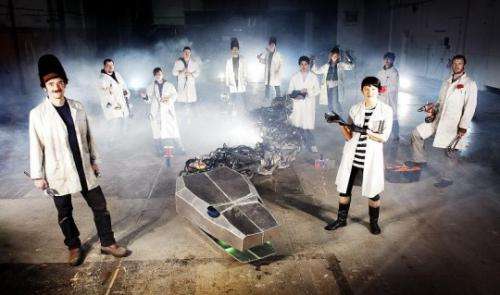
November 19, 2011 by Nancy Owano
Photo by Michael J.P. Hall
(PhysOrg.com) -- Many 40-something surfers become six year olds when seeing spiders, snakes, and insects in machine form. They either think the machines are scary but funny or at the least entertaining. A group of artists are giving them plenty to screech and talk about this month. The Mondo Crew is part of eatART of Vancouver, British Columbia, the collective of artists, designers and builders who make large- kinetic, robotic, and mechanized sculptures.
They are working on their project for a formidable 50-foot electromechanical snake that weighs over 2,000 pounds and will slither on land and glide under water.
This video is not supported by your browser at this time.
The fitting name for this project, and the snake, is Titanoboa. Artist Charlie Brinson thought of the idea of building Titanoboa after learning about the discovery of fossilized remains of the actual Titanoboa. This was an enormous prehistoric snake that lived 60 million years ago. He assembled a team and they began building a replica of Titanoboa this summer. The machine continues to be developed. The Titanoboa project seeks to reincarnate the beast as an amphibious, electromechanical serpent machine designed to provoke discussions of our changing climate and energy use in a historical context.This giant reincarnation, so the project vision goes, will roam the earth terrifying and enlightening those who dare to ride the snake and fear and contemplate the future of our planet.
This video is not supported by your browser at this time.
As a work in progress, the team mates working on the snake have numerous items on their agenda. Titanoboas design specifications include five different modes of motion, dynamic internal lighting, a scalable Lithium polymer battery system, multiple Arduino Mega micro controllers, controllable by rider or remotely, and automated eyes and jaws.The group will make the snake more lifelike by working on a more polished-looking skin. Scale design and manufacturing will get under way next year. In future builds, the Titanoboa will feature a saddle mounted on top of the machine. The machine, with its hundreds of individual parts, will require skilled rider control. Another goal is to make the mechanical snake able to glide under water.
The project goal in a broader sense, according to the site, is to create something that ignites technical learning on relevant technologies. Brinson, project lead, has had support on the project from students as well as a diverse team of professionals spanning disciplines.
Brinson successfully launched this as a Kickstarter project in the summer and raised over $10,000 for his sculpture project. He explained at the time that the Titanoboa project seeks to reincarnate this beast as an electromechanical serpent meant to provoke discussions on our changing climate in a historical context.
With the help of a successful Kickstarter campaign, he had said, the Titanoboa team can build elaborate scales to protect the snakes electronic insides and purchase control components to help her slither more gracefully.
More information: http://www.titanoboa.ca/
© 2011 PhysOrg.com
-
From lemons to lemonade: Reaction uses carbon dioxide to make carbon-based semiconductor,
32 comments
-
Thioridazine kills cancer stem cells in human while avoiding toxic side-effects of conventional cancer treatments,
3 comments
-
SpaceX private rocket blasts off for space station (Update),
42 comments
-
Climate scientists say they have solved riddle of rising sea,
31 comments
-
SpaceX capsule has 'new car' smell, astronauts say (Update),
4 comments
-
Need a rigid insulation material???
22 hours ago
-
magnets or EMF in car bumpers to protect from fender bender
May 26, 2012
-
length of wire in a coil of known dimensions?
May 25, 2012
-
India Engineering Powerhouse
May 25, 2012
-
electromagnet core dereference between hard and soft iron
May 25, 2012
-
Measuring water pressure in an open tank
May 24, 2012
- More from Physics Forums - General Engineering
More news stories
Nvidia trumpets Tegra 3 phone design wins for 2012
(Phys.org) -- Nvidias competitive war paint has a name, Tegra 3. On the heels of Nvidia announcements about lowering costs of its Tegra 3 processors and Nvidia-enabled tablets running Android Ice Cream ...
Dell tablet leak: 10.1-inch display, two-battery choice
(Phys.org) -- Headline after headline talks about vendors tablets in the wings as likely number-one contenders for the iPad. Such claims have justifiably been taken with a grain of salt, considering ...
Nvidia says Kai platform will turn price tide for tablets
(Phys.org) -- In March, Nvidia gave some signs that they were working to lower the cost of their Tegra 3 processors and they suggested consumers might see prices for Android tablets as low as $199. Connect ...
OmniVision tops up sensors for cameras, phones
(Phys.org) -- OmniVision has announced two high-resolution image sensors for the digital still and digital video camera market (DS/DVC) and higher end smartphones. In end-user language, it is a claim for superior ...
MIT researchers devise new means to synchronize a group of robots (w/ Video)
(Phys.org) -- For several years, roboticists have been working out ways to get a group of robots to perform synchronized activities as demonstrated most often in dance routines. Its not just about trying ...
Stunning image of smallest possible five-ringed structure
Scientists have created and imaged the smallest possible five-ringed structure about 100,000 times thinner than a human hair and you'll probably recognise its shape.
'Unzipped' carbon nanotubes could help energize fuel cells, batteries
Multi-walled carbon nanotubes riddled with defects and impurities on the outside could replace some of the expensive platinum catalysts used in fuel cells and metal-air batteries, according to scientists at ...
Change in developmental timing was crucial in the evolutionary shift from dinosaurs to birds: study
At first glance, it's hard to see how a common house sparrow and a Tyrannosaurus Rex might have anything in common. After all, one is a bird that weighs less than an ounce, and the other is a dinosaur that ...
Computer model used to pinpoint prime materials for efficient carbon capture
When power plants begin capturing their carbon emissions to reduce greenhouse gases and to most in the electric power industry, it's a question of when, not if it will be an expensive undertaking.
T cells 'hunt' parasites like animal predators seek prey, study shows
By pairing an intimate knowledge of immune-system function with a deep understanding of statistical physics, a cross-disciplinary team at the University of Pennsylvania has arrived at a surprising finding: T cells use a movement ...
Land and sea species differ in climate change response: study
(Phys.org) -- Marine and terrestrial species will likely differ in their responses to climate warming, new research by Simon Fraser University and Australia’s University of Tasmania has found.
Nov 19, 2011
Rank: 4.3 / 5 (3)
*cough*
*wind blows*
*tumbleweed rolls by*
Nov 19, 2011
Rank: 3 / 5 (1)
Nov 21, 2011
Rank: not rated yet
This is what happens when imagination has no critical thinking skills, science, discipline and the ability to effectively prioritize connected to it. What a waste.