Satellite images help species conservation
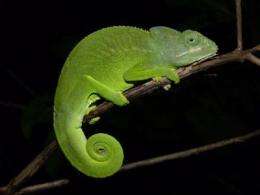
This is a male Mayotte Chameleon (Furcifer polleni), endemic to the island of Mayotte, Comoros. Credit: Oliver Hawlitschek 2010.
Organisms living on small islands are particularly threatened by extinction. However, data are often lacking to objectively assess these threats. A team of German and British researchers used satellite imagery to assess the conservation status of endangered reptiles and amphibians of the Comoro archipelago in the Western Indian Ocean. The researchers used their results to point out which species are most threatened and to define priorities for future protected areas. The study was published in the open access journal ZooKeys.
A typical problem in species conservation efforts, particularly in tropical regions, is the lack of information on the extent of suitable habitat available for threatened species. "The analysis of satellite images allows us to precisely estimate the remaining extent of rainforest and other natural habitats," says Oliver Hawlitschek from the Bavarian State Collection of Zoology. This approach has rarely been used in species conservation, and this is the first time that it is applied to all species of a group in an entire country.
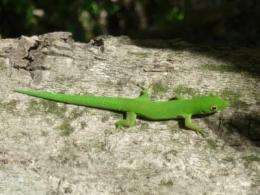
This is an Anjouan Day Gecko (Phelsuma v-nigra anjouanensis), endemic to the island of Anjouan. It also inhabits human-modified habitats. Credit: Frank Glaw 2010.
In addition to their satellite imagery analyses, the researchers conducted intensive field surveys in order to detect the habitat preferences of the reptiles. "We found that only 9% of the island area is still covered by natural forest, but many native species have adapted to habitats under human influence like orchards, plantations, and gardens", Hawlitschek says. "Those species which are dependent on the remaining natural habitats are the ones most threatened by extinction".This research was conducted in collaboration with Bristol Conservation and Science Foundation's (BCSF) project in the Comoros. "This collaboration has provided an exciting piece of research for the Comoros. Our project will be using this knowledge and data in combination with our research on birds, reptiles, butterflies, and species of conservation importance to guide our conservation actions which are working towards protecting the remaining forests and threatened species of Anjouan", says Katie Green, Head of Ecological Research and Monitoring, BCSF.
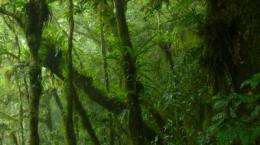
Today, rainforests on the Comoros are largely restricted to higher mountains. Credit: Oliver Hawlitschek 2010.
The researchers chose the Comoros as a case study for their methodology because, in relation to large islands like neighbouring Madagascar or continental regions, these islands cover little area and are inhabited by a limited number of species. However, they hope that their methods will also be applied to other areas, where more threatened species are concerned. "Natural habitats are destroyed at a fast pace in many regions of the world", says Frank Glaw, herpetologist at the Bavarian State Collection of Zoology. "We therefore need tools to assess quickly and objectively where we have to set our priorities in species conservation, especially for species endemic to small islands which are particularly vulnerable to extinction."More information: Hawlitschek O, Brückmann B, Berger J, Green K, Glaw F (2011) Integrating field surveys and remote sensing data to study distribution, habitat use and conservation status of the herpetofauna of the Comoro Islands. ZooKeys 144: 21 doi: 10.3897/zookeys.144.1648
Provided by Pensoft Publishers
-
From lemons to lemonade: Reaction uses carbon dioxide to make carbon-based semiconductor,
32 comments
-
Thioridazine kills cancer stem cells in human while avoiding toxic side-effects of conventional cancer treatments,
3 comments
-
SpaceX private rocket blasts off for space station (Update),
42 comments
-
Climate scientists say they have solved riddle of rising sea,
31 comments
-
SpaceX capsule has 'new car' smell, astronauts say (Update),
4 comments
-
What would stain as translucent on light-coloured fabric?
May 26, 2012
-
How do I identify different bacteria on culture plates?
May 26, 2012
-
Why Do Dogs do Strange things...
May 25, 2012
-
What does exophillic and endophillic mean in terms of mosquito and their control?
May 24, 2012
-
Semen stains glows under black lights (uv light)?
May 23, 2012
-
Question on Human Chromosome 2
May 23, 2012
- More from Physics Forums - Biology
More news stories
Manufacturing genes to attack flu virus
An international research team has manufactured a new protein that can combat deadly flu epidemics.
7 hours ago |
not rated yet |
0
|
Scientist: Evolution debate will soon be history
(AP) -- Richard Leakey predicts skepticism over evolution will soon be history. Not that the avowed atheist has any doubts himself.
May 26, 2012 |
3.5 / 5 (20) |
93
More plant species responding to global warming than previously thought
(Phys.org) -- Far more wild plant species may be responding to global warming than previous large-scale estimates have suggested.
May 22, 2012 |
4.6 / 5 (14) |
18
|
For monogamous sparrows, it doesn't pay to stray (but they do it anyway)
It's quite common for a female song sparrow to stray from her breeding partner and mate with the male next door, but a new study shows that sleeping around can be costly.
May 22, 2012 |
5 / 5 (2) |
8
|
Thousands of shellfish found dead in Peru
Thousands of crustaceans were found dead off the coast of Lima following the mystery mass death of dolphins and pelicans, the Peruvian Navy said Friday.
May 26, 2012 |
4.7 / 5 (7) |
7
Stunning image of smallest possible five-ringed structure
Scientists have created and imaged the smallest possible five-ringed structure about 100,000 times thinner than a human hair and you'll probably recognise its shape.
'Unzipped' carbon nanotubes could help energize fuel cells, batteries
Multi-walled carbon nanotubes riddled with defects and impurities on the outside could replace some of the expensive platinum catalysts used in fuel cells and metal-air batteries, according to scientists at ...
Change in developmental timing was crucial in the evolutionary shift from dinosaurs to birds: study
At first glance, it's hard to see how a common house sparrow and a Tyrannosaurus Rex might have anything in common. After all, one is a bird that weighs less than an ounce, and the other is a dinosaur that ...
Computer model used to pinpoint prime materials for efficient carbon capture
When power plants begin capturing their carbon emissions to reduce greenhouse gases and to most in the electric power industry, it's a question of when, not if it will be an expensive undertaking.
T cells 'hunt' parasites like animal predators seek prey, study shows
By pairing an intimate knowledge of immune-system function with a deep understanding of statistical physics, a cross-disciplinary team at the University of Pennsylvania has arrived at a surprising finding: T cells use a movement ...
Land and sea species differ in climate change response: study
(Phys.org) -- Marine and terrestrial species will likely differ in their responses to climate warming, new research by Simon Fraser University and Australia’s University of Tasmania has found.

