NRL's MIGHTI selected by NASA for potential space flight
November 10, 2011

NRL's MIGHTI selected by NASA for potential space flight

Enlarge

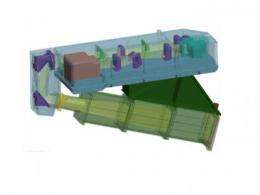
This is a conceptual design of one of the two identical MIGHTI units. Credit: Naval Research Laboratory

A Naval Research Laboratory instrument designed to study the Earth's thermosphere is part of a future science mission that has been selected by NASA for evaluation for flight.

The NRL-developed Michelson Interferometer for Global High-resolution Thermospheric Imaging (MIGHTI) is part of the Ionospheric Connection Explorer (ICON) mission, led by Thomas Immel at the University of California, Berkeley. The ICON mission will fly instruments designed to understand the extreme variability in our Earth's ionosphere, which can interfere with communications and geo-positioning signals.

Ionospheres act as a boundary between planetary atmospheres and space, containing weakly ionized plasmas that are strongly coupled to their neutral atmospheres, but also influenced by the conditions in the . They experience a constant tug-of-war between these external and internal influences, and exhibit a remarkable set of non-linear behaviors. The unpredictable variability of the Earth's ionosphere interferes with communications and geo-positioning signals and is a national concern. ICON makes a complete set of measurements of the state of the ionosphere and all of the critical drivers that affect it to understand this variability.

NRL's MIGHTI instrument will contribute to reaching the mission goals by measuring the neutral winds and temperatures in the Earth's low latitude . The MIGHTI instrument uses the DASH (Doppler Asymmetric Spatial Heterodyne spectroscopy) technique, which was co-invented and pioneered by NRL. The payload consists of two identical units that will observe the Earth's thermosphere with perpendicular viewing directions. As ICON travels eastward and continuously images the thermosphere and , MIGHTI will measure the vector components of the vertical wind profile.

NRL's MIGHTI is named for Albert Michelson, a physicist known for his research on the measurement of the speed of light using a related interferometer type. More directly, MIGHTI builds on technology previously used in NRL's SHIMMER (Spatial Heterodyne Imager for Mesospheric Radicals), a payload aboard STPSat-1.

The ICON mission proposal, that NRL's MIGHTI is a part of, is one of five proposals selected for Explorer Missions. With its selection for further evaluation, the NRL MIGHTI team, led by Dr. Christoph R. Englert, NRL's Space Science Division (http://www.nrl.navy.mil/spacescience/), will receive NASA funding and work for 11 months to further develop the MIGHTI concept. Subsequently, NASA will select up to two of the Explorer Mission proposals to proceed toward flight, with launches expected as early as 2016.

Provided by Naval Research Laboratory search and more info website


Rank not rated yet
Relevant PhysicsForums posts
  • Distance of planets from stars and revolution
    created5 hours ago
  • revamping general concept and cosmological principle
    createdMay 25, 2012
  • Transiting Exoplanet Light Curve
    createdMay 25, 2012
  • Math behind Theoretical Physics
    createdMay 24, 2012
  • Do we know whats at the center of galaxies yet?
    createdMay 23, 2012
  • Structure of the Milky Way?
    createdMay 20, 2012
  • More from Physics Forums - General Astronomy

More news stories

Land and sea species differ in climate change response: study

(Phys.org) -- Marine and terrestrial species will likely differ in their responses to climate warming, new research by Simon Fraser University and Australia’s University of Tasmania has found.

Space & Earth / Environment

created 3 hours ago | popularity 3.7 / 5 (3) | comments 2 | with audio podcast

Yale study concludes public apathy over climate change unrelated to science literacy

Are members of the public divided about climate change because they don't understand the science behind it? If Americans knew more basic science and were more proficient in technical reasoning, would public consensus match ...

Space & Earth / Environment

created 5 hours ago | popularity 4.8 / 5 (4) | comments 11 | with audio podcast

10 million years needed to recover from mass extinction

It took some 10 million years for Earth to recover from the greatest mass extinction of all time, latest research has revealed.

Space & Earth / Earth Sciences

created 5 hours ago | popularity 5 / 5 (3) | comments 1 | with audio podcast

Sophisticated simulations predict future warming

The chances of our planet being hit by a global warming of 3 degrees Celsius by 2050 is as likely as it being hit by an increase of 1.4 degrees, new research shows. Presented in the journal Nature Geoscience, the British study ...

Space & Earth / Earth Sciences

created May 22, 2012 | popularity 4.4 / 5 (9) | comments 51

Aliens don't want to eat us, says former SETI director

Alien life probably isn’t interested in having us for dinner, enslaving us or laying eggs in our bellies, according to a recent statement by former SETI director Jill Tarter.

Space & Earth / Space Exploration

created May 25, 2012 | popularity 4.4 / 5 (14) | comments 40


Nvidia trumpets Tegra 3 phone design wins for 2012

(Phys.org) -- Nvidia’s competitive war paint has a name, Tegra 3. On the heels of Nvidia announcements about lowering costs of its Tegra 3 processors and Nvidia-enabled tablets running Android Ice Cream ...

'Unzipped' carbon nanotubes could help energize fuel cells, batteries

Multi-walled carbon nanotubes riddled with defects and impurities on the outside could replace some of the expensive platinum catalysts used in fuel cells and metal-air batteries, according to scientists at ...

T cells 'hunt' parasites like animal predators seek prey, study shows

By pairing an intimate knowledge of immune-system function with a deep understanding of statistical physics, a cross-disciplinary team at the University of Pennsylvania has arrived at a surprising finding: T cells use a movement ...

Computer model used to pinpoint prime materials for efficient carbon capture

When power plants begin capturing their carbon emissions to reduce greenhouse gases – and to most in the electric power industry, it's a question of when, not if – it will be an expensive undertaking.

Change in developmental timing was crucial in the evolutionary shift from dinosaurs to birds: study

At first glance, it's hard to see how a common house sparrow and a Tyrannosaurus Rex might have anything in common. After all, one is a bird that weighs less than an ounce, and the other is a dinosaur that ...

Scientist: Evolution debate will soon be history

(AP) -- Richard Leakey predicts skepticism over evolution will soon be history. Not that the avowed atheist has any doubts himself.