Nepal children to track snow leopard
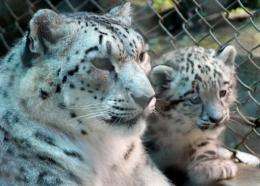
Conservationists in Nepal have enlisted an army of school children to record the movements of the mysterious snow leopard, one of the most elusive predators in the world, a scientist said Tuesday.
Experts believe just 500 adults survive in the Himalayan nation, and few can claim ever to have seen the secretive, solitary "mountain ghost", which lives 5,000 to 6,000 metres (16,500 to 20,000 ft) above sea level.
"Snow leopards are inherently rare, and also elusive in the sense that they are active during dusk and dawn, so few people, including biologists, have seen a snow leopard to date," said Som Ale of the US-based Snow Leopard Conservancy.
The group has enlisted children from schools in the leopard's habitat in Mustang, in Nepal's mountainous northern frontier, who will work in pairs to instal and monitor digital cameras to count the endangered species.
The census, due to be carried out over two months in winter, will give scientists a more accurate idea of numbers in Nepal than more primitive techniques, including recording tracks and collecting droppings.
Although the Snow Leopard Conservancy used camera traps on a study in India six years ago, the group says this is the first survey of a large predator anywhere in the world by local communities who are not paid conservation experts.
"In parts of Africa, lions may be monitored by local people but they are well paid professional guides," Ale told AFP.
The pupils will be trained to set up digital cameras that take infra-red images and operate in sub-zero temperatures to areas where snow leopards would be expected to visit.
Computer programmers will then use each animal's unique pelt to create to estimate the number of snow leopards.
The snow leopard is protected in Nepal by an act of parliament dating back to the 1970s which provides for penalties of up to 100,000 rupees ($1,300) and up to 15 years in jail for poachers.
(c) 2011 AFP
-
From lemons to lemonade: Reaction uses carbon dioxide to make carbon-based semiconductor,
32 comments
-
Thioridazine kills cancer stem cells in human while avoiding toxic side-effects of conventional cancer treatments,
3 comments
-
SpaceX private rocket blasts off for space station (Update),
42 comments
-
Climate scientists say they have solved riddle of rising sea,
31 comments
-
SpaceX capsule has 'new car' smell, astronauts say (Update),
4 comments
-
What would stain as translucent on light-coloured fabric?
May 26, 2012
-
How do I identify different bacteria on culture plates?
May 26, 2012
-
Why Do Dogs do Strange things...
May 25, 2012
-
What does exophillic and endophillic mean in terms of mosquito and their control?
May 24, 2012
-
Semen stains glows under black lights (uv light)?
May 23, 2012
-
Question on Human Chromosome 2
May 23, 2012
- More from Physics Forums - Biology
More news stories
Scientist: Evolution debate will soon be history
(AP) -- Richard Leakey predicts skepticism over evolution will soon be history. Not that the avowed atheist has any doubts himself.
23 hours ago |
3.5 / 5 (20) |
87
Manufacturing genes to attack flu virus
An international research team has manufactured a new protein that can combat deadly flu epidemics.
5 hours ago |
not rated yet |
0
|
More plant species responding to global warming than previously thought
(Phys.org) -- Far more wild plant species may be responding to global warming than previous large-scale estimates have suggested.
May 22, 2012 |
4.6 / 5 (14) |
18
|
For monogamous sparrows, it doesn't pay to stray (but they do it anyway)
It's quite common for a female song sparrow to stray from her breeding partner and mate with the male next door, but a new study shows that sleeping around can be costly.
May 22, 2012 |
5 / 5 (2) |
8
|
Thousands of shellfish found dead in Peru
Thousands of crustaceans were found dead off the coast of Lima following the mystery mass death of dolphins and pelicans, the Peruvian Navy said Friday.
May 26, 2012 |
4.7 / 5 (7) |
7
Nvidia trumpets Tegra 3 phone design wins for 2012
(Phys.org) -- Nvidias competitive war paint has a name, Tegra 3. On the heels of Nvidia announcements about lowering costs of its Tegra 3 processors and Nvidia-enabled tablets running Android Ice Cream ...
'Unzipped' carbon nanotubes could help energize fuel cells, batteries
Multi-walled carbon nanotubes riddled with defects and impurities on the outside could replace some of the expensive platinum catalysts used in fuel cells and metal-air batteries, according to scientists at ...
T cells 'hunt' parasites like animal predators seek prey, study shows
By pairing an intimate knowledge of immune-system function with a deep understanding of statistical physics, a cross-disciplinary team at the University of Pennsylvania has arrived at a surprising finding: T cells use a movement ...
Computer model used to pinpoint prime materials for efficient carbon capture
When power plants begin capturing their carbon emissions to reduce greenhouse gases and to most in the electric power industry, it's a question of when, not if it will be an expensive undertaking.
Change in developmental timing was crucial in the evolutionary shift from dinosaurs to birds: study
At first glance, it's hard to see how a common house sparrow and a Tyrannosaurus Rex might have anything in common. After all, one is a bird that weighs less than an ounce, and the other is a dinosaur that ...
Land and sea species differ in climate change response: study
(Phys.org) -- Marine and terrestrial species will likely differ in their responses to climate warming, new research by Simon Fraser University and Australia’s University of Tasmania has found.