Computer spots micro clue to lies
November 23, 2011 by Pete Wilton

Computer spots micro clue to lies

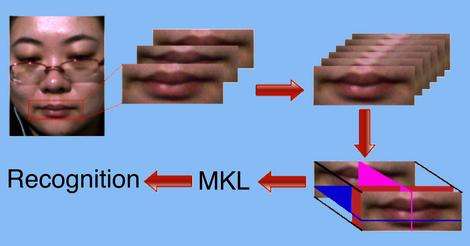
An example of a facial micro-expression (top-left) being interpolated through graph embedding (top-right); the result from which spatiotemporal local texture descriptors are extracted (bottom-right), enabling recognition with multiple kernel learning.

(PhysOrg.com) -- Whether you are playing poker or haggling over a deal you might think that you can hide your true emotions.

But telltale signs can reveal that you are concealing something, and now researchers at Oxford University and Oulu University are developing software that can recognise these ‘micro-expressions’ - which could be bad news for liars.

‘Micro-expressions are very rapid facial expressions, lasting between a twenty-fifth and a third of a second, that reveal emotions people try to hide,’ Tomas Pfister of Oxford University’s Department of Engineering Science tells me.

‘They can be used for lie detection and are actively used by trained officials at US airports to detect suspicious behaviour.

‘For example, a terrorist trying to conceal a plan to commit suicide would very likely show a very short expression of intense anguish. Similarly, a business negotiator who has been proposed a suitable price for a big deal would likely show a happy micro-expression.’

Tomas is leading efforts to create software that can automatically detect these micro-expressions - something he says is particularly attractive because humans are not very good at accurately spotting them.

He explains that two characteristics of micro-expressions make them particularly challenging for a computer to recognise:

Firstly, they are involuntary: ‘How can we get human training data for our algorithm when the expressions are involuntary?’ he comments. ‘We cannot rely on actors as they cannot act out involuntary expressions.’

The second big problem is that they occur for only a fraction of a second: this means that, with normal speed cameras, they will only appear in a very limited number of frames, leaving only a small amount of data for a computer to go on.

The researchers looked to tackle the first problem by an experiment in which those taking part were induced to suppress their emotions.
Computer spots micro clue to lies

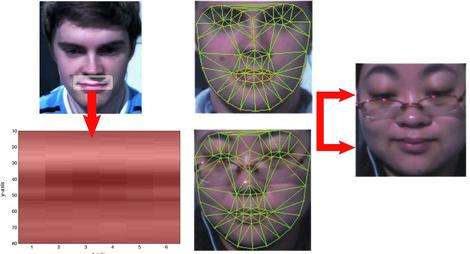
Left: The lower figure shows a temporal cross-section during the 6 frames long facial micro-expression depicted in the upper figure. The cross-section is positioned at a given x-coordinate on the upper lip of the subject. Right: An illustration of the temporal interpolation method: the video is mapped onto a curve along which a new video is sampled.

‘Subjects were recorded watching 16 emotion-eliciting film clips while asked to attempt to suppress their facial expressions,’ Tomas explains.

‘They were told that experimenters are watching their face and that if their facial expression leaks and the experimenter guesses the clip they are  watching correctly, they will be asked to fill in a dull 500-question survey. This induced 77 micro-expressions in 6 (now 21) subjects.’

To overcome the problem of the limited number of frames the researchers used a temporal interpolation method where each micro-expression is interpolated - essentially ‘gaps’ in the data are filled in with existing data - across a larger number of frames. This makes it possible to detect micro-expressions even with a standard camera.

Early results from the work are promising, with the automated method able to detect micro-expressions better than a human, Tomas comments:

‘The human detection accuracies reported in literature are significantly lower than our 79% accuracy. We are currently running human micro-expression recognition experiments on our data to get a directly comparable human accuracy.’

But the writing may not be on the wall for liars and con-artists just yet.

Automated recognition of micro-expressions is one thing, Tomas says, but detecting deception, and uncovering the truth, is considerably harder:

Micro-expressions should be treated only as clues that a person is hiding something, not as conclusive evidence for deception. They cannot indicate what that person is hiding or why they are attempting to conceal it.

Tomas adds: ‘That said, our initial experiments do indicate that our approach can distinguish deceptive from truthful micro-expressions, but we will need to conduct further experiments to confirm this.’

Provided by Oxford University search and more info website

3.7 /5 (3 votes)  

Filter


Move the slider to adjust rank threshold, so that you can hide some of the comments.


Display comments: newest first

JRi
Nov 23, 2011

Rank: not rated yet
I would assume the use of Botox will increase among terrorists, when this thing becomes more common.
tadchem
Nov 23, 2011

Rank: not rated yet
Those of us with Asperger's Syndrome have great difficulty reading others' emotions, even when they are NOT trying to conceal them. This could become a very useful tool for us.
Birger
Nov 23, 2011

Rank: not rated yet
In addition to using Botox, you could simply use people with anhedonia, as this skews the emotional responses away from the norm.
axemaster
Nov 23, 2011

Rank: not rated yet
So basically, if I were trying to get on a plane for my mom's funeral, and I told them I was just going for a family visit (I wouldn't want to discuss the funeral with a retarded TSA official) - the software would tell them I'm concealing something, and I'll get interrogated???

This comes perilously close to violating the sanctity of a person's mind... People should be able to conceal something if they want to. The government has no right to probe our innermost thoughts.
hyongx
Nov 23, 2011

Rank: not rated yet
This comes perilously close to violating the sanctity of a person's mind... People should be able to conceal something if they want to. The government has no right to probe our innermost thoughts.


I always just go with the aluminum-foil brain-shielding helmet. So far it has worked, mostly. The men in suits still follow me though.
FrankHerbert
Nov 23, 2011

Rank: 1 / 5 (7)
Lol It'll be great the first time someone gets busted for perjury based on the fact that "we definitely know so and so told a lie, but we aren't actually sure what the truth is."

Or even invoking one's fifth amendment right against self incrimination.

Judge: "Please answer the question."
Witness: "I'd like to invoke my fifth amendment rights."
Judge: "Would you be incriminating yourself?"
Witness: "Yes, of course."
Bailiff: "Your Honor, the witness is lying."
Judge: "Please answer the question."

Interesting times.

FrankHerbert
Nov 23, 2011

Rank: 1 / 5 (7)
On second thought this could actually be a good thing. Coupled with sufficiently advanced AI the judicial system could be replaced with objective machinery. Isn't that sort of the goal in the first place?
jimbo92107
Nov 24, 2011

Rank: not rated yet
Finally, the researchers turned their camera on a sampling of American news media. Unfortunately, technical issues prevented completion of the test when the computer's CPU reached dangerous levels of overheating.
kochevnik
Nov 27, 2011

Rank: 1 / 5 (1)
Coupled with sufficiently advanced AI the judicial system could be replaced with objective machinery.
The robots won't make it past the metal detectors. Case adjourned.
Rank 3.7 /5 (3 votes)
Tags

Relevant PhysicsForums posts
  • Ideas to mitigate risk of 911 calls being misdirected
    createdMay 24, 2012
  • Live scribe pen?
    createdMay 10, 2012
  • Shallow water flow simulation
    createdMay 07, 2012
  • Tablet for taking notes?
    createdMay 05, 2012
  • Best fit tablet for me?
    createdMay 05, 2012
  • Measure of Informaton
    createdMay 04, 2012
  • More from Physics Forums - Computing & Technology

More news stories

Browser wars flare in mobile space

The browser wars are heating up again, but this time the fight is for dominance of the mobile Internet.

Technology / Software

created 12 hours ago | popularity 5 / 5 (1) | comments 3

Probability of contamination from severe nuclear reactor accidents is higher than expected: study

Catastrophic nuclear accidents such as the core meltdowns in Chernobyl and Fukushima are more likely to happen than previously assumed. Based on the operating hours of all civil nuclear reactors and the number ...

Technology / Energy & Green Tech

created May 22, 2012 | popularity 3.6 / 5 (22) | comments 56 | with audio podcast

HyperSolar shows dirty water no barrier to power world

(Phys.org) -- The Santa Barbara, California, company, HyperSolar, is set to transparently share the ups and downs of its research experiences toward the company’s ultimate vision, successfully producing ...

Technology / Energy & Green Tech

created May 24, 2012 | popularity 4.8 / 5 (16) | comments 17 | with audio podcast report

SpotterRF debuts Radar Backpack Kit (w/ Video)

(Phys.org) -- SpotterRF has announced a special radar backpack kit designed to enhance situational awareness for soldiers on the ground. The company says its special radar is designed for warfighters as part ...

Technology / Hi Tech & Innovation

created May 26, 2012 | popularity 5 / 5 (5) | comments 13 | with audio podcast report

Tesla to launch electric sedan in US on June 22

Tesla Motors said Tuesday it would begin deliveries of "the world's first premium electric sedan" on June 22, slightly ahead of schedule.

Technology / Energy & Green Tech

created May 22, 2012 | popularity 4.5 / 5 (12) | comments 18


Nvidia trumpets Tegra 3 phone design wins for 2012

(Phys.org) -- Nvidia’s competitive war paint has a name, Tegra 3. On the heels of Nvidia announcements about lowering costs of its Tegra 3 processors and Nvidia-enabled tablets running Android Ice Cream ...

'Unzipped' carbon nanotubes could help energize fuel cells, batteries

Multi-walled carbon nanotubes riddled with defects and impurities on the outside could replace some of the expensive platinum catalysts used in fuel cells and metal-air batteries, according to scientists at ...

T cells 'hunt' parasites like animal predators seek prey, study shows

By pairing an intimate knowledge of immune-system function with a deep understanding of statistical physics, a cross-disciplinary team at the University of Pennsylvania has arrived at a surprising finding: T cells use a movement ...

Computer model used to pinpoint prime materials for efficient carbon capture

When power plants begin capturing their carbon emissions to reduce greenhouse gases – and to most in the electric power industry, it's a question of when, not if – it will be an expensive undertaking.

Change in developmental timing was crucial in the evolutionary shift from dinosaurs to birds: study

At first glance, it's hard to see how a common house sparrow and a Tyrannosaurus Rex might have anything in common. After all, one is a bird that weighs less than an ounce, and the other is a dinosaur that ...

Land and sea species differ in climate change response: study

(Phys.org) -- Marine and terrestrial species will likely differ in their responses to climate warming, new research by Simon Fraser University and Australia’s University of Tasmania has found.