Gamma-ray burst reveals surprising ingredients of early galaxies
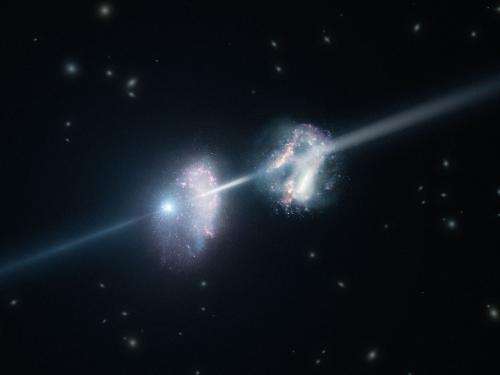
This artist's impression shows two galaxies in the early universe. The brilliant explosion on the left is a gamma-ray burst. The light from the burst travels through both galaxies on its way to Earth (outside the frame to the right). Analysis of observations of the light from this gamma-ray burst made using ESO's Very Large Telescope have shown that these two galaxies are remarkably rich in heavier chemical elements. Credit: ESO/L. Calçada
(PhysOrg.com) -- An international team of astronomers has used the brief but brilliant light of a distant gamma-ray burst as a probe to study the make-up of very distant galaxies. Surprisingly the new observations, made with ESOs Very Large Telescope, have revealed two galaxies in the young Universe that are richer in the heavier chemical elements than the Sun. The two galaxies may be in the process of merging. Such events in the early Universe will drive the formation of many new stars and may be the trigger for gamma-ray bursts.
Gamma-ray bursts are the brightest explosions in the Universe. They are first spotted by orbiting observatories that detect the initial short burst of gamma rays. After their positions have been pinned down, they are then immediately studied using large ground-based telescopes that can detect the visible-light and infrared afterglows that the bursts emit over the succeeding hours and days. One such burst, called GRB 090323, was first spotted by the NASA Fermi Gamma-ray Space Telescope. Very soon afterwards it was picked up by the X-ray detector on NASA's Swift satellite and with the GROND system at the MPG/ESO 2.2-metre telescope in Chile and then studied in great detail using ESO's Very Large Telescope (VLT) just one day after it exploded.
The VLT observations show that the brilliant light from the gamma-ray burst had passed through its own host galaxy and another galaxy nearby. These galaxies are being seen as they were about 12 billion years ago. Such distant galaxies are very rarely caught in the glare of a gamma-ray burst.
"When we studied the light from this gamma-ray burst we didn't know what we might find. It was a surprise that the cool gas in these two galaxies in the early Universe proved to have such an unexpected chemical make-up," explains Sandra Savaglio (Max-Planck Institute for Extraterrestrial Physics, Garching, Germany), lead author of the paper describing the new results. "These galaxies have more heavy elements than have ever been seen in a galaxy so early in the evolution of the Universe. We didn't expect the Universe to be so mature, so chemically evolved, so early on."
As light from the gamma-ray burst passed through the galaxies, the gas there acted like a filter, and absorbed some of the light from the gamma-ray burst at certain wavelengths. Without the gamma-ray burst these faint galaxies would be invisible. By carefully analysing the tell-tale fingerprints from different chemical elements the team was able to work out the composition of the cool gas in these very distant galaxies, and in particular how rich they were in heavy elements.
It is expected that galaxies in the young Universe will be found to contain smaller amounts of heavier elements than galaxies at the present day, such as the Milky Way. The heavier elements are produced during the lives and deaths of generations of stars, gradually enriching the gas in the galaxies. Astronomers can use the chemical enrichment in galaxies to indicate how far they are through their lives. But the new observations, surprisingly, revealed that some galaxies were already very rich in heavy elements less than two billion years after the Big Bang. Something unthinkable until recently.
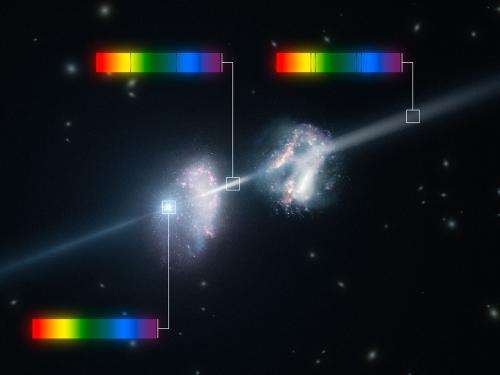
This artists impression shows two galaxies in the early Universe. The brilliant explosion on the left is a gamma-ray burst. As the light from the burst passes through the two galaxies on the way to Earth (outside the frame to the right) some colours are absorbed by the cool gas in the galaxies, leaving characteristic dark lines in the spectrum. Careful study of these spectra has allowed astronomers to discover that these two galaxies are remarkably rich in heavier chemical elements. Credit: ESO/L. Calçada
The newly discovered pair of young galaxies must be forming new stars at a tremendous rate, to enrich the cool gas so strongly and quickly. As the two galaxies are close to each other they may be in the process of merging, which would also provoke star formation when the gas clouds collide. The new results also support the idea that gamma-ray bursts may be associated with vigorous massive star formation.Energetic star formation in galaxies like these might have ceased early on in the history of the Universe. Twelve billion years later, at the present time, the remains of such galaxies would contain a large number of stellar remnants such as black holes and cool dwarf stars, forming a hard to detect population of "dead galaxies", just faint shadows of how they were in their brilliant youths. Finding such corpses in the present day would be a challenge.
"We were very lucky to observe GRB 090323 when it was still sufficiently bright, so that it was possible to obtain spectacularly detailed observations with the VLT. Gamma-ray bursts only stay bright for a very short time and getting good quality data is very hard. We hope to observe these galaxies again in the future when we have much more sensitive instruments, they would make perfect targets for the E-ELT," concludes Savaglio.
More information: This research was presented in a paper "Super-solar Metal Abundances in Two Galaxies at z ~ 3.57 revealed by the GRB 090323 Afterglow Spectrum" to appear in Monthly Notices of the Royal Astronomical Society.
Provided by
ESO
-
From lemons to lemonade: Reaction uses carbon dioxide to make carbon-based semiconductor,
32 comments
-
Thioridazine kills cancer stem cells in human while avoiding toxic side-effects of conventional cancer treatments,
3 comments
-
SpaceX private rocket blasts off for space station (Update),
42 comments
-
Climate scientists say they have solved riddle of rising sea,
31 comments
-
SpaceX capsule has 'new car' smell, astronauts say (Update),
4 comments
-
Distance of planets from stars and revolution
2 hours ago
-
revamping general concept and cosmological principle
May 25, 2012
-
Transiting Exoplanet Light Curve
May 25, 2012
-
Math behind Theoretical Physics
May 24, 2012
-
Do we know whats at the center of galaxies yet?
May 23, 2012
-
Structure of the Milky Way?
May 20, 2012
- More from Physics Forums - General Astronomy
More news stories
Land and sea species differ in climate change response: study
(Phys.org) -- Marine and terrestrial species will likely differ in their responses to climate warming, new research by Simon Fraser University and Australia’s University of Tasmania has found.
25 minutes ago |
not rated yet |
1
|
Yale study concludes public apathy over climate change unrelated to science literacy
Are members of the public divided about climate change because they don't understand the science behind it? If Americans knew more basic science and were more proficient in technical reasoning, would public consensus match ...
2 hours ago |
not rated yet |
10
|
10 million years needed to recover from mass extinction
It took some 10 million years for Earth to recover from the greatest mass extinction of all time, latest research has revealed.
Space & Earth / Earth Sciences
2 hours ago |
not rated yet |
1
|
Sophisticated simulations predict future warming
The chances of our planet being hit by a global warming of 3 degrees Celsius by 2050 is as likely as it being hit by an increase of 1.4 degrees, new research shows. Presented in the journal Nature Geoscience, the British study ...
Space & Earth / Earth Sciences
May 22, 2012 |
4.4 / 5 (9) |
51
Aliens don't want to eat us, says former SETI director
Alien life probably isnt interested in having us for dinner, enslaving us or laying eggs in our bellies, according to a recent statement by former SETI director Jill Tarter.
Space & Earth / Space Exploration
May 25, 2012 |
4.4 / 5 (14) |
39
Almost half of new vets seek disability
(AP) -- America's newest veterans are filing for disability benefits at a historic rate, claiming to be the most medically and mentally troubled generation of former troops the nation has ever seen.
'Unzipped' carbon nanotubes could help energize fuel cells, batteries
Multi-walled carbon nanotubes riddled with defects and impurities on the outside could replace some of the expensive platinum catalysts used in fuel cells and metal-air batteries, according to scientists at ...
T cells 'hunt' parasites like animal predators seek prey, study shows
By pairing an intimate knowledge of immune-system function with a deep understanding of statistical physics, a cross-disciplinary team at the University of Pennsylvania has arrived at a surprising finding: T cells use a movement ...
Computer model used to pinpoint prime materials for efficient carbon capture
When power plants begin capturing their carbon emissions to reduce greenhouse gases and to most in the electric power industry, it's a question of when, not if it will be an expensive undertaking.
Change in developmental timing was crucial in the evolutionary shift from dinosaurs to birds: study
At first glance, it's hard to see how a common house sparrow and a Tyrannosaurus Rex might have anything in common. After all, one is a bird that weighs less than an ounce, and the other is a dinosaur that ...
Same gene that stunts infants' growth also makes them grow too big: research
UCLA geneticists have identified the mutation responsible for IMAGe* syndrome, a rare disorder that stunts infants' growth. The twist? The mutation occurs on the same gene that causes Beckwith-Wiedemann syndrome, which makes ...

Nov 02, 2011
Rank: not rated yet
Nov 02, 2011
Rank: 1.4 / 5 (28)
By now it should be clear. The use of the word "surprise" basically means that the big bang assumptions have been falsified really badly. Just about every new observation does this, yet big bang continues to hang around in the minds of the research fraternity - awaiting final destruction by some really intrepid soul.
As I've mentioned a few times here already - the deeper the researchers look, the more they'll discover mature galaxies that shouldn't be according to big bang theory.
Nov 02, 2011
Rank: 4.6 / 5 (11)
Yeah! And the total destruction of the Round Earth Theory too! Right?
Nov 02, 2011
Rank: 3.6 / 5 (14)
But What to replace it with?
I would recommend Repulsive Neutrons, no assumptions needed just blind mindless faith in one mans delusions. Other mens delusions don't include as many undeniable links to a paper of my own and a dropbox account full of vague shite.
I will throw-in links to basically the same asinine statements I pepper interweb forums with, knowing that repetition is proof as proved by my repetition of Repellent Neutron theory, their sweet voices that only I can here whisper the secrets of the universe to me as I sleep.
Nov 02, 2011
Rank: 1.5 / 5 (16)
Nov 02, 2011
Rank: 4.4 / 5 (7)
Nov 02, 2011
Rank: 4.6 / 5 (10)
When was the Flood Kevin? But I ask anyway.
No, there is the remote possibility that the BB is completely wrong but there is no chance we live in a young Universe. What this really means we don't yet understand the evolution of galaxies in the earliest stages. It is kind of hard to see them.
No. You just lie them which is not the same thing.>>
Nov 02, 2011
Rank: 4.6 / 5 (10)
You don't count very well do you?
Only they have looked and not seen what you claim. The distant galaxies are more mature than expected but they not the same as the closer and thus older galaxies.
Ethelred
Nov 02, 2011
Rank: 4.6 / 5 (11)
Close to that same as the core as we can see that matches the nebulae that stars form in.
For which you have no evidence just a desire for it to be true so you manufacture evidence based on the theory that the Sun has a neutron core which is circular reasoning.
Which is contrary to the evidence. The smallest pulsars are all more massive than the Sun.
And it is all dependent on a magic supernova that somehow keeps the metals in the inner solar system despite ALL known supernova blasting out most of the debris into interstellar space. Neither you nor anyone else even has the beginning of a wild assed guess as to how a supernova would not disperse most of the metals into interstellar space.
Ethelred
Nov 02, 2011
Rank: 4.6 / 5 (11)
Here is more that you have never made an actual reply to.
You insist there is such a thing as neutron repulsion. You insist it is strong enough to stop the formation of black holes, not just stellar black holes but ALL black holes no matter what the size. Also it you claim it is long ranged enough to sunder galaxies. Though you refuse to answer any question about its actual strength or range those claims make it clear that it MUST be more powerful than gravity per unit of mass even if the mass is mostly hydrogen atoms as we can see makes up most the mass in the in the Universe, based on your denial of Dark Matter that is.
It really doesn't require a great deal of effort to notice that there is a severe problem with that set of claims. They make galaxies, stars, even neutron stars, planets and pretty much everything held together by gravity impossible.>>
Nov 02, 2011
Rank: 4.6 / 5 (10)
Another ONE is not an explanation. I and any anyone else would have to consider it either another of your sullen surrenders or just an attempt to bully.
Ethelred
Nov 02, 2011
Rank: 4.6 / 5 (9)
And conversely, a new paper posted recently on arXiv has again looked at the possibility that an ancient supernova seeded the primordial cloud that eventually collapsed to form our solar system: http://arxiv.org/...12v1.pdf
Using hydrodynamic models these researchers found that a supernova would be able to both initiate collapse of and sufficiently enrich a 10 solar mass gas cloud with Al26 (within ~5pc, similar to the environment found in some young star clusters; M16 is referenced).
While not the first study examine this scenario, it does underscore some of the advances being made in the study of the birth of the solar system.
Nov 03, 2011
Rank: 1 / 5 (4)
I think he believes our sun was once a supernova with a remaining neutron star. Now there is a way to go from a neutron star to our sun, neutrons decay into hydrogen. After 4.5 plus billion years the neutron core could have completely decayed by now.
Nov 03, 2011
Rank: 5 / 5 (6)
He has claimed exactly that many times.
The smallest possible neutron star is larger than our Sun.
Bound neutrons do not decay. Free neutrons and neutrons in unstable nuclei yes, but actually bound no. The neutrons in a neutron star are bound by pressure so strong that protons merge with and electron and a neutrino and some energy to form the neutrons. Protons from the decay of neutrons would just be forced back into a neutron.
We can see pulsars, the Crab has one. They show no signs of this alleged decay. Plus Oliver is quite insistent that the Sun HAS a pulsar in it. Not had, HAS.
Ethelred
Nov 04, 2011
Rank: 1.6 / 5 (7)
Nov 04, 2011
Rank: 4.4 / 5 (7)
And there is no evidence that it is decaying. No reason to believe it should either as it would be contrary to how the neutronium forms from the pressure of gravity.
Four and half billion years in our past. Around 16 rotations of the galaxy ago. Not likely to be in our neighborhood anymore and not likely to be visible unless very close.
No. They aren't going to make the gravitational pressure disappear.
Not one single neutron that is bound in a stable atom has ever been detected to decay. If one did so the pressure would just force the proton to merge with the first available electron.
Ethelred
Nov 04, 2011
Rank: 1.7 / 5 (6)
For one, the centrifugal force of a rotating neutron star could offset much of the gravitational force.
True , neither one of us has any evidence as to whether or not a neutron star could decay, so why would you close the door to that possibility?
Furthermore, wouldn't the pulsar(s) that create the heavy elements in our solar system have rotated around our galaxy along with us? Where are they?
Oliver could just be onto something. Maybe it just decay into our sun.
Nov 05, 2011
Rank: 3.9 / 5 (7)
There should be evidence but there isn't any. That is why.>>
Nov 05, 2011
Rank: 4.1 / 5 (9)
The only thing Oliver has ever been onto is that the Solar System was effected by A supernova. Supernova disperse matter into interstellar space. The do NOT dump it all just a few AU out from the star as Oliver is claiming. It is not an accident that Oliver is ignoring my posts on that. He has NO answer for the simple that he is wrong.
Keep an open mind. But not so far open that your brains fall out.
There is a better chance that Zephir-rawa-callipo is right than Oliver.
Ethelred
Nov 05, 2011
Rank: 1.6 / 5 (7)
Where are the missing pulsars? I say most likely they decay into sun size stars with orbiting planets, what is your answer?
You also maintain that bound neutrons do not decay. They have been decaying in radioactive nuclei for eons.
Nov 05, 2011
Rank: 4 / 5 (8)
What you are doing is exactly the same as if I insisted that Geese lay golden eggs and said it YOU have failed to prove they don't.
No. None. Go ahead an post something besides the nonexistence of any reason to suppose that they do.
Why do you think we should be able to detect something 20 miles in diameter when it isn't active.
They are dark. They are tiny despite the mass. Or rather because of the mass and the lack of energy output.
They are dark. There is no reason to expect to see them.>>
Nov 05, 2011
Rank: 4 / 5 (8)
Yes except you left out the stable nuclei part.
Those are not bound. I said bound neutrons in stable nuclei, not simply bound. I also showed why they can't decay in neutron stars. YOU are making the claim. It is up to YOU to support it. The matter in neutron stars is either bound by gravity or in the form of degenerate but stable nuclei as that what will remain after a star goes boom.
To do so you will need to show how a neutron star can decay despite the lack of evidence that they do. We already know why they can't be seen. They are small and eventually dark. If they decayed they would never become dark.>>
Nov 05, 2011
Rank: 4.4 / 5 (7)
http://en.wikiped...on_stars
http://en.wikiped...upernova
The above is the type of supernova that Oliver is claiming.
That is why a supernova of the Sun could not provide material for our Solar System. Oliver refuses to even acknowledge questions about this.
Theories are not the just the waving of hands and saying things are so. In physics there is a need for a mathematical description and actual evidence that fits the math.>>
Nov 05, 2011
Rank: 4.2 / 5 (5)
On top of all that, in an attempt to support his idea Oliver came up with neutron repulsion. There is no evidence for it. What he claims as evidence fits the Pauli Exclusion Principle and in fact does NOT fit he neutron repulsion theory since if it where true the addition of neutrons would make larger nuclei less stable not more as the evidence shows. Oliver just ignore this when it is mentioned. He has been asked about here and elsewhere many times. He ignores the question.>>
Nov 05, 2011
Rank: 3.7 / 5 (6)
It is up to YOU or Oliver to show how a Supernova could dump the new material in the inner solar system despite the ample evidence that it would not. To show that neutrons can decay in a neutron star. TO show the neutrons repel each other at long range rather than fitting the Pauli Exclusion Principle. To show how a a star, planet, or anything at all could be bound by gravity is neutron repulsion actually existed.>>
Nov 05, 2011
Rank: 3.9 / 5 (7)
'Well I am glad you asked that question. Here are links to my papers.'
And nothing in the papers cover the questions. I and others have looked. How about YOU read them?
Ethelred
Nov 05, 2011
Rank: 1.4 / 5 (10)
Arguing with "Ethylred" is useless.
He/she/it has no scientific credentials and understands nothing of what he/she/it reads.
When the history of science is finally written, remarkable parallels will be found between:
1. Big Bang model of the universe,
2. The UNs global climate model [a],
3. The Bilderberg SSM solar model [b], and
4. The Greenspan/Bernanke economic model for the Federal Reserve [c]
If writers of history are less persuaded by political pressure than writers of BB, AGW, SSM and Economics.
However, the hero in "1984" finally conceded the power of Big Brother [d]
[a] The UN's IPCC Reports on Climate Change
www.ipcc.ch/
[b] Solar Physics 3, 5-25 (1968)
http://adsabs.har...oPh.3.5G
[c] The Federal Reserve
www.save-a-patrio...fed.html
[d] George Orwell, "1984"
www.online-litera...ll/1984/
Nov 05, 2011
Rank: 1.4 / 5 (10)
http://adsabs.har....3....5G
Nov 05, 2011
Rank: 3.8 / 5 (10)
Then post irrelevant links to global warming deniers as proof of the validity of ALL of his fantastical claims. All this superfluous, nonsensical exposition by oliver is then posted on multiple science blogs, instead of a professional forum to be examined and critiqued by a jury of his peers.
What a colossal waste of everybody's time!
Nov 05, 2011
Rank: 1.4 / 5 (10)
www.eso.org/publi...eso1029/
www.omatumr.com/P...face.htm
http://apod.nasa....918.html
www.youtube.com/w...7OZx2NYo
www.omatumr.com/i...Fig3.htm
www.griffith.edu....S176.pdf
www.mitosyfraudes...t-1.html
http://arxiv.org/.../0501441
www.lpi.usra.edu/...1033.pdf]www.lpi.usra.edu/...1033.pdf[/url]
http://arxiv.org/...2.1499v1
www.lpi.usra.edu/...1033.pdf]www.lpi.usra.edu/...1033.pdf[/url]
http://arxiv.org/.../0609509
With kind regards,
Oliver K. Manuel
http://myprofile....anuelo09
Nov 05, 2011
Rank: 4.1 / 5 (9)
1)neutron repulsion as an observed phenomena
2)that the sun is a supernova remnant with a pulsar at its' core
3)that galaxies and star clusters form from the fragmentation of "supermassive neutron stars"
4)that the accelerated expansion of the universe results from neutron repulsion
5)that black holes of any mass cannot form in light of neutron repulsion
6)that all stars are "plasma diffusers" that rely on neutron star cores born from their supernova progenitor
7)that neutron repulsion is nothing more than a manifestation of the well known Heisenberg uncertainty principle
etcetera, etcetera, etcetera
Any independent confirmation (not written, coauthored or peer reviewed by you) of these *observations* outside of the dated, disproved work by Toth and Molina?
Nov 05, 2011
Rank: 1.4 / 5 (9)
As for the planets forming around a neutron star after the supernova explodes, well what do you think exploded into the void around the exploding star? Two guesses, heavy and light elements. With the lighter elements further out, just like in our solar system.
Neutrino oscillation is highly questionable.
Nov 05, 2011
Rank: 4 / 5 (8)
We can't see them. Where is your proof that they don't exist? We already know that they are tiny and cool down. We knew exactly were the Crab pulsar was but it wasn't seen in visible light till recently those farther will be more difficult. We also know that at least one type IIa supernova has no detectable pulsar in the remains, 1987a. That means it either black holed, and Oliver says this cannot happen, or pulsars have a directional component to the radio beams and that 1987a is not pointed in our direction. So either Oliver is wrong and black holes exist or there are many pulsars that are invisible even when they are new.>>
Nov 05, 2011
Rank: 4 / 5 (8)
I just did it again. IF neutronium can form the very laws that make it form make it inherent that they remain bound. If that is beyond your comprehension than you need to take some time off from the discussion till you understand it.
Matter at ten percent of the speed of light. I said that already also, it is time you started to read what you respond to.>>
Nov 05, 2011
Rank: 4 / 5 (8)
Read the bloody links I posted. And that was cowardly the way you failed to acknowledge my successful prediction of Oliver's actions. Ranking me at one for a successful prediction is the sign of closed mind. However you now have Oliver's papers right in front of you. READ THEM and the two links I posted.
The evidence is quite sound. Oliver is one of the few that questions it and he is simply ignoring the evidence. Just like he is ignoring my questions.
Ethelred
Nov 05, 2011
Rank: 4.3 / 5 (4)
Stop right there. Not 'If one did so ..'. They simply do not.
Any conjecture involving neutron decay within a stable atom is time wasting fantasy.
Can I have one of the geese?
Nov 05, 2011
Rank: 3.9 / 5 (7)
You do lie a lot. I fully understood your papers. YOU do not understand that you have no evidence to support your claims. And YOUR credentials are an embarrassment to the institutions that awarded them.
By the way that personal attack earns a link to the Missouri Megan's Law page for you.
http://www.mshp.d...leName=K
Gee nice new photo. Just last month.>>
Nov 05, 2011
Rank: 3.9 / 5 (7)
The two have no relation. You clearly did not read the Bilderberg paper. It makes no claims about the stability of the Sun AND its both obsolete and not generally accepted.
Has nothing to do with your theories. The Federal Reserve may or not suck but that doesn't make any difference to your lack of evidence.
And it is still fiction. I read it in Junior High, about the same time Kennedy was assassinated. Based on your non-reading of the Bilderberg paper and that Kissinger letter that didn't support your wild eyed claims about it, it is likely that you haven't read 1984 either.>>
Nov 05, 2011
Rank: 3.9 / 5 (7)
None of whom actually support your papers or site them. And your students are most obvious by their total avoidance of you. Not a one has supported you.
Answer the questions.
Ethelred
Nov 05, 2011
Rank: 4.3 / 5 (6)
Ethelred
Nov 05, 2011
Rank: 1 / 5 (6)
Nov 05, 2011
Rank: 1.5 / 5 (8)
Also you still have not shone me ANY evidence of gravity slowing down or stopping neutron decay. Gravity and the strong force are not the same thing!
Nov 06, 2011
Rank: 1.6 / 5 (7)
In fact Ethelred's statement is false.
The first planetary system discovered beyond the solar system consisted of rocky, Earth-like planets [made of HEAVY ELEMENTS like Fe, O, Ni, Si, S] orbiting a neutron star.
Nature 255, 145-147 (1992)
www.nature.com/na...5a0.html
Science 264, 538-542 (1994)
www.sciencemag.or...5158/538
Nov 06, 2011
Rank: 1.4 / 5 (9)
One geese is a goose.
Nov 06, 2011
Rank: 4.1 / 5 (9)
Nov 06, 2011
Rank: 3.7 / 5 (6)
READ THE BLOODY LINKS.
Does the concept of BLOWN OUT OF THE SYSTEM FOR LIGHT YEARS AROUND completely escape you? Exactly unlike Oliver is claiming.>>
Nov 06, 2011
Rank: 3.7 / 5 (6)
Where did that come from? I never made such a claim. GO READ THE LINKS. HERE THEY ARE AGAIN.
Bloody hell, arguing that you don't know anything is no excuse for this crap.
en.wikipedia.org/wiki/Type_IIa_supernova
http://en.wikiped...on_stars
And have some antidotes to ignorance.
http://www.astro....tar.html
http://arxiv.org/.../0309041
http://imagine.gs...ars.html]http://imagine.gs...ars.html[/url]
http://spacedaily...ake.html
Why we can't expect to find them where they started
http://www.newsci...e/dn9730
http://en.wikiped...b_Nebula
More
Nov 06, 2011
Rank: 3.4 / 5 (5)
There is a possibility that the Crab pulsar has a planet. But there has been no confirmation in the succeeding 40 years. If there is one it would be a remnant of something from before the Supernova as it has been way too short a time for anything to form anew. Especially with the pulsar driving the remaining material out of the system.
http://en.wikiped...ron_star
http://en.wikiped...SN_1987A
http://en.wikiped...stars%29
Heck this image is just of a nova, the star Eta Carinae is still there.
http://en.wikiped...inae.jpg
Oliver, you should read the links too. Its about time you read something that wasn't your own paper. Heck we have caught posting links to things you didn't read. I recommend that you read that Bilderberg paper as you clearly have not read it. It doesn't say what you claim.
Ethelred
Nov 06, 2011
Rank: 3.4 / 5 (5)
That was an interesting link. A unique system. Which means it doesn't apply to much else.
http://en.wikiped...257%2B12
Which does say they might be from a second round of planet formation. What they don't show is a SUN. There is an actual millisecond pulsar. Which is quite contrary to your theory. And there are only rocky planets, and no known gas giants.
A follow up paper by Konacki and Wolszczan from 2003
http://iopscience...fulltext
More of quote in next.
Nov 06, 2011
Rank: 3.4 / 5 (5)
Nov 06, 2011
Rank: 3.4 / 5 (5)
Note that this is one FAST moving system at 300KM/S. Which is another more than slightly unusual aspect. The paper above is about the way the planets might have formed.
Oliver none of that stuff actually fits your theories. It is interesting though. This neutron star may not even be the result of type IIa supernova.
Now since you have shown yourself willing to respond to stuff that others FALSELY claimed I wrote it is about time you responded to what I really write. Some of questions are already here on the thread. It is exceedingly disingenuous to respond only to stuff others faked.
Ethelred
Nov 06, 2011
Rank: 1.5 / 5 (8)
Nov 06, 2011
Rank: 1.6 / 5 (7)
An Ethelred direct quote: "No. It all reaches escape velocity. EVERY supernova that has been observed does that. Even planetary nebulae and simple novas blow the matter into interstellar space. That is not a guess we can see it happen."
Barakn, I think I quoted Ethelred correctly. What part of ALL don't you understand?
Nov 06, 2011
Rank: 3 / 5 (2)
Few agree with me on my ideas about math being the reason for the existence of the Universe. But I unlike Oliver I don't spam the place with it and I know its pure speculation. I don't sweat it that I can't get everyone to agree. I don't impugn the motives of my opponents on that either.
I am waiting for those observations. Tick Tock.
This time. Not the first time.>>
Nov 06, 2011
Rank: 3.7 / 5 (3)
This time:
They are similar but NOT the same. For one thing that is the matter from the supernova. I said nothing about the matter in the rest of system and that was intentional. Planets have a chance to remain and stars definitely do.
As for 'all' I should have said most but it seemed a bit pedantic even for me. ALMOST all would be more accurate. However I am not aware of any system that with an OBSERVED supernova that had much if anything remaining after. Both the Crab and 1987a systems are pretty much empty in the zone where planets would form. The case Oliver posted MAY have been a type IIa supernova but no one was certain of it.>>
Nov 06, 2011
Rank: 3.7 / 5 (3)
In any case that possible supernova was NOT observed and the system may have gathered material as it moved as it is moving VERY fast. I did not make up this idea in was in the papers I posted the links to.
Now read the bloody links. Don't you think it is about time you learned something instead of waving you hands and getting sullen because you can't produce any evidence?
Have you even read Oliver's papers? Its clear you haven't read the Wikis that were posted. It is telling that you have ignored reading anything you don't like. Oliver doesn't even read half the crap he posts. He just assumes it supports him and the only reason he hasn't gotten embarrassed over it is because sociopaths don't get embarrassed.
Ethelred
Nov 06, 2011
Rank: 1.6 / 5 (7)
Oliver does have many different ideas that I do not agree with. But he is not the first person to propose a supernova origin to our solar system. I happen to think it has more merit than any other idea.
Here are two reason I say this, one the heavier elements are neared the the sun or the original neutron star. This is exactly like all explosions from the center out.
Secondly, isn't a bit strange that ALL the planets orbit the sun on nearly the same plane and in the same direction?
This also indicates a common source not some random picking up of heavy elements from some distant supernovae.
Nov 07, 2011
Rank: 3 / 5 (4)
He is the only person pushing it as OUR Sun being the source. I am FULLY aware that a supernova was involved in the Solar Systems beginning. I have so said on this very thread. If you look carefully at Olivers stuff his first attempt to make that idea public was at a convention and he was expecting to give a talk. Someone ELSE gave a talk on a supernova being involved in the initiation of our Solar System. That person didn't claim the SUN was what went bang which is likely the reason he gave a talk and Oliver did not.>>
Nov 07, 2011
Rank: 3.4 / 5 (5)
This is already understood. Light elements cannot remain in the inner solar system after the Sun lights up. Heavy elements ARE in the outer Solar System.
Except it ignores the fact that ALL the elements from the supernova are almost entirely blown out of any system.
No. And a magic supernova would have to be REALLY magic to have anything to do with that. The formation of a disc is inherent as a gas cloud collapses.>>
Nov 07, 2011
Rank: 3 / 5 (4)
We can see star forming nebulae with young massive stars in them. Those stars are too massive to last long. The largest, which are the ones that will create the most metals, are going to supernova before the nebula is scattered. We can see this in the Carina Nebula which is still quite dense and will soon be blasted by the supernova of Eta Carinae. That Sun could go at any time in the next million years or even the next day, though thousands of years seems more likely a million years seems rather long for such a massive star.>>
Nov 07, 2011
Rank: 4 / 5 (4)
I see that you didn't read ANY of the links again. Please do so. You are still arguing from purest ignorance and you are just waving your hands around and insisting things may be so because you said so.
Ethelred
Nov 07, 2011
Rank: 3 / 5 (4)
You seemed to have overlooked a recent paper (that I linked above) discussing this very topic: http://arxiv.org/...12v1.pdf
Why not give it a read and reconsider your ill-informed statement.
Nov 07, 2011
Rank: 1 / 5 (5)
Nov 07, 2011
Rank: 1 / 5 (4)
I said I did not agree with many of Oliver's ideas.
But at the same time that is not evidence the a supernova origin to our solar system is wrong.
Nov 07, 2011
Rank: 1 / 5 (6)
Nov 07, 2011
Rank: not rated yet
Doesnt matter! Waaaaaaaaaa!!
Nov 07, 2011
Rank: 1 / 5 (6)
XYZ, I did read it and it does not deal with the odds against all the planets orbit in the same direction and in nearly the same plane. Now I may not be correct on this but I believe the sun also rotates in the same direction.
What are the odds against something like that?
Nov 07, 2011
Rank: 1.8 / 5 (5)
Nov 07, 2011
Rank: 1.8 / 5 (5)
That is not any proof whatsoever that the idea is wrong. Remember at one time only a few people thought the earth was round and not flat. That did not make those people wrong did it?
Nov 07, 2011
Rank: 4 / 5 (4)
You are agreeing with the most idiotic of them. The Sun could not have ever had a pulsar in it. The mass is wrong and a pulsar simply isn't going to shed mass or have neutron decay. The surface gravity is too high for the former and the core pressure that created the neutronium in the first place is going to keep it that way.
The Solar System DID have a supernova in its origin. The sun was not the supernova that will not change just because you and Oliver wave your hands really fast.>>
Nov 07, 2011
Rank: 4 / 5 (4)
That has absolutely nothing to with a the Sun not having been a supernova. Or rather if the Sun was the supernova then where did the angular momentum come from in the solar system. It was the rotation of the cloud that caused it to form a disc as it collapsed. Obviously that concept escaped you.
The Sun and planets came from the same cloud. So they have same angle of rotation.
One hundred percent. Its conservation of angular momentum. Clearly you don't have a clue. Here are some clues.>>
Nov 07, 2011
Rank: 1.6 / 5 (7)
Nov 07, 2011
Rank: 1.7 / 5 (6)
You do have a minor point here. And I suppose the remenants of the heavy elements created by a near by supernove just happen to have the same angular monentum as that gas cloud.
That is just more wishful thinking. The supernova-neutron star-sun follows a logical scenario without any wishful thinking or add-ons.
Nov 07, 2011
Rank: 1.8 / 5 (5)
Neutrons decay in a nuclei after being stable for millions or billions of years. So what causes the neutron to suddenly decay? It cannot be pressure because the pressure is the same throughout this period of time according to the Standard Model.
Nov 07, 2011
Rank: 4.2 / 5 (5)
http://hubblesite...ets-form
http://en.wikiped...r_System
http://en.wikiped...pothesis
Which mentions some questions about some of the details and the next link is a proposal which covers some of those questions.
http://www.scient...net-grow
And these recent physorg article shows a barred spiral fitting the above proposal.
http://www.physor...ets.html
http://www.physor...rms.html
A discussion of Oliver's Iron Sun theory, which he actually waffles on between iron and neutron, he has lately been emphasizing the pulsar idea with an iron mantle instead of an iron sun.
http://curious.as...mber=673
>>
Nov 07, 2011
Rank: 4 / 5 (4)
Or its just because we think the Sun was cooler in the past based on the standard model. There isn't any actual evidence that the Sun was 30 percent cooler its part of the model that does NOT have a neutron star in the Sun.
It is nice to see that you have read ONE of the links. Have you read Oliver's paper yet? I did. Have you read any of the others links. I did. I even checked that link in your profile. Is that handwaving yours?
Ethelred
Nov 07, 2011
Rank: 1.8 / 5 (5)
But I think it is MUCH more likely our solar system formed by a supernova-neutron star decaying into our sun method. It describes things better than happen-stance supernova in our vicinity. It is too beautiful to just dismiss it without facts! I have not heard any from you yet.
Nov 08, 2011
Rank: 3.3 / 5 (7)
Instead you make some non sequitur statement about the rotation of the planets being lined up with the parent star, which in no way is relevant to the discussion on cloud seeding of heavy elements by supernovae. If you have something relevant to add to the cloud seeding issue, I'm all ears (and would appreciate any legitimate refs).
Otherwise I leave you to the mercy of Ethelred. May the FSM have pity on your soul. :)
Nov 08, 2011
Rank: 1.8 / 5 (5)
One big problem with seeded gas cloud is in its condensation, most if not nearly all the heavy elements would have ended up in the sun. When things condense the separate by weight.
Nov 08, 2011
Rank: 2 / 5 (4)
I am still waiting for Ethelred's answer, I would like to hear yours also YYZ.
I neither of you can answer this question YOU cannot rule out the decay of neutron stars!
Nov 08, 2011
Rank: 4 / 5 (4)
Do you have any specific objections to the the paper I referenced by Gritschneder et al concerning the possible enrichment of the protosolar nebula by a nearby supernova?
How about these related studies:
http://arxiv.org/...11v1.pdf
http://arxiv.org/...59v1.pdf
http://www.lpi.us...1409.pdf
(Oliver ought to get a kick out of that last paper)
So, bluehigh, what specifically are your objections to the notion that a supernova seeded the protosolar nebula with heavy elements. Any reputable refs?
Nov 08, 2011
Rank: 4 / 5 (4)
Got any peer-reviewed refs outside of Oliver & Co. papers to back up your claims, are are you just opining?
Nov 08, 2011
Rank: 3.7 / 5 (3)
Here are two additional pieces of evidence supporting supernova enrichment of the protosolar nebula that I neglected to mention above:
http://arxiv.org/...73v1.pdf
http://www.scienc...78.short
Nov 08, 2011
Rank: 1.8 / 5 (5)
By your silence am I to take it you agree it is possible for a neutron star to decay?
Nov 08, 2011
Rank: 1.7 / 5 (6)
Nov 08, 2011
Rank: 3.4 / 5 (5)
Why not study up on subject in which you apparently have little practical knowledge. Like here, for starters: http://www.astro....tar.html
Nov 08, 2011
Rank: 1.6 / 5 (7)
Gritschneder et al ignore the same experimental observations that leaders of the US National Academy of Sciences ignored since 1975:
www.omatumr.com/D...Data.htm
At the birth of the Solar System [1-6]:
a. All primordial He was trapped in a carbon matrix with "strange Xe" from the outer layer of the supernova;
b. No primordial He was trapped in rocky minerals with "normal Xe" from the central part of the supernova;
c. Thus, the Galileo probe found "strange Xe" in Jupiter's He-rich atmosphere as predicted in 1983 [7]; and
d. The planet Mars and FeS inclusions of diverse meteorites contain "normal Xe", like the Earth [8,9]
References:
1. "Elemental and isotopic inhomogeneities in noble gases:
The case for local synthesis of the chemical elements",
Trans MO Acad Sci 9, 104-122 (1975)
2. To be cont
Nov 08, 2011
Rank: 1.6 / 5 (7)
www.nature.com/na...8a0.html
3. "Strange xenon, extinct super-heavy elements, and the solar neutrino puzzle", Science 195, 208-209 (1977)
www.omatumr.com/a...enon.pdf
4. "Isotopes of tellurium, xenon and krypton in the Allende meteorite retain record of nucleosynthesis", Nature 277, 615-620 (1979)
www.nature.com/na...5a0.html
5. "The enigma of helium and anomalous xenon," Icarus 41, 312-315 (1980)
6. "Heterogeneity of isotopic and elemental compositions in meteorites: Evidence of local synthesis of the elements ",
Geokhimiya (12) 1776-1801 (1981) [In Russian]
7. "Solar abundances of the elements", Meteoritics 18, 209-222 (1983)
www.omatumr.com/a...nces.pdf
8. "Terrestrial-type xenon in sulfides of the Allende
meteorite", Geochemical Journal 30, 17-30 (1996)
www.terrapub.co.j...0017.PDF
Nov 08, 2011
Rank: 3.7 / 5 (6)
Nov 08, 2011
Rank: 1.7 / 5 (6)
www.sciencedirect...80900147
http://adsabs.har...41..312M
9. Isotopic ratios in Jupiter confirm intra-solar diffusion", Meteoritics 33, A97, 5011 (1998)
www.lpi.usra.edu/...5011.pdf
10. "The Sun's origin, composition and source of energy", 1041, 32nd LPSC (March 12-16, 2001) LPI Contribution 1080
www.omatumr.com/lpsc.prn.pdf
11. "Solar abundance of elements from neutron-capture cross sections", 1033, 36th LPSC (March 14-18, 2005)
www.lpi.usra.edu/...1033.pdf
Nov 08, 2011
Rank: 1.7 / 5 (6)
1. Decay products of extinct elements:
www.omatumr.com/D...Data.htm
2. "Xenon in carbonaceous chondrites", Nature 240, 99-101 (1972)
www.omatumr.com/a...ites.pdf
www.omatumr.com/D...Data.htm
"Strange xenon" accompanied all of the primordial helium in Jupiter and in carbon-rich inclusions of primitive meteorites (diamonds and graphite) at the birth of the solar system.
That link of "strange xenon" will all primordial helium
http://www.omatum...Data.htm
has been ignored by leaders of the space science community since 1975.
Nov 08, 2011
Rank: 4 / 5 (4)
"YYZ, I have not stated that the seeding of a cloud of gas with heavy elements from a nearby supernova is not a viable explanation."
"It is just not the best explanation."
Then kindly provide your relevant peer-reviewed source(s) that support that statement, as others here have done so. Mere hand-waiving and obfuscation of the issues at hand does nothing to bolster your assertions. Let's see some real evidence of your claims for other interested readers to critically evaluate.
Nov 08, 2011
Rank: 1.8 / 5 (5)
I have name several types of evidence that all fit very nicely into the supernova-neutron star's-decaying into stars like our sun. But you chose to ignore them.
Let me list them again: The arrangement of heavy to light elements from the center out, just like all explosions. The rotation of all the mass in the system, angular momentum is conserved. The lower output of energy from our sun in earlier times, there was the remnants of neutron star early in our sun's life. I have explain how the mass of our sun fits very nicely into the mass of neutron stars.
continued - - - -
Nov 08, 2011
Rank: 1.8 / 5 (5)
It is people like Ethelred and (possibly) you that claim a neutron star cannot decay. And to prove to you and everyone else that they can decay I ask the question about the decay of neutrons in long 1/2 life radioactive isotopes.
Apparent Ethelred can't answer that question and I don't think you can either.
You are putting way to much weight on peer reviews. There is a time period when nearly everyone else is wrong before a radical new idea is accepted, and that can take decades or even centuries.
Nov 08, 2011
Rank: 1.7 / 5 (6)
The results of measurements on diverse meteorites and planets are given in manuscripts cited above.
Nov 08, 2011
Rank: 3.4 / 5 (5)
So where did the star that went supernova, turn into a neutron star, and decay into our sun come from. And the star before that, ad infinitum. You need a star to go SN to create another star or has that escaped you.
"New ideas do not have peer reviews, the decaying of neutron stars is and idea I have never read about anywhere."
In other words, your just making it up as you go along, based on your years of training in physics and astronomy? This is no proof. This is wholly you conjecture. And your're fully welcome to it, misguided as has been amply illustrated by others on this thread (downranking of my posts by oliver don't count, of course).
Just don't try to foist your beliefs as facts (they're unsupported conjecture), especially when you present no hard evidence to back up your claims, despite ample requests for such evidence.
Nov 08, 2011
Rank: 1.7 / 5 (6)
Measurements at the University of Chicago provided the "hard evidence" that you and eth have been seeking:
www.omatumr.com/D...Data.htm
Why was all primordial Helium labeled with "strange Xenon" at the birth of the Solar System?
Nov 08, 2011
Rank: 1.6 / 5 (7)
Quote YYZ: "So where did the star that went supernova, turn into a neutron star, and decay into our sun come from. And the star before that, ad infinitum. You need a star to go SN to create another star or has that escaped you."
I really do not understand your statement. Let me simply state it this way a very LARGE star goes supernova leaving behind a neutron star along with asteroid size chunks of heavy elements orbiting it. The neutrons on the surface of this neutron star, now only slightly larger than our sun, decay into hydrogen. The asteroid size chunks of heavy elements form the earth and the other planets over millions of years.
During these millions of years the hydrogen builds up on surface into a large enough quantity and under the intense gravitational pressure of the core neutron star it starts fusing again.
continued - - -
Nov 08, 2011
Rank: 1.6 / 5 (7)
Nov 08, 2011
Rank: 3.7 / 5 (3)
OK, now, where does the very first star in the universe come from? Got a ref for that?
Nov 08, 2011
Rank: 1 / 5 (6)
Nov 08, 2011
Rank: 4.2 / 5 (5)
Again, a 1.4 Solar mass neutron star has a radius of ~10km: http://www.astro....r/ns.gif
Is this beyond your comprehension level?
Nov 08, 2011
Rank: 1 / 5 (6)
Nov 08, 2011
Rank: 1.7 / 5 (6)
What "First star?" The universe is cyclic and infinite!
No Big Bang. No first star. No magic.
See: "Is the Universe Expanding?", The Journal of Cosmology 13, 4187-4190 (2011)
http://journalofc...102.html
Here are more data from analyses of diverse meteorites for YYZ and ETH to address:
www.sciencedirect...80900147
http://adsabs.har...41..312M
Nov 09, 2011
Rank: 1 / 5 (1)
Crikey YYZ .. I missed most of this conversation. Probably thought you were just a bum chum of one of the naysayers around here. Tell you what, out of respect, a bit later after work (this effing piezoelectric gas flow sensor won't fit in the damn tube and the techs are shaking heads - aahhhh), I will have a closer read of what was said and get back to you.
Nov 09, 2011
Rank: 1.8 / 5 (5)
Nov 10, 2011
Rank: 5 / 5 (1)
You insist there is such a thing as neutron repulsion. You insist it is strong enough to stop the formation of black holes, not just stellar black holes but ALL black holes no matter what the size. Also it you claim it is long ranged enough to sunder galaxies. Though you refuse to answer any question about its actual strength or range those claims make it clear that it MUST be more powerful than gravity per unit of mass even if the mass is mostly hydrogen atoms as we can see makes up most the mass in the in the Universe, based on your denial of Dark Matter that is.
It really doesn't require a great deal of effort to notice that there is a severe problem with that set of claims. They make galaxies, stars, even neutron stars, planets and pretty much everything held together by gravity impossible.>>
Please explain this contradiction of reality that is an inevitable conclusion based on your own claims for Neutron Repulsion.
Ethelred
Nov 10, 2011
Rank: 5 / 5 (1)
So deal with the above as it the flaw isn't going away just because you ignore it.
I got more unanswered questions. But I will save till after you deal with this one, at which point I will deal with your latest attempt to make reality go away.
This sort of refusal to deal with previous questions and demand answers that you will also ignore is what has got you banned from one site after another. Of course on Physorg.com's sister site Physicsforum.com you didn't even last that long. Five increasingly rude posts masquerading as polite and you were history. I suppose you think they took a bribe from Al Gore.
Ethelred
Nov 10, 2011
Rank: 5 / 5 (1)
First they aren't on the surface they are under a layer of degenerate matter. Second they can't decay because
The pressure that caused them to become neutrons is still there to force them back into being neutrons.
And there is the quantum mechanical problem of there being no open energy levels for the electrons.
To see a discussion of this you can go to this site. Oliver has been banned there.
http://www.bautfo...e-stable
>>
Nov 10, 2011
Rank: 5 / 5 (1)
Only catch is the neutron star in those known cases is still a neutron star and shows no signs of magically transforming into something else.
Can't as the neutrons are not on the surface and can't decay. BUT lets pretend that somehow, in defiance of physics, the neutrons decay and the hydrogen magically is transported through the degenerate iron and reaches the surface. Then what happens.>>
Nov 10, 2011
Rank: 5 / 5 (1)
And here is a question for you. What happened to your previous incarnation as QUESTION? Your stopped posting under that name in May.
Ethelred
Nov 10, 2011
Rank: 1 / 5 (3)
As for your claim that neutrons cannot decay because of the pressure of 3 billion gravitys on the surface of neutron stars, the pressure in the nucleus is 10 to the 38 power times greater than the gravitational force. So unless my math is way off, I would say there is NO comparison between the two. But some how neutrons keep decaying inside nuclei.
Nov 10, 2011
Rank: 3 / 5 (2)
Nonsense. Its three BILLION gravities at the surface. Go read the links on neutron stars.
Yes. Gravity is cumulative.
That is not under 3 billion Gs. And even then only when there is a room, energetically for the electrons. Which there isn't in a neutron star.
Read the links. Its about time you did that.
Ethelred
Nov 10, 2011
Rank: 1 / 5 (3)
Sure the force of gravity is cumulative and that is one of the reason I mention the decay of SURFACE neutrons.
True, there isn't room for energetic electons IN a neutron star but there is on the surface.
Nov 10, 2011
Rank: 5 / 5 (1)
With a neutron star gravity is so powerful that not only do the electron shellscollapse but the electrons no longer have any place to be except in the neutrons
Gravity is cumulative EM is not. Nor is the strong force. This is purely a matter of you not wanting to deal with the evidence. Much like saying you were blocked when you were banned.
Read the link to the forum I posted. Its a bit thick but it covers all this. The key though that if there can neutron stars, and the evidence is that they exist then that 10 to 38 is not enough.
Ethelred
Nov 14, 2011
Rank: 1 / 5 (1)
http://www.physor...ion.html
http://www.physor...ent.html
predicted to dissipate within weeks, but still going strong over seven months later. He maintains that this event still maintains the energy characteristics consistent with quasars.
http://starburstf...g/?p=186
I look forward to the explanations...
Nov 14, 2011
Rank: 5 / 5 (1)
So what? Who cares about the opinions of a known crank, besides yourself? Where is LaVs peer-reviewed work on GRB 110328A? Nonexistent, I presume.
I see in his blog LaV misstates Bloom's mention of blazar-like time variability and maintains that his statement backs up LaVs claims that this is an QSO phenomenon.
[Bloom's original quote: "We also note an analogy of the reported behavior to blazar activity, in that highly variable gamma-ray and (non-thermal) X-ray emission is accompanied by (presumably) non-thermal long-wavelength emission (radio and sub-mm)."( http://grblog.org...GCN11847 ). Note Bloom was referring to the similarity in the time variations of the various emissions as being similar to what is seen in blazars, not the mechanism(s) themselves.]
"predicted to dissipate within weeks..."
Newer work suggests otherwise: http://arxiv.org/abs/1106.3568