Fujitsu develops cooling technology that utilizes a CPU's waste heat
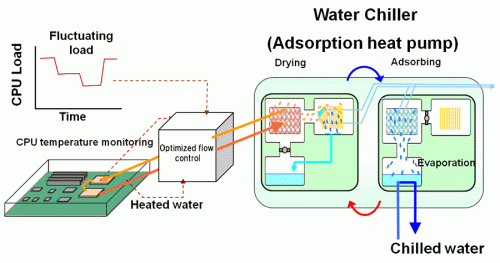
Fujitsu Laboratories announced the development of cooling technology that employs waste heat generated by CPUs to produce chilled water that can be used to cool server rooms.
Producing water of a temperature low enough for use in cooling factory equipment requires a substantial amount of energy. Currently, water is normally chilled using electricity, boilers or other sources of thermal energy, but now there are new attempts to employ heat, including that from high temperature waste water, as an energy source. Fujitsu Laboratories has developed a technology that can chill water from relatively low-temperature sources that have not been usable in the past. At 55°C, water produced from water-cooled type CPUs is of a relatively low temperature, which fluctuates depending on load. However, it is possible to continuously produce chilled water even from this waste water.
This technology offers the ability to use a CPU's waste heat to cool a datacenter, which had previously been impossible, and could save about 20% of the power used to air condition datacenters, which accounts for approximately 40% of all power used by datacenters. For a single server rack, which consumes up to 12,000 kWh per year, this is equivalent to the volume of CO2 cut by 360 cedar trees.
Details of this technology were presented at the 2011 International Conference on Power and Energy Engineering, opened from October 28, 2011, in Shanghai.
Datacenters that provide the infrastructure required for cloud services are expected to consume considerably more electricity as these services become more prevalent. This makes reducing their power consumption an increasingly urgent issue. Air conditioning used to cool IT resources accounts for some 40% of all the electricity consumed at datacenters, so improving the efficiency of air conditioning is an especially important aspect of any larger plan to reduce power consumption.
Most factories currently produce chilled water using electricity as a way to cool equipment. However, efforts are also being undertaken to produce chilled water from high-temperature waste heat. If this principle could be applied to a datacenter, using the energy in the waste heat from CPUs to chill water that would be used as a coolant, then the power needed to cool the datacenter would be reduced. But continuously chilling water requires hot water that is consistently at 65°C or above. At temperatures below that level, the variable loads on CPUs make the waste heat from IT resources difficult to exploit, so it is merely carried to the outdoors by the air conditioning, without being used productively for cooling.
Fujitsu Laboratories has developed a technology that will continuously chill water to a temperature of 15°C -18°C using waste heat from CPUs. Aspects of this technology are as follows.
1. New material efficiently extracts heat from water at relatively low temperatures (55°C)
Waste-heat water chillers are adsorption-type heat pumps that work by adsorbing water that has been heated by waste heat into an adsorbing material and then vaporizing it, taking advantage of the phenomenon in which heat is lost during vaporization. Fujitsu Laboratories has developed a new material that has the adsorbent properties of water at room temperature and that has the ability to dry at 55°C. This is what makes operations possible at the low temperature of 55°C.
2. Technology that maintains waste water temperature necessary for drying
CPU temperatures vary in response to the load. To produce a constant stream of chilled water, it is necessary to maintain waste water at 40°C to 55°C, this being a temperature range in which the adsorbent material is capable of vaporizing water. Fujitsu developed technology to maintain the temperature of waste water provided to the water chiller in the 40°C to 55°C range by controlling the flow volume in tandem with CPU load.
These technologies—the new material and the technology to maintain temperature—have been shown to generate chilled water with a thermal capacity equivalent to up to 60% of the total waste heat energy input into the water chiller.
Using water chilled by the waste heat from CPUs in air-conditioning systems can reduce total air-conditioning power requirements for a datacenter by roughly 20%. This means that the volume of CO2 cut by a single server rack, which consumes up to 12,000 kWh per year, is equivalent to 360 cedar trees.
Fujitsu Labs is working to increase the reliability of these technologies, and expanding their scale and space efficiency, with the goal of deploying them in datacenters around 2014. Moreover, they aims to deploy waste-heat capture for use not only in datacenters but also in factories, office buildings, and solar power generators, and for purposes other than air conditioning.
Provided by Fujitsu


