Chemical weapon in spider silk repels ant attack: study
November 23, 2011

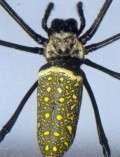
Nephila antipodiana

Nephila antipodiana. Image credit: nus.edu.sg (by Joseph K H Koh)

Researchers have shown for the first time how Golden orb web spiders (Nephila antipodiana) add a chemical to their web silk to repel invading ants.

The finding adds a chemical defense to the impressive properties of spider , already known to be very strong, elastic and adhesive, and may provide new opportunities for pesticide design.

The study was led by researchers from the National University of Singapore (NUS) and the University of Melbourne, and is published in the journal today [Wednesday, 23 November 2011].

Associate Professor Daiqin Li, who led the team at the National University of Singapore, said that ants rarely occur on the web of spiders, despite their abundance, so his team set out to discover why.

"We found that large Golden orb web spiders add a defensive alkaloid chemical onto the silk, which stops the ants from walking onto the web when they come into contact with it," said Assoc Prof Li from the Department of Biological Sciences, NUS.

Professor Mark Elgar from the University of Melbourne's Department of Zoology said the team was impressed by the strength of the ant repellent in the web silk.

"The type of chemical deterrent found in the is known as a pyrrolidine alkaloid, which acts as a predator deterrent in many species of ants, and ," Prof Elgar said.

The team found that only large Golden orb web spiders produce the defensive compound, suggesting that the younger, smaller spiders could rely on their thinner web silk to physically prevent ants being able to climb into their webs.

They made the discovery by allowing the Golden orb web spider to spin webs in the lab and then analyzing the compounds in the silk. Once the defensive alkaloid compound was identified, the researchers observed the behaviour of ants in its presence.

"The orb spider is potentially vulnerable to attack from groups of ants while sitting in its web waiting for prey, so the chemical defense in web silk may have evolved to not only protect the spider, but to reduce the time and energy that would otherwise be required to chase away invading ," said Prof Elgar.

The Golden orb web spider is typically found in the forests of Australia, Asia, Africa and America.

Provided by University of Melbourne search and more info website

4.8 /5 (4 votes)  

Filter


Move the slider to adjust rank threshold, so that you can hide some of the comments.


Display comments: newest first

antialias_physorg
Nov 23, 2011

Rank: 5 / 5 (1)
How wonderful for the spider that its ancestors were able to divine what chemical kept ants away!!!

You really don't have any clue how mutation and selection works?

A quick primer:
Mutation in the DNA is (more or less) random. Many things don't work (and the so mutated specimens die). Occasionally a mutation does work and this speciemen survives and reproduces. It's descendants carry the mutation and quickly outbreed the ones that don't have it.

Not all mutations need to be done at the same time. Maybe the first mutation was production of the alkaloid. Millenia later another mutation added the ability to let this stuff stick to webs.

Just like with the eye: having an eye that only distinguishes light from dark is already an advantage over blind competitors. Later incoroprating a very rudimentary lens is an advantage over the ones that merely have the dark/light ability. Stuff adds up over millions of years until you get the wonderfully complex structures we have today.
The Singularity
Nov 23, 2011

Rank: not rated yet
The image is mildy disturbing & should be labelled as so.
thuber
Nov 23, 2011

Rank: not rated yet
I find this kind of hidden, natural warfare fascinating. I really do. Nature is an amazing source of invention.
aroc91
Nov 23, 2011

Rank: not rated yet
Thanks again for proving you don't know how selection works, kevin. The mutation isn't a response to the environmental/predatory/sexual selection pressure. Tard.
Rank 4.8 /5 (4 votes)
Relevant PhysicsForums posts

More news stories

Scientist: Evolution debate will soon be history

(AP) -- Richard Leakey predicts skepticism over evolution will soon be history. Not that the avowed atheist has any doubts himself.

Biology / Evolution

created 22 hours ago | popularity 3.5 / 5 (20) | comments 85

Manufacturing genes to attack flu virus

An international research team has manufactured a new protein that can combat deadly flu epidemics.

Biology / Biotechnology

created 3 hours ago | popularity not rated yet | comments 0 | with audio podcast

More plant species responding to global warming than previously thought

(Phys.org) -- Far more wild plant species may be responding to global warming than previous large-scale estimates have suggested.

Biology / Ecology

created May 22, 2012 | popularity 4.6 / 5 (14) | comments 18 | with audio podcast

Thousands of shellfish found dead in Peru

Thousands of crustaceans were found dead off the coast of Lima following the mystery mass death of dolphins and pelicans, the Peruvian Navy said Friday.

Biology / Ecology

created May 26, 2012 | popularity 4.7 / 5 (6) | comments 7

For monogamous sparrows, it doesn't pay to stray (but they do it anyway)

It's quite common for a female song sparrow to stray from her breeding partner and mate with the male next door, but a new study shows that sleeping around can be costly.

Biology / Plants & Animals

created May 22, 2012 | popularity 5 / 5 (2) | comments 8 | with audio podcast


Land and sea species differ in climate change response: study

(Phys.org) -- Marine and terrestrial species will likely differ in their responses to climate warming, new research by Simon Fraser University and Australia’s University of Tasmania has found.

'Unzipped' carbon nanotubes could help energize fuel cells, batteries

Multi-walled carbon nanotubes riddled with defects and impurities on the outside could replace some of the expensive platinum catalysts used in fuel cells and metal-air batteries, according to scientists at ...

T cells 'hunt' parasites like animal predators seek prey, study shows

By pairing an intimate knowledge of immune-system function with a deep understanding of statistical physics, a cross-disciplinary team at the University of Pennsylvania has arrived at a surprising finding: T cells use a movement ...

Computer model used to pinpoint prime materials for efficient carbon capture

When power plants begin capturing their carbon emissions to reduce greenhouse gases – and to most in the electric power industry, it's a question of when, not if – it will be an expensive undertaking.

Change in developmental timing was crucial in the evolutionary shift from dinosaurs to birds: study

At first glance, it's hard to see how a common house sparrow and a Tyrannosaurus Rex might have anything in common. After all, one is a bird that weighs less than an ounce, and the other is a dinosaur that ...

Nvidia trumpets Tegra 3 phone design wins for 2012

(Phys.org) -- Nvidia’s competitive war paint has a name, Tegra 3. On the heels of Nvidia announcements about lowering costs of its Tegra 3 processors and Nvidia-enabled tablets running Android Ice Cream ...