Carbon isotope reveals a solely C3 biomass diet for gigantopithecus in the early pleistocene of South China
November 10, 2011

Carbon isotope reveals a solely C3 biomass diet for gigantopithecus in the early pleistocene of South China

Enlarge

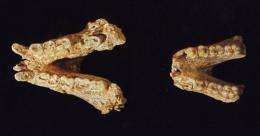
Fig.1: The mandibles of Gigantopithecus blacki from Juyuandong Cave of Liucheng, Guangxi Province, China.

The extinct giant ape, Gigantopithecus blacki, is a species of large hominoids that dominated the Pleistocene of South China. Its massive mandible, large postcanine teeth and extremely thick enamel always spark people's curiosity about what a diet for this giant ape was. The precise diet and habitat of Gigantopithecus remains unknown so far.

Drs. ZHAO LingXia, ZHANG LiZhao and WU XinZhi, Institute of Vertebrate Paleontology and Paleoanthropology, Chinese Academy of Sciences, and ZHANG FuSong from Institute of Geology and Geophysics, Chinese Academy of Sciences, analyze enamel stable carbon isotope values of G. blacki and the associated mammalian megafauna from two sites in South China, and find that this giant ape and other large mammals solely fed on C3 biomass, and lived in forest habitats, as reported in the journal of Chinese Science Bulletin, 2011(56), No.33:3590-3595.

Zhao and her collaborators prepared and analyzed a total of 32 tooth samples for their study. Four teeth of G. blacki and 24 teeth of associated large mammals were from Longgudong Cave, Jianshi, Hubei Province, and the other 4 teeth of G. blacki were taken from Juyuandong Cave of Liucheng, Guangxi Province. The most enriched δ13C value was -14.1‰, and the most depleted was -18.8‰. Concerning an enrichment of about 14‰ for δ13C between food and enamel, the δ13C values of food sources would be from -32.8‰ to -28.1‰, which is within the δ13C range of C3 biomass and far too negative for that of C4 biomass. It is clear that Gigantopithecus and the affiliated megafauna, such as browsers (Cervus sp. and Tapirus sinensis), grazers (Equus sp. and Leptobos sp.) and carnivores (Pachycrocuta licenti and Ursus sp.), all derived their carbon from solely C3 biomass sources. Zhao and her collaborators suggested that Gigantopithecus should live in closed forest habitat and not an open habitat, which is consistent with the associated faunal and floral analyses.

“Analysis of stable carbon isotopes is a powerful method for exploring the diet and habitat use of extinct herbivorous mammals, and it has been used in paleoanthropology in analysis on early hominins fossils. This method is based on the fact that the carbon isotope composition is significantly different between plants that use different photosynthetic pathways, such as C3 plants (δ13C from -22‰ to -35‰) and C4 plants (δ13C from -8‰ to -16‰), and the stable carbon isotope composition of enamel is dependent on the diet components throughout the food chain”, said Dr. ZHAO LingXia, the lead author and research designer, “The diet and habitat of Gigantopithecus blacki was significantly different from that of early hominins in Africa, such as Australopithecus and Paranthropus, which could consume both C3 and C4 resources and live in open habitats, although they all somehow show similar powerful mastication morphology . Dependence on forest habitat might be an important factor that made Gigantopithecus extinct when the climate and environment changed dramatically during the Pleistocene.”

Journal reference: Chinese Science Bulletin search and more info website

Provided by Institute of Vertebrae Paleontology and Paleoanthropology


Rank not rated yet
Tags

Relevant PhysicsForums posts

More news stories

Change in developmental timing was crucial in the evolutionary shift from dinosaurs to birds: study

At first glance, it's hard to see how a common house sparrow and a Tyrannosaurus Rex might have anything in common. After all, one is a bird that weighs less than an ounce, and the other is a dinosaur that ...

Other Sciences / Archaeology & Fossils

created 3 hours ago | popularity 5 / 5 (2) | comments 0 | with audio podcast

Social welfare cuts ultimately come with heavy price, researchers say

(Phys.org) -- Slashing government funding for Medicaid, food stamps and other programs that serve the poor – while politically popular with some lawmakers and many conservatives – may do more harm ...

Other Sciences / Social Sciences

created May 24, 2012 | popularity 4.3 / 5 (16) | comments 152

Ancient Bethlehem seal unearthed in Jerusalem

Israeli archaeologists have discovered a 2,700-year-old seal that bears the inscription "Bethlehem," the Israel Antiquities Authority announced Wednesday, in what experts believe to be the oldest artifact ...

Other Sciences / Archaeology & Fossils

created May 23, 2012 | popularity 3.5 / 5 (14) | comments 24

Oldest Jewish archaeological evidence on the Iberian Peninsula

German archaeologists of the Friedrich Schiller University Jena found one of the oldest archaeological evidence so far of Jewish Culture on the Iberian Peninsula at an excavation site in the south of Portugal, ...

Other Sciences / Archaeology & Fossils

created May 25, 2012 | popularity 4.2 / 5 (6) | comments 12

Dollars and sense: Why are some people morally against tax?

As the U.S. presidential election campaigns heat up, the economic debate is dominated by bailouts, austerity and, inevitably, taxation. Now a new study published in Symbolic Interaction asks why tax is such an important issue ...

Other Sciences / Social Sciences

created May 23, 2012 | popularity 3 / 5 (2) | comments 12


Land and sea species differ in climate change response: study

(Phys.org) -- Marine and terrestrial species will likely differ in their responses to climate warming, new research by Simon Fraser University and Australia’s University of Tasmania has found.

'Unzipped' carbon nanotubes could help energize fuel cells, batteries

Multi-walled carbon nanotubes riddled with defects and impurities on the outside could replace some of the expensive platinum catalysts used in fuel cells and metal-air batteries, according to scientists at ...

T cells 'hunt' parasites like animal predators seek prey, study shows

By pairing an intimate knowledge of immune-system function with a deep understanding of statistical physics, a cross-disciplinary team at the University of Pennsylvania has arrived at a surprising finding: T cells use a movement ...

Computer model used to pinpoint prime materials for efficient carbon capture

When power plants begin capturing their carbon emissions to reduce greenhouse gases – and to most in the electric power industry, it's a question of when, not if – it will be an expensive undertaking.

Nvidia trumpets Tegra 3 phone design wins for 2012

(Phys.org) -- Nvidia’s competitive war paint has a name, Tegra 3. On the heels of Nvidia announcements about lowering costs of its Tegra 3 processors and Nvidia-enabled tablets running Android Ice Cream ...

Yale study concludes public apathy over climate change unrelated to science literacy

Are members of the public divided about climate change because they don't understand the science behind it? If Americans knew more basic science and were more proficient in technical reasoning, would public consensus match ...