Ancient stars shed light on the prehistory of the Milky Way
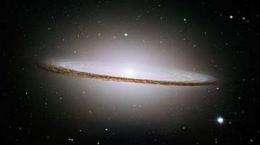
The Milky Way is like NGC 4594 (pictured), a disc shaped spiral galaxy with around 200 billion stars. Above and below the galactic plane there is a halo, which includes older stars dating back to the galaxy’s childhood billions of years ago. In principle they should all be primitive and poor in heavy elements like gold, platinum and uranium. New research shows that the explanation lies in violent jets from exploding giant stars. Credit: Hubble Telescope
a kind of stellar fossils in the outer reaches of our galaxy, contain abnormally large amounts of heavy elements like gold, platinum and uranium. Where these large amounts came from has been a mystery for researchers, since they are usually seen in much later generations of stars. Researchers at the Niels Bohr Institute have been studying these ancient stars for several years with ESO's giant telescopes in Chile in order to trace the origin of these heavy elements and with recent observations they have concluded how they could have been formed in the early history of the Milky Way. The results are published in prestigious Astrophysical Journal Letters.
Shortly after the Big Bang the universe was dominated by the mysterious dark matter along with hydrogen and helium. As the dark matter and gasses clumped together under their own gravity, they formed the first stars. In the scorching interior of these stars, hydrogen and helium melted together and formed the first heavier elements like carbon, nitrogen and oxygen, and after a 'short' while (a few hundred million years) all of the known elements were in place. However, these early stars only contained a thousandth of the heavy-elements seen in the Sun today.
Every time a massive star burns out and dies in a violent explosion known as a supernova, it releases clouds of gas and newly formed elements out into space, where the gas clouds contract again and finally collapse and form new stars. In this way, the new generations of stars become richer and richer in heavy elements.
Fossils from the galaxy's childhood
It is therefore surprising to find stars from the early universe that are relatively rich in the very heaviest elements. But they exist and even right in our own galaxy, the Milky Way.
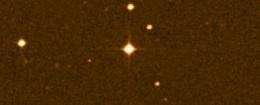
The research group has analyzed 17 stellar fossils from the Milky Way's childhood. The stars are small light stars and they live longer than large massive stars. They do not burn hydrogen longer, but swell up into red giants that will later cool and become white dwarfs. The image shows the most famous of the stars CS31082-001, which was the first star that uranium was found in. Credit: ESO
"In the outer parts of the Milky Way there are old 'stellar fossils' from our own galaxy's childhood. These old stars lie in a halo above and below the galaxy's flat disc. In a small percentage approx. 1-2 percent of these primitive stars, you find abnormal quantities of the heaviest elements relative to iron and other 'normal' heavy elements", explains Terese Hansen, who is an astrophysicist in the research group Astrophysics and Planetary Science at the Niels Bohr Institute at the University of Copenhagen.The research group at the Niels Bohr Institute had studied these ancient stars with ESO's giant telescopes in Chile over several years. To get a handle on the origin of the heavy elements, they followed 17 of these 'abnormal' stars for another four years with the Nordic Optical Telescope on La Palma.
Terese Hansen used her master's thesis to analyse the observations. "After slaving away on these very difficult observations for a few years I suddenly realised that three of the stars had clear orbital motions that we could define, while the rest didn't budge out of place and this was an important clue to explaining what kind of mechanism must have created the elements in the stars", explains Terese Hansen, who calculated the velocities along with researchers from the Niels Bohr Institute and Michigan State University, USA.
Gold plated gas clouds
She explains that there are two theories that can explain the early stars' overdose of heavy elements. One theory is that these stars are all close binary star systems where one star has exploded as a supernova and has coated its companion star with a thin layer of freshly made gold, platinum, uranium and so on. The other theory is that early supernovae (exploding giant stars) could shoot the heavy elements out in jets in different directions, so these elements would be built into some of the diffuse gas clouds that formed some of the stars we see today in the galaxy's halo.
"My observations of the motions of the stars showed that the great majority of the 17 heavy-element rich stars are in fact single. Only three (20 percent) belong to binary star systems - this is completely normal, 20 percent of all stars belong to binary star systems. So the theory of the gold-plated neighbouring star cannot be the general explanation. The reason why some of the old stars became abnormally rich in heavy elements must therefore be that exploding supernovae sent jets out into space. In the supernova explosion the heavy elements like gold, platinum and uranium are formed and when the jets hit the surrounding gas clouds, they will be enriched with the elements and form stars that are incredibly rich in heavy elements", says Terese Hansen, who immediately after her groundbreaking results was offered a PhD grant by one of the leading European research groups in astrophysics at the University of Heidelberg.
More information: Terese Hansen et al. 2011 ApJ 743 L1 doi:10.1088/2041-8205/743/1/L1
Journal reference:
Astrophysical Journal Letters
Provided by University of Copenhagen
-
From lemons to lemonade: Reaction uses carbon dioxide to make carbon-based semiconductor,
32 comments
-
Thioridazine kills cancer stem cells in human while avoiding toxic side-effects of conventional cancer treatments,
3 comments
-
SpaceX private rocket blasts off for space station (Update),
42 comments
-
Climate scientists say they have solved riddle of rising sea,
31 comments
-
SpaceX capsule has 'new car' smell, astronauts say (Update),
4 comments
-
Distance of planets from stars and revolution
3 hours ago
-
revamping general concept and cosmological principle
May 25, 2012
-
Transiting Exoplanet Light Curve
May 25, 2012
-
Math behind Theoretical Physics
May 24, 2012
-
Do we know whats at the center of galaxies yet?
May 23, 2012
-
Structure of the Milky Way?
May 20, 2012
- More from Physics Forums - General Astronomy
More news stories
Land and sea species differ in climate change response: study
(Phys.org) -- Marine and terrestrial species will likely differ in their responses to climate warming, new research by Simon Fraser University and Australia’s University of Tasmania has found.
55 minutes ago |
not rated yet |
1
|
Yale study concludes public apathy over climate change unrelated to science literacy
Are members of the public divided about climate change because they don't understand the science behind it? If Americans knew more basic science and were more proficient in technical reasoning, would public consensus match ...
2 hours ago |
4 / 5 (1) |
10
|
10 million years needed to recover from mass extinction
It took some 10 million years for Earth to recover from the greatest mass extinction of all time, latest research has revealed.
Space & Earth / Earth Sciences
2 hours ago |
not rated yet |
1
|
Sophisticated simulations predict future warming
The chances of our planet being hit by a global warming of 3 degrees Celsius by 2050 is as likely as it being hit by an increase of 1.4 degrees, new research shows. Presented in the journal Nature Geoscience, the British study ...
Space & Earth / Earth Sciences
May 22, 2012 |
4.4 / 5 (9) |
51
Aliens don't want to eat us, says former SETI director
Alien life probably isnt interested in having us for dinner, enslaving us or laying eggs in our bellies, according to a recent statement by former SETI director Jill Tarter.
Space & Earth / Space Exploration
May 25, 2012 |
4.4 / 5 (14) |
39
Almost half of new vets seek disability
(AP) -- America's newest veterans are filing for disability benefits at a historic rate, claiming to be the most medically and mentally troubled generation of former troops the nation has ever seen.
'Unzipped' carbon nanotubes could help energize fuel cells, batteries
Multi-walled carbon nanotubes riddled with defects and impurities on the outside could replace some of the expensive platinum catalysts used in fuel cells and metal-air batteries, according to scientists at ...
T cells 'hunt' parasites like animal predators seek prey, study shows
By pairing an intimate knowledge of immune-system function with a deep understanding of statistical physics, a cross-disciplinary team at the University of Pennsylvania has arrived at a surprising finding: T cells use a movement ...
Computer model used to pinpoint prime materials for efficient carbon capture
When power plants begin capturing their carbon emissions to reduce greenhouse gases and to most in the electric power industry, it's a question of when, not if it will be an expensive undertaking.
Change in developmental timing was crucial in the evolutionary shift from dinosaurs to birds: study
At first glance, it's hard to see how a common house sparrow and a Tyrannosaurus Rex might have anything in common. After all, one is a bird that weighs less than an ounce, and the other is a dinosaur that ...
Nvidia trumpets Tegra 3 phone design wins for 2012
(Phys.org) -- Nvidias competitive war paint has a name, Tegra 3. On the heels of Nvidia announcements about lowering costs of its Tegra 3 processors and Nvidia-enabled tablets running Android Ice Cream ...

Nov 15, 2011
Rank: 5 / 5 (4)
Nov 16, 2011
Rank: 1 / 5 (2)
Nov 16, 2011
Rank: 5 / 5 (1)
Ethelred