Zoning boundaries can make good neighbors in conservation
As the world's biodiversity hotspots are increasingly stressed by their human neighbors, zoning is becoming a common strategy to balance environmental protection and human needs. But a recent study shows zoning for conservation demands reality checks.
"Zoning ordinances are rarely evaluated for their ability to make positive changes using empirical data on both human and biodiversity characteristics." says Jianguo (Jack) Liu, an internationally recognized expert at Michigan State University in a study of coupled human and natural systems. "It's critical to examine both human and natural systems to see if ordinances are working and understand what changes might be needed."
A unique case study that does of one of the world's renowned nature reserves in southwestern China shows that zoning is helping protect endangered giant pandas. The analysis from Michigan State University's Center for Systems Integration and Sustainability (CSIS) also reveals critical weaknesses.
According to the paper, zoning ordinances can be useful to balance human activities and wildlife habitat as long as a few limitations are remembered: Lines on a map don't show up in a forest, laws mean little without enforcement and animals can't read zoning ordinances.
"Zoning everywhere, in China and in the United States, is about drawing lines on a piece of paper. But the big challenge is always how do you bring those lines to life?" said Vanessa Hull, the lead author of a paper published in the Oct. 28 online edition of Biological Conservation. "The people who live in that landscape can't see it and there are no fences. We're showing that zoning is an effective tool for controlling some human impacts but not others."
Hull is a fisheries and wildlife doctoral candidate in CSIS who has spent years periodically living in the Wolong Nature Reserve to understand the delicate balance between pandas and the people who live amongst them.
Wolong, like many nature reserves across the globe, is home to both animals and people. Increasingly, governments are turning to zoning ordinances to protect habitat while still allowing people access to a livelihood. People in Wolong historically have farmed, chopped down trees for fuel and construction, kept livestock and accommodated the tourists who stream in to see the beloved pandas in breeding centers.
Pandas are picky about their habitat – needing gentle slops, moderate elevation and plenty of bamboo to munch. While other species that contribute to Wolong's rich biodiversity benefit from conservation efforts, the charismatic pandas drive much of the policy there.
Wolong has been zoned into three areas: The "core" area strictly limits human activity to limit human impact on pandas. The "experimental" area thrives with homes, businesses and roads. In between is a "buffer zone" of limited human access intended to acknowledge that it's hard to declare a forest pristine if a hotel is right next door.
To understand how the zoning is working out, Hull and Liu, her mentor, CSIS director and Rachel Carson Chair in Sustainability, joined with colleagues to compile a broad range of data. Liu's previous work on panda habitat classification, a national giant panda census, geographic data on locations of roads and human establishments, and new data on movements of individual pandas and livestock are combined to create an unusually robust look at the effectiveness of zoning.
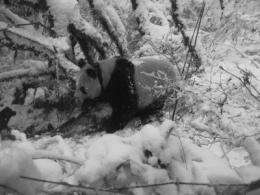
Two female pandas – Mei-Mei and Pan-Pan – fitted by Hull and collaborators with GPS collars, provided new insight on how pandas move about.
The result is a way to breathe life into policy and provide a novel look that goes beyond theory. Hull said that zoning in Wolong is protecting some, but not all prime panda real estate. The study also is helping show where improvements are needed. Including:
- Much of the buffer zone is important for pandas. Some 54 percent of land that is highly suitable for pandas in Wolong lies outside the protected core zone. Data showing Pan-Pan and Mei-Mei wandering frequently out of the core zone left no doubt pandas don't read zoning ordinances.
- The rules of the buffer zone are ambiguous, making it susceptible for a buffer area to become a place of commerce and development. Without clear rules, land use manager can't rely on clear guidelines when fielding requests for variances.
- Even small instances of disregard for zoning ordinances – especially in the case of roaming livestock – can have significant effects on panda habitat. Hull said it's becoming clear a few small herds of cattle or horses can decimate large swaths of a panda's feeding ground. Communicating zoning rules is a challenge, and a lack of enforcement compounds problems.
She noted that enormous conservation efforts in China that pay people in nature reserves not to farm and to monitor to prevent timber removal have been crucial.
"We're showing that you should have zoning in your toolbox to conserve habitat, but it shouldn't be the only tool you have," she said. "It needs to be paired with other policies when it comes to human behavior. We know that it is crucial to work directly with people and provide benefits to people to preserve habitat."
More information: Evaluating the Efficacy of Zoning Designations for Protected Area Management, Biological Conservation.
Provided by Michigan State University


