Wolf hunting strategy follows simple rules
October 28, 2011 by Lin Edwards
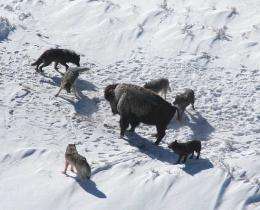
Mollies Pack Wolves Baiting a Bison. Image: Wikipedia.
(PhysOrg.com) -- A new study of wolves (Canis lupus) has found that communication between pack members and a social hierarchy are not essential features of a successful hunt, and all the wolves have to do is follow two simple rules.
The researchers, led by Cristina Muro of the Assistance Dogs Association AEPA-Euskadi, in Bilbao, Spain and colleagues in Spain and the US, used computational simulations to study the strategies of wolf packs in hunting and capturing prey.
The results of the study were that two simple rules were sufficient to reproduce the actual wolf-pack behaviour of tracking, pursuing and encircling prey seen in the wild. The rules were, firstly, move towards the prey until at a close but safe distance (the distance depending on factors such as the length of horns), and then secondly, when at the minimum safe distance, to move away from the other wolves which are also in position.
The only information each of the five wolves in the computer-simulated pack needed was the position of the other wolves in the pack, and it did not necessarily need to communicate with the other members. The computer models also found that no hierarchy was required within the pack for the hunting to be successful.
The results suggest that theories requiring the wolves to display a strict hierarchy along with superior intelligence and ability to plan the chase may be off the mark, since simply following the two rules resulted in the virtual wolves in the computer simulation behaving remarkably like wild wolf packs. The virtual wolves closed in and encircled the prey in the same way as real wolves, and if the prey tried to escape one wolf would sometimes seem to ambush the prey after it drew back to maintain distance from the other members of the pack, which placed it in the path of the prey animal.
The results of the study do not prove, however, that wolves are not intelligent and do not show foresight or planning.
Research at Yellowstone Park reported on last month at Physorg also demonstrated that wolves are risk-averse and keep at a safe distance if they can, leaving other members of the pack to do the dangerous work of getting in closer to prey, which can kick or gore them to death. This research also showed that smaller wolf packs can hunt more effectively than larger packs.
The results of the two studies raise questions about why wolves tend to live in packs, since the previously held assumptions of a large pack being more effective at hunting, and social behaviour and communication being essential, appear to be wrong.
More information: Wolf-pack (Canis lupus) hunting strategies emerge from simple rules in computational simulations, Behavioural Processes,
Volume 88, Issue 3, November 2011, Pages 192-197. doi:10.1016/j.beproc.2011.09.006
Abstract
We have produced computational simulations of multi-agent systems in which wolf agents chase prey agents. We show that two simple decentralized rules controlling the movement of each wolf are enough to reproduce the main features of the wolf-pack hunting behavior: tracking the prey, carrying out the pursuit, and encircling the prey until it stops moving. The rules are (1) move towards the prey until a minimum safe distance to the prey is reached, and (2) when close enough to the prey, move away from the other wolves that are close to the safe distance to the prey. The hunting agents are autonomous, interchangeable and indistinguishable; the only information each agent needs is the position of the other agents. Our results suggest that wolf-pack hunting is an emergent collective behavior which does not necessarily rely on the presence of effective communication between the individuals participating in the hunt, and that no hierarchy is needed in the group to achieve the task properly.
via Newscientist
© 2011 PhysOrg.com
-
From lemons to lemonade: Reaction uses carbon dioxide to make carbon-based semiconductor,
32 comments
-
Thioridazine kills cancer stem cells in human while avoiding toxic side-effects of conventional cancer treatments,
3 comments
-
SpaceX private rocket blasts off for space station (Update),
42 comments
-
Climate scientists say they have solved riddle of rising sea,
31 comments
-
SpaceX capsule has 'new car' smell, astronauts say (Update),
4 comments
-
What would stain as translucent on light-coloured fabric?
22 hours ago
-
How do I identify different bacteria on culture plates?
May 26, 2012
-
Why Do Dogs do Strange things...
May 25, 2012
-
What does exophillic and endophillic mean in terms of mosquito and their control?
May 24, 2012
-
Semen stains glows under black lights (uv light)?
May 23, 2012
-
Question on Human Chromosome 2
May 23, 2012
- More from Physics Forums - Biology
More news stories
Manufacturing genes to attack flu virus
An international research team has manufactured a new protein that can combat deadly flu epidemics.
2 hours ago |
not rated yet |
0
|
Scientist: Evolution debate will soon be history
(AP) -- Richard Leakey predicts skepticism over evolution will soon be history. Not that the avowed atheist has any doubts himself.
21 hours ago |
3.5 / 5 (20) |
81
More plant species responding to global warming than previously thought
(Phys.org) -- Far more wild plant species may be responding to global warming than previous large-scale estimates have suggested.
May 22, 2012 |
4.6 / 5 (14) |
18
|
Thousands of shellfish found dead in Peru
Thousands of crustaceans were found dead off the coast of Lima following the mystery mass death of dolphins and pelicans, the Peruvian Navy said Friday.
May 26, 2012 |
4.8 / 5 (5) |
7
For monogamous sparrows, it doesn't pay to stray (but they do it anyway)
It's quite common for a female song sparrow to stray from her breeding partner and mate with the male next door, but a new study shows that sleeping around can be costly.
May 22, 2012 |
5 / 5 (2) |
8
|
Land and sea species differ in climate change response: study
(Phys.org) -- Marine and terrestrial species will likely differ in their responses to climate warming, new research by Simon Fraser University and Australia’s University of Tasmania has found.
Almost half of new vets seek disability
(AP) -- America's newest veterans are filing for disability benefits at a historic rate, claiming to be the most medically and mentally troubled generation of former troops the nation has ever seen.
'Unzipped' carbon nanotubes could help energize fuel cells, batteries
Multi-walled carbon nanotubes riddled with defects and impurities on the outside could replace some of the expensive platinum catalysts used in fuel cells and metal-air batteries, according to scientists at ...
T cells 'hunt' parasites like animal predators seek prey, study shows
By pairing an intimate knowledge of immune-system function with a deep understanding of statistical physics, a cross-disciplinary team at the University of Pennsylvania has arrived at a surprising finding: T cells use a movement ...
Computer model used to pinpoint prime materials for efficient carbon capture
When power plants begin capturing their carbon emissions to reduce greenhouse gases and to most in the electric power industry, it's a question of when, not if it will be an expensive undertaking.
Change in developmental timing was crucial in the evolutionary shift from dinosaurs to birds: study
At first glance, it's hard to see how a common house sparrow and a Tyrannosaurus Rex might have anything in common. After all, one is a bird that weighs less than an ounce, and the other is a dinosaur that ...
Oct 28, 2011
Rank: 5 / 5 (2)
The pack may not need to be very large, but there still needs to be a pack. One wolf can't surround the prey by itself. It's as simple as that!
Oct 28, 2011
Rank: 5 / 5 (3)
Pack size shouldn't be the determining factor. Expected gain per wolf (i.e. amount of food per wolf per unit of time) should be the determining factor.
Increased pack size will increase the chance of a successfull hunt while decreased pack size will increase the amount of food per wolf per kill. This in turn needs to be balanced with availability of prey animals.
I.e. if prey animals are sparse then we have the competing factors of
1) Success per hunt is important (which favors a large pack)
2) Number of hunts is low (which favors a small pack).
Optimum in this 'scarcity' case may be either a large pack or a lone wolf.
If prey animals are plentiful then - even though a smaller number of wolves can amass enough food with only a moderate amount of efficiency - a more successfull pack can sustain larger numbers.
Oct 28, 2011
Rank: not rated yet
Oct 28, 2011
Rank: not rated yet
very well said. i was going to touch on the ideal number depending on the situation but im lazy.
Oct 28, 2011
Rank: not rated yet
theyre also too damn stupid to correct their own mal investment into dozens of multibillion dollar failures like the fa22 and to spend effort refocussing on the most important military weapon, the patriotic liberty loving disciplined and dutiful american. instead you get a military hopped on techno crack rife with fraud and infiltrated by gang members and fatsoes
Oct 29, 2011
Rank: not rated yet