Toshiba bites Apple with 498 ppi display

October 24, 2011 by Nancy Owano
(PhysOrg.com) -- As soon as Toshiba announced its 6.1-inch Liquid crystal display (LCD) panel last week, bloggers and tech news sites were noting the numbers and poking at mobile display monarchs Apple. Toshiba's new display packs a 2560x1600 resolution with a 1000:1 contrast ratio. The display works out to 498 pixels per inch (ppi).
"Astounding," staggering, and "Prepare to have your eyes melted," were some of the reactions. Reports hastened to compare display numbers with those from Apple.
Suddenly Apple's "retina display" iPhone 4/4S smartphones of 326 ppi was a less exciting feat. Adjectives like "razor sharp" were usurped from Apple's gate and replanted at Toshiba's.
Among other bragging points is the fact that Toshibas display can show 16.7 million different colors.
Toshiba describes the display technology as based on processing techniques with low-temperature poly-silicon (LTPS) thin-film transistors (TFT) on glass substrates and other fabrication techniques that Toshiba has cultivated over the years.
Toshiba credits its LTPS technology as the enabler of advancements like the new LCD display. Low temperature poly silicon makes possible higher pixel density, which in turn makes text and images more readable. Thats especially useful in smaller device screens like handhelds and portable diagnostic equipment, as well as for larger screens, says Toshiba.
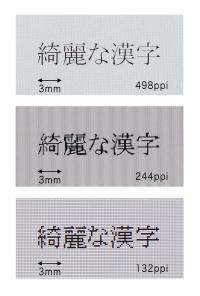
The display is for 2-D images but the LCD panel achieves high-definition images with photographic quality, says Toshiba, and those images impart depth and realism.
Missing from the announcement were specifics on how the display will translate into product. Many are wondering what type of end product will use the display.
One easy assumption is that the display will translate into smaller tablets but a few observers are raising questions about that. The hardware review site AnandTech asks, what is the use for a 6.1-inch display? The report points out that smaller 4.5-inch displays are, with a few exceptions, the maximum for most smartphones. As for tablets, they usually start at 7 inches. Toshibas display at 6.1 inches hovers over both categories, too big for smartphones and too small for tablets.
Others guess that Toshiba's targets may be e-reader manufacturers who want to take their displays to a newer level.
Those in Yokohama, Japan, this week will be able to see the LCD panel at the FPD International 2011 from October 26 to 28.
Enhanced viewing and graphics capabilities are a competitive feature in mobile devices, as manufacturers strive to respond to user wants, needs, and expectations.
Toshibas new-to-showcase LCD, with its superior resolution, has already attracted much attention. For now, though, in the absence of any product details from Toshiba, Apple can still rest on its laurels. As Apple tells the world, its "retina display" makes viewing "hundreds of pixels better."
More information: Press release
© 2011 PhysOrg.com
-
From lemons to lemonade: Reaction uses carbon dioxide to make carbon-based semiconductor,
32 comments
-
Thioridazine kills cancer stem cells in human while avoiding toxic side-effects of conventional cancer treatments,
3 comments
-
SpaceX private rocket blasts off for space station (Update),
42 comments
-
Climate scientists say they have solved riddle of rising sea,
31 comments
-
SpaceX capsule has 'new car' smell, astronauts say (Update),
3 comments
-
Need a rigid insulation material???
17 hours ago
-
magnets or EMF in car bumpers to protect from fender bender
May 26, 2012
-
length of wire in a coil of known dimensions?
May 25, 2012
-
India Engineering Powerhouse
May 25, 2012
-
electromagnet core dereference between hard and soft iron
May 25, 2012
-
Measuring water pressure in an open tank
May 24, 2012
- More from Physics Forums - General Engineering
More news stories
Nvidia trumpets Tegra 3 phone design wins for 2012
(Phys.org) -- Nvidias competitive war paint has a name, Tegra 3. On the heels of Nvidia announcements about lowering costs of its Tegra 3 processors and Nvidia-enabled tablets running Android Ice Cream ...
Dell tablet leak: 10.1-inch display, two-battery choice
(Phys.org) -- Headline after headline talks about vendors tablets in the wings as likely number-one contenders for the iPad. Such claims have justifiably been taken with a grain of salt, considering ...
Nvidia says Kai platform will turn price tide for tablets
(Phys.org) -- In March, Nvidia gave some signs that they were working to lower the cost of their Tegra 3 processors and they suggested consumers might see prices for Android tablets as low as $199. Connect ...
OmniVision tops up sensors for cameras, phones
(Phys.org) -- OmniVision has announced two high-resolution image sensors for the digital still and digital video camera market (DS/DVC) and higher end smartphones. In end-user language, it is a claim for superior ...
MIT researchers devise new means to synchronize a group of robots (w/ Video)
(Phys.org) -- For several years, roboticists have been working out ways to get a group of robots to perform synchronized activities as demonstrated most often in dance routines. Its not just about trying ...
Land and sea species differ in climate change response: study
(Phys.org) -- Marine and terrestrial species will likely differ in their responses to climate warming, new research by Simon Fraser University and Australia’s University of Tasmania has found.
Almost half of new vets seek disability
(AP) -- America's newest veterans are filing for disability benefits at a historic rate, claiming to be the most medically and mentally troubled generation of former troops the nation has ever seen.
'Unzipped' carbon nanotubes could help energize fuel cells, batteries
Multi-walled carbon nanotubes riddled with defects and impurities on the outside could replace some of the expensive platinum catalysts used in fuel cells and metal-air batteries, according to scientists at ...
T cells 'hunt' parasites like animal predators seek prey, study shows
By pairing an intimate knowledge of immune-system function with a deep understanding of statistical physics, a cross-disciplinary team at the University of Pennsylvania has arrived at a surprising finding: T cells use a movement ...
Computer model used to pinpoint prime materials for efficient carbon capture
When power plants begin capturing their carbon emissions to reduce greenhouse gases and to most in the electric power industry, it's a question of when, not if it will be an expensive undertaking.
Change in developmental timing was crucial in the evolutionary shift from dinosaurs to birds: study
At first glance, it's hard to see how a common house sparrow and a Tyrannosaurus Rex might have anything in common. After all, one is a bird that weighs less than an ounce, and the other is a dinosaur that ...

Oct 24, 2011
Rank: 5 / 5 (1)
Oct 24, 2011
Rank: not rated yet
Oct 24, 2011
Rank: not rated yet
Somebody should do that kind of a computer monitor. No more viewing angle problems, adjustable picture size... etc. Would be great for people who like photography, because even at 30" size the image would still be sharper than common "FullHD" LCD monitors at 23"
Oct 24, 2011
Rank: 5 / 5 (1)
Oct 24, 2011
Rank: 5 / 5 (5)
291 ppi to be exact, theoretically at least. The trouble is, we have two eyes doing the sampling, and even one eye can still see moire patterns at that resolution due to the pixel grid.
Ideally the surface area of a pixel would be half the surface area of a point we can see. At 300 mm distance, the point is roughly 87 µm in diameter. A square of half the area would be 55 µm on the side, giving a final resolution of 466 pixels per inch.
I'm applying Nyquist. A signal can accurately represent information at half its frequency, so if the signal we want to transmit is at the spatial resolution of the human retina at 300 mm, then the display must have twice the resolution to show it free of aliasing errors.
Oct 24, 2011
Rank: 5 / 5 (3)
As you decrease the pixel size further, the possible aliasing errors gradually vanish, until the eye is always sampling at least two pixels per dot of visual resolution, and can't distinguish the fact that a contrast edge may be misplaced by one pixel.
Oct 24, 2011
Rank: 5 / 5 (2)
Oct 25, 2011
Rank: 3 / 5 (2)
I have an over average sharp vision, but for me an 24" HD monitor at a distance of 60-75cm (>2ft) is OK, 90-100cm (3ft.) is absolutely perfect. At an bigger distance I get the impression to miss some details.
In praxis, I don't have the feeling that it really needs a higher pixle density.
That would mean, at 30cm distance I need an 8" display in HD. - equals 240dpi
In addition, who wants to use a cellphone that close that this resolution would be a real advantage?
It is a technical masterpiece, without any additional practical value to me
Oct 26, 2011
Rank: not rated yet
Otherwise it's simply boasting...